Odissi is believed to be oldest form of Indian dance according to the various sculptural evidences available. Temples has been the basis of cultural life in this state therefore Odissi dance has been closely connected with their routine activities. Odissi dances show signs of Buddhism, Tantrism, Shaivism, and Vaishnavism. In Natyashastra it is referred to as Odhra Magadhi. It has been differentiated from other Indian dance forms as it emphasizes upon the tribhangi, the independent movement of head, chest and pelvis on the basic square stance known as chauka.
Origin of Odissi Dance
The most outstanding archaeological evidence of Odissi is found in the Rani Gumpha from 2nd Century B.C. in Odisha. Scholars have dated these caves earlier than the writing of the Natyashastra. From the 7th Century onwards there is a continuous history of this dance form, supported by chronicles and archaeological and literary evidence. This dance tradition was however kept alive by the Devadasis, the female servants of God. The Devadasis used to dance to the recitation of hymns and bols of talas. The dance remained an oral tradition through the beginning of the 20th century, in possession of semi-literates who were not aware of the existing Sanskrit texts on dance.
History of Odissi Dance
The history of Odissi dance is deeply rooted in the Natya Shastra, an ancient Hindu Sanskrit text on performance arts. This text, attributed to the venerable scholar Bharata Muni, is believed to have been compiled between 200 BCE and 200 CE, although dating estimates vary between 500 BCE and 500 CE. It consists of approximately 6000 verses organized into 36 chapters, encompassing the theory of Ta??ava dance (associated with Lord Shiva), rasa theory, bhava (emotions), expressive gestures, acting techniques, basic steps, and standing postures, all integral to Indian classical dances.
According to the Natya Shastra, dance and performance arts serve as a means of expressing spiritual ideas, virtues, and the essence of scriptures. Notably, it references four pravrittis (methods of expressive delivery) prevalent in its time, including Odra-Magadhi, with "Odra" specifically referring to Odisha. Further historical evidence of dance and music as ancient performance arts is found in the archaeological sites of Bhubaneswar, Konark, and Puri. Notably, the Manchapuri cave in Udayagiri displays intricate carvings depicting dance and musicians, dating back to the era of Jain king Kharavela in the first or second century BCE. The Hathigumpha inscriptions, also associated with King Kharavela, make reference to music and dance.
Odissi`s classical music tradition, known as Odissi music, can also trace its roots to antiquity. Archaeological findings, such as a meticulously crafted basalt lithophone discovered in Sankarjang, the highlands of Odisha, and dated to around 1000 BCE, provide tangible evidence of the ancient musical heritage of this region.

Odissi Dance in Medieval Era
During the medieval era, Odissi dance flourished in the historical landscape of Odisha. Archaeological sites in the region, including the Assia hills, bear inscriptions and carvings dating from the 6th to 9th century CE, providing tangible evidence of its existence. Sites such as Ranigumpha in Udaygiri, as well as caves and temples at Lalitgiri, Ratnagiri, and Alatgiri, reveal depictions of dance in the forms of Hindu, Jain, and Buddhist iconography. Dance postures resembling Odissi can be observed in Buddhist iconography, where deities like Heruka, Vajravarahi, and Marichi are portrayed in Odissi-like poses.
Historical records indicate the presence of Odissi Maharis (Hindu temple dancers) and dance halls (nata-mandapa) as early as the 9th century CE. The Jain Kalpasutra manuscripts discovered in Gujarat even incorporate classical Indian dance poses found in Odissi. Hindu dance texts such as the Abhinaya Chandrika and Abhinaya Darpana meticulously describe Odissi`s intricate movements, footwork, postures, and repertoire, including karanas outlined in the Natya Shastra. The Shilpa Prakasha, an illustrated Hindu text on temple architecture from Odisha, also includes Odissi postures.
The surviving sculptures and panel reliefs in Odia temples, spanning the 10th to 14th centuries, provide visual documentation of Odissi dance. These depictions are found in temples dedicated to Vaishnavism, Shaivism, Shaktism, and Vedic deities, including the renowned Jagannatha temple in Puri, the Konark Sun Temple, and the Brahmeswara Temple in Bhubaneswar.
The composition of poetic texts by figures like 8th-century Shankaracharya and the divine love-inspired Gitagovinda by 12th-century Jayadeva significantly influenced the evolution of modern Odissi. Within the temple precincts, Maharis, trained rigorously from a young age, performed Odissi, interpreting spiritual poems and religious plays, contributing to the art form`s sanctified role in religious services.
Odissi Dance in Mughal and Colonial Era
During the Mughal and Colonial eras, Odissi dance faced significant challenges and transformations. After the 12th century, Odia temples and institutions like Puspagiri endured assaults by Muslim armies, resulting in the desecration of temples, defacement of dancing statues, and the decline of Odissi. While some benevolent rulers in this period continued to patronize the arts, Odissi dancers were often relocated to entertain the Sultan`s family and courts, becoming associated with nobility concubinage.
In the 17th century, King Ramachandradeva`s support led to Odissi`s revival and integration with martial arts and athletics, involving young boys known as Gotipuas. This was aimed at physical training for defense against foreign invasions, with historical records suggesting its presence in the 14th century. During the British Raj, colonial officials criticized temple traditions, while Christian missionaries attacked the perceived sensuousness of Odissi. In 1872, William Hunter disparaged temple dancers, describing their rituals as indecent. Christian missionaries initiated the "anti-dance movement" in 1892, leading to the stigmatization of dancers as prostitutes. In 1910, the British colonial government banned temple dancing, leaving dance artists in dire poverty due to a lack of financial support and enduring societal stereotypes.
Odissi Dance in Modern Era
The colonial era`s ban on temple dances and cultural discrimination prompted a Hindu-led movement to challenge stereotypes and rejuvenate India`s regional arts, including Odissi. Following India`s independence from colonial rule, a renaissance and reconstruction period for classical Indian dances, including Odissi, gained momentum.
In the 1950s notable scholars and performers, most prominently Kavichandra Kalicharan Pattanayak, an Oriya poet, dramatist, and researcher played pivotal roles in the revival. Pattanayak is credited with christening the dance form as "Odissi." This era marked the resurgence of Odissi and its recognition alongside other major Indian dance forms.
Evolution of Odissi Dance
Odissi dance originally featured Maharis, women who performed spiritual or religious narratives within Hindu temple sanctums or Natamandiras. These Maharis combined pure dance with abhinaya (gestures) to convey the text`s essence. Later, Gotipuas, young boys dressed as girls, expanded the repertoire, infusing acrobatics and athleticism, often entertaining at temples and fairs. Many Gotipuas became gurus later in life.
Modern Odissi is a diverse art form with male participation, enriched since the 1950s by incorporating new elements and influences from other Indian dances. While Odissi has historically expressed themes of love and spirituality, the modern emphasis has shifted toward artistic excellence as ritualized spiritual expression.
Theme of Odissi Dance
Odissi derives its theme from Geeta Govinda mostly. It is generally believed that the composers fixed the tala and raga of each song as in those of Geeta Govinda. Mostly these romantic compositions are set in a slow rhythm which enables the dancer to fully depict the emotion by gestures and softer movements to bring about the full meaning of the compositions. Odissi`s dependence on Geeta Govinda has enhanced its popularity and made it acceptable to the masses. The dance while portraying the bhava brings out the many tones of the Shrinagar rasa. Devotional songs are used in this item. The themes of Odissi revolve around Lord Krishna. The Ashtapadi of Jayadeva is a very common theme. Odissi centers on spirituality and devotion.
Technique of Odissi Dance
Odissi dancing follows the basic rules of the Natyashastra and the Silpasastra in its techniques. Hip deflection is the characteristic feature of this dance. It has similar foot movements as Bharatnatyam. The essence of Odissi dance lies in its sculpturesque quality. Its beautiful poses resemble the sculptures of the famous temples, which once nourished this art. This dance form lays emphasis on sensitive facial expression. It has vigorous movements that make the dancer emotional, tired and exhausted. This style of dance maintains a perfect balance between physical, mental and spiritual aspects of dance.
Repertoire in Odissi Dance
The traditional Odissi repertoire comprises Nritta (pure dance), Nritya (expressive dance), and Natya (dramatic dance). Nritta captivates with abstract, rhythmic movements devoid of narrative, appealing to the senses. Nritya engages emotions and communicates stories using gestures and body language. Natya, often a team effort, enacts stories with standardized movements. Mokshya, a climactic pure dance, symbolizes spiritual liberation.
Odissi performances feature Odia and Sanskrit languages set to Odissi`s traditional ragas and talas. Talas include Ekatali, Khemata, Rupaka, Tripata, Jhampa, Jati Tala, Adatali, Matha, Aditala, Sarimana, Kuduka, and others. The traditional sequence in Odissi dance begins with the Mangalacharana, an invocation featuring a hymn praising a deity, like Jagannath, expressed through dance. This is followed by Pushpanjali, offering flowers, and Bhumi Pranam, salutation to mother earth, along with the Trikhandi Pranam, a three-fold salutation to gods, teachers, and the audience.
Next is the Batu, a fast-paced, pure dance dedicated to Shiva, accompanied by rhythmic music but no vocalization. It leads into the Pallavi, transitioning from slow, graceful movements of eyes, neck, torso, and feet to a crescendo of faster tempo. Nritya follows, encompassing Abhinaya, an expressive dance that narrates songs or poetry. Dancers convey stories through sign language, mudras (hand gestures), bhavas (emotions), and fluid, graceful movements, often using verses in Sanskrit or Odia.
The Natya section presents dance dramas featuring Hindu mythologies, epics, or legendary tales. The Odissi tradition culminates with Moksha, symbolizing spiritual liberation and a climax of fast-paced pure dance, merging movement and pose to convey a sense of soul liberation.
Dance Postures and Mudras in Odissi
In Odissi, the foundational elements are the bhangas, composed of eight belis or body positions, categorized into uthas (rising), baithas (sitting), or sthankas (standing). Gaits, referred to as chaalis, convey emotions, with quick burhas indicating excitement and slow paces reflecting dejection. Dancers pivot around a central point in their imaginary square of space, keeping spins and expressions contained. Odissi distinguishes itself with six pada bhedas (foot movements), a deviation from the typical four in classical Indian dance.
The three primary positions are Chouka, a square posture with equal weight on both squatting legs and raised, bent arms; Abhanga, weight shifting to one foot, with the hips and torso extending sideways; and Tribhanga, an S-shaped, three-fold bend with deflections in opposite directions, forming an aesthetic frame.
Odissi employs mudras or hastas, hand gestures conveying emotions and meanings in storytelling. Comprising 63 hastas, these gestures align with pan-Indian Hindu texts but closely adhere to the Abhinaya Chandrika. They fall into three categories such as Asamyukta Hasta (single hand gestures), Samyukta Hasta (double hand gestures), and Nrutya Hasta (pure dance gestures), originating from the ancient Natya Shastra and Abhinaya Darpana.
Jewellery and Costumes in Odissi Dance
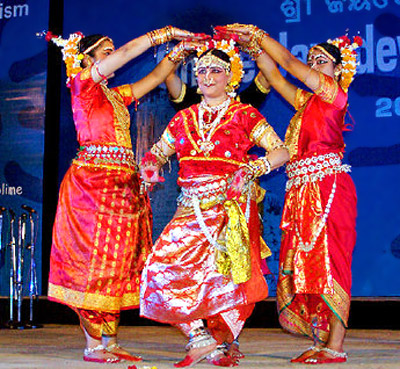
Odissi dance attire has a stitched costume in pyjama style made out of the special Odisha handloom silk sarees, draped in a comfortable style. The sarees have special borders and intricate designs which distinguish them from other sarees. Earlier only the sarees used to be draped around. However over a period of time, the stitched costume has been used due to its convenience.
Odissi dance uses silver jewellery. The dancer wears a choker, a longer necklace, armlets, bracelets, a belt, anklets, bells, earrings, each placed on the bun, and a seenthi which is a piece placed on the hair and forehead. An Odissi dancer has elaborate hair-do in a knot adorned with the "Tahiya" which represents a temple tower. Flower garlands are woven into the hair. Palms and soles are painted with the Alta. They also wear the head ornament called the Mathami. Earlier the headpiece used to be made of real flowers, but now it has been changed to Styrofoam. They also wear the "Kapa" on the ears, "Kankana" on the wrists, armlets called "Bahichudi" or "Tayila" and an elaborate belt. She wears on her ankles bells strung together on a single cord. A "Padaka-tilaka", a necklace with a locket rests on the chest is also worn.
Music in Odissi Dance
In Odissi, the words used in Drutala (speedy rhymes) are called padis and Navatala`s (nine rhymes) use is also the special feature of Odissi music. Dasatala (ten rhymes) and Egaratala (eleven rhymes) are commonly used. Odissi music is a unique blend of North and South Indian classical music but has its own distinct qualities. Today the orchestra consists of the Guru who mostly is also the pakhawaj player accompanied with one or two vocalists. There are a number of musical instruments that accompany the Odissi dance. One of the most important is the pakhawaj, also known as the mardal. Other instruments are the bansuri, the Manjira, the sitar and the tanpura. Odissi music is a separate system of Indian classical music and has all the essential ingredients of Indian Classical form. The present form is the outcome of the continuous evolution of the earliest Indian classical music. Odissi dance finally assumed the present form of "Ragaksyudra-Geeta-Pravandha-Gana". This is styled as traditional Odissi music.
 Performance by Odissi Dancers
Odissi presents a fine synthesis of Lasya and Tandava aspects of the Indian Classical Dance. The dancer very efficiently changes from one posture to the other according to the need of the expressional number, rhythmic syllables and abhinaya. The music is a combination of Hindustani and Carnatic classical styles. The performance of Odissi dance recital is tender, vigorous, intensely erotic and devotional.
Guinness World Records has officially recognized a remarkable achievement in the world of Odissi dance. On December 23, 2011, a historic gathering of 555 Odissi dancers took place at the Kalinga stadium in Bhubaneswar, Odisha. During this extraordinary event, the dancers collectively performed various segments from the Odissi repertoire, including Mangalacharan, Battu, Pallavi, Abhinay, and Mokshya.
Another noteworthy milestone occurred on March 12, 2016, at the World Cultural Festival, where an astounding assembly of over 1000 Odissi dancers united to perform. This event remains unparalleled in terms of the largest congregation of Odissi dancers ever witnessed, underscoring the enduring popularity and cultural significance of this classical dance form.
Indian Odissi Dancers
Today, the dancing style of the state of Odisha is considered as Odissi. Odissi was revived in the late forties and early fifties by Guru Kelucharan Mahapatra, Guru Pankaj Charan Das, Guru Deba Prasad Das and Guru Raghunath Dutta. Most of the present day gurus were Gotipua dancers themselves. Some of the famous Odissi dancers are Madhavi Mudgal, Rekha Tandon, Sreyashi Dey and many more.
Odissi School in India
A notable development in the realm of classical Indian arts is the inclusion of Odissi in the BTech syllabus at the Indian Institute of Technology Bhubaneswar. This pioneering initiative, implemented since 2015, marked a significant milestone as it became the first Indian national technical institute to integrate a classical dance form into its curriculum. This commendable decision not only demonstrates the cultural significance of Odissi but also underscores the institute`s commitment to fostering a holistic educational environment that encompasses diverse facets of India`s rich heritage, thereby nurturing a well-rounded generation of students.