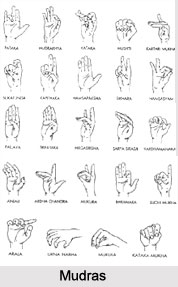
 Mudra is a gesture by hand or seal which symbolizes energy. This is one of the most beautiful forms of expression by using the fingers and thumb. Mudra is a voluntary neuromuscular action (contraction) or posture by which the prana is controlled and directed through a particular Nadi, known as Mudra. It is also known as the ritual or symbolic gesture which is practiced from very old times in Buddhism and Hinduism. Mudra calls for the involvement of the whole body and it is performed by the use of fingers and the hands as well. Mudra is regarded as energetic or the "seal of authenticity" utilized in the Indian religious spiritual practice. There are references of Mudras in the philosophies of the Eastern world and it is also a part of Yogic practice and culture. Mudra is hence defined as a mystical gesture of the hand in order to focus elusive energy by symbols.
Etymology of Mudra
The term "mudra" is derived from two words; "mud" and "ra". Here, "mud" means to rejoice or to be happy and "ra" means "to give". Thus, Mudra is an action which offers delight or extreme joy. This is an indication that the practice of Mudra is concerned with sensory aspect.
Concept of Mudras
Concept of Mudras depends upon all the fingers of both the hands of an individual. Each of the fingers is linked with specific meaning and energy. The accurate use of the fingers provides the Mudra with the energy to heal. Fingers are stated to bear the human body`s five elements, which are air, water, fire, earth and sky. These are there in set proportions and a slight imbalance may cause severe disaster. The striking of balance in between these elements is however not easy. Thus, the practice of Mudra facilitates the harmonizing of the five elements present in the human body.
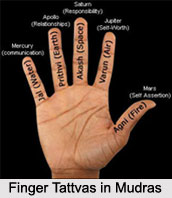
Finger Tattvas in Mudras
An elaborate study concerning the fingers and their links with the five elements unveils the fact that the element earth, worry and stomach are represented by the thumb. Index finger of a human being comprises of the element metal and has an influence over the large intestine, lungs, and also the control over emotions like sadness, depression and grief. The hand`s middle finger is regarded as the element fire which is connected with the small intestine, heart, respiratory and circulatory systems and the emotions include hastiness and impatience. The element wood is constituted by the ring finger and the same is associated with the gall bladder, liver and nervous system, and represents anger, while the little finger represents water, fear and kidney.
Origin of Mudras
 Mudras have an ancient origin. As per mythology, Lord Shiva is regarded to have started the basic Mudras. Mudra practice is prevalent all over the world. Mudra is found in all forms and is used in dance, religion, art and also in Tantra. The importance of Mudra is both esoteric and exoteric. It also forms a useful identification of the Bodhisattvas, the Buddha and deities. Science of Mudra is very much interesting. For harmonizing the mind`s undercurrents, Mudra science is regarded very much significant. Moreover, the Mudra science of Mudra Vigyan is the feature which helps one to practice meditation. Thus, Mudra Vigyan is an independent and separate branch of yoga.
Purpose of Mudra
The most prominent purpose of Mudra is to boost the soul of a human being and encourage the individual in order to secure divine powers. Mudras help in keeping the body in perfect condition. Apart from giving spiritual gains, Mudras are also known to be of great therapeutic use. Mudras are described as emotional, devotional, psychic and aesthetic attitudes or gestures.
Mudras are practiced to stimulate a particular neuromuscular area (e.g., anal sphincters as in Ashwini Mudra) of the body by voluntary muscular contraction maintained for some length of time or repeated with counter relaxation. This generates currents of energy that travel upward and they minimize the activity of mind and the sadhaka experiences the emotional and mental stability.
Types of Mudras
As per "Hatha Yoga Pradapika" and "Shiv Samhita", there are ten types of mudras which are Mahamudra, Mahabandha, Mahauedha, Khechari, Uddiyana bandha, Mula bandha, Jalandhara bandha, Viparita karani, Vajroli and Shaktichalana. Vajroli is further subdivided into Amroli and Sahajoli. According to "Hathapradipika", Mudras are practiced in order to awake the Kundalini power or the Kundalini Prabodhana while "Gherand Samhita" recommends it for stability or sthirata and equilibrium.
Benefits of Mudras
The benefits obtained from Mudra are large in number, since Mudra Vigyan is used in different ways. Mudra helps in maintaining the smooth energy flow by the "nadis" which nourish the internal organs of human body. Mudras in therapeutic use have also gained prominence. A regular practice of Mudras can cure arthritis, insomnia and memory loss. Mudras can be practiced to get a particular state of consciousness. Apart from these, mastering the Mudras will help an individual to reject the thoughts of negative nature which will help in mood elevation. Mudras can also be applied in meditation. Meditation and Mudra together can provide a change of human mind. Colour and Mudras form an exclusive combination and arouses positive energy in the human mind, body and soul.
Mudras comprise of the slight physical movements which change attitude, mood and perception, and it also deepens the concentration and awareness. Mudra is a term which has universal application. Mudras are practiced before or after yoga practices like asanas or pranayama.