 With its sublime tradition Indian Music is reckoned as one of the oldest unbroken musical traditions in the world. Despite India`s vast area and many cultures, its musical traditions are linked by distinctive central threads. With the spread of religions Indian music has broadened its horizon even abroad. It is believed that the origin of this system go back to the Vedas and Upanishads. Legends, myths and lores lace the origins and development of Indian classical music which so very eloquently points out the importance of music in Indian culture.
Indian music can be described as having been inaugurated with the chanting of Vedic hymns, though it is more than probable that the Indus Valley Civilization was not without its musical culture, of which almost nothing is known. There are references to various string and wind instruments, as well as several kinds of drums and cymbals, in the Vedas. Sometime between the 2nd century BC and the 5th century AD, the Natyashastra, on Treatise on the Dramatic Arts, was composed by Bharata. This work has ever since exercised an incalculable influence on the development of Indian music, dance, and the performing arts in general. 
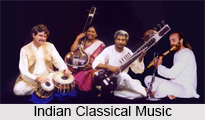
However the advent of cultural and historical research on Indian music has shown that Indian music has developed within a very complex interaction between different peoples of different races and cultures. That was just the beginning of the journey of Indian music as an art form. Indian music laced with its sheer originality has travelled a long way after that to gain the chic contour. The saga of Indian music is therefore the tale of changing tradition in India. The basis for Indian music is Sangeet which stands as the combination of two art forms like Vocal music and instrumental music .Indian musicologists inform that there were at least fifty known forms of vocal and instrumental music in India. However, out of these only eight light classical and classical vocal forms are heard in concert circuits. These are Dhrupad, Dhammar, Khayal, Tarana, Khayalnuma, Chaturang, Thumri, Tappa and Dadra. The sheer aura of the north Indian musical tradition and the utter artistry of the south Indian musical tradition complete the circle of Indian music as an expression of emotion. While the North Indian tradition is known as Hindustani music the south Indian musical tradition is typically named as the Carnatic Sangeet.. Both systems are fundamentally similar but differ in nomenclature and performance practice. With the emergence of the classical or Hindustani music and Carnatic Sangeet in the strict sense of the term, the stature of Indian music was elevated to sublime heights. Rooted in the ancient centuries of evolvement, Indian classical music incorporates the legendary forms like dhrupad, khayal, tarana, khayalnuma, chaturang, dadra, tappa or thumri. The list is endless, because the styles, dictions, modes, renditions or revival of musical fashion, perhaps develops in every decade. Indian Classical Music refers to the music of the highest class. This music was developed during the latter half of the 18th and the early 19th centuries, which was something different than the traditional Indian Music or folk music. Thus, it refers to the based on ancient musical traditions, which have evolved through several thousand years. It is a part of the Hindu religion as well as Indian culture.
Indian music with its varied mood, diverse element and sublime form is more than just being songs or musical notes, and technically, general broad terms, Indian classical music can be defined by two basic elements - it must follow a Raga and a specific rhythm or Taal. Raaga represents an integral part of the Indian music whilst comprehending motley of musical notes. It is perhaps the oldest and most durable of Indian melodic edifices. Raaga generally utilizes the entire range of the octave, starting with aroha and ending in avaroha, where the singer culminates the recital, as of in a musical frenzy. It is hugely complex in tonal quality, and it entirely depends on the performer to make the best use of it adroitly. Taal is the rhythmic forms of Indian music. 
The most important element of Indian music and Indian musical tradition is the "guru shishya parampara" or the relationship between the teacher and the student. Regarded as the most sacred one the parampara in Indian music determines the gharana or the style of Indian musical tradition. A student ideally assimilates whatever the preceptor imparts to him; the student thus becomes the vehicle for the transmission of a particular "Parampara" or gharana. The gharanas tradition as we understand today was evolved with the growth of the Hindustani classical music. A gharana represents a distinct musical style. Based on the distinctive feature of gharanas in Hindustani classical music in modern India can broadly classified into two distinct groups like the Khayal Gharanas and the Dhrupad Gharanas.
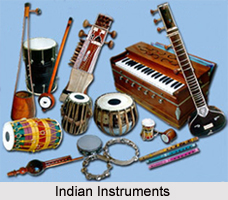
Indian music entwined with its sheer magic, rhythm, tradition and verve has time and time again redefined the rich heritage of India. The pulse of the Indian musical instruments, the essence of spirituality and magnanimousness in Indian music makes up the complex yet exciting, alluring yet sublime field of Indian music.