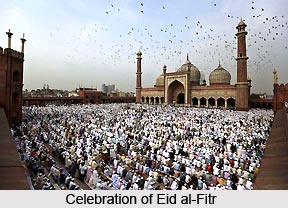
 Eid ul-Fitr occurs at the end of Ramzan, the ninth month of the Muslim year, on the first day of the new moon in Shawwal. Eid ul-Fitr means the `festival of breaking the fast`. `Fitr` is derived from the word `fatar` meaning `breaking`. Another allegation suggests that it is derived from fitrah or `alms`. Certain Sunni Muslims believe that fitr comes from fitrat meaning `nature` and Eid ul-Fitr is the celebration of God`s magnanimity in providing nature to man. A 30-day fast of the month of Ramzan, is broken on Eid ul-Fitr. It is broken with special prayers and festivities with sumptuous feasts. People embrace each other three times, as is laid down in the Quran (The Holy Book of Muslims). The festival originated after proclaiming Ramadan as the period of fasting and austerity. Prophet Muhammad announced this day for celebrations to reiterate the feeling of Eid ul-Fitr, brotherhood.
It was during this month that Allah gave Prophet Muhammad the Holy Quran for the first time on one of the odd nights of the last ten days of the month of Ramzan. The exact date is not known. Muslims keep a fast every day during this month and the completion of the period is decided by the appearance of the new moon. Prayers are offered in mosques and Eidgahs and elaborate festivities are held.
`Do Rakat Namaz`, the Eid special prayer is performed in the morning in the mosque. These prayers can be read anytime between sunrise and just afternoon. Charitable gift, called Sadaqah Fitr, is to be given to a needy person as thanksgiving. Even one who has not kept the `rojas` is expected to give alms. The amount to be gifted must be in excess of one`s essential needs and free from all the burden of debt. Food grains or their cost can be donated. The Quran also specifies the grain and their quantities. A person should give 3.5 lb of wheat or its flour per head, or 7 lb of barley per head or their cost. Do Rakat Namaz is performed. Even women in veil attend the prayers in special chambers.
 On the festival of Eid, many people decorate their houses and people also buy new clothes to wear. In the morning, everyone gets up very early to attend the prayers. These are special prayers, held only at Eid. They are held only in very big mosques, or in large open areas, such as football stadiums. They are held about 80 minutes after sunrise, so in the summer months it is very early. Every Muslim is required to pray with his brethren in faith. Before joining the prayer, every Muslim gives alms to the poor. After the alms have been distributed, the gathering goes to the house of the Muslim religious official for Eid prayers.
At the end of the prayer, the Kazi delivers a sermon and then offers special prayers to Allah for the welfare of the faith, remission of sins of all Muslims, for the safety of pilgrims and travellers, for the recovery of the sick, for timely rain, for protection from misfortune and for freedom from debts. Thereafter, people visit friends and relatives to say Eid Mubarak and to attend Eid fairs to buy toys and trinkets. Eid ul-Fitr is an occasion for general goodwill.
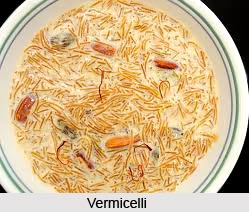
Each day of the holiday is spent with one of the relatives, so that everyone is visited. In the evening, the visits start up again. This goes on for three days, but money is normally given to the children on the first two days. Women prepare sweets at home. Vermicelli cooked in sweetened milk, is popular. People then get together for celebrations. Some people visit cemeteries and stay there for many hours. This is perhaps to honour their ancestors and to be with their spirits. To a devout Muslim, Eid is a time to forget all past grievances.