


 Botanical name:Cochlearia armoracia Linn Botanical name:Cochlearia armoracia Linn
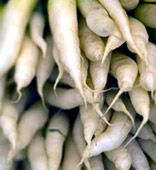
Family:Crucifereae. Horseradish is a near relative of turnip, cabbage and mustard. It is one of the oldest condiments and is a well-known large leaved hardy perennial in many long established gardens. It is the thick white fleshy tasty root of horseradish, which is highly prized as an appetizing condiment with certain foods. It is grown in the USA in bulk, where it is classified as two varieties, such as 'Common' and 'Bohemian'. The common type has broad leaves and produces a root of high quality. The bohemian type has narrow leaves, is more disease resistant but yields poorer quality roots. Horseradish plant is highly sterile and hence is propagated asexually by root. The tap root is tuberous and cylindrical (30 cm long and about 18 mm in diameter), possesses an acrid, pungent taste and, when scraped or bruised, emits a characteristic pungent odor. The root contains a pungent, acrid and vesicating volatile oil. The pungency is due to the presence of Sinigrin, a sulphur containing glucoside, which in the presence of water and under the influence of an enzyme yields 'allyl mustard oil' or allyl isothiocyanate as in mustard seed. Distillation of the triturated root gives about 0.05 to 0.2 % volatile oil, which is not produced on a commercial scale. Harvest Season : October to November Marketing Season : December to January The composition of the spice is given below: Moisture:3.4 % Protein:3.2 % Fat:0.2 % Total ash:1.8 % Carbohydrates:21.4 % Fiber:2.4 %. The root is a rich source of Vitamin C, the fresh material contains on an average, 302 mg of ascorbic acid per 100 g. 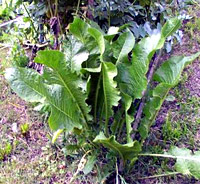 Horseradish is used as an appetizing condiment. It is credited with digestive and anti-scorbutic properties because of its high vitamin C content. It is highly prized as a condiment especially with oysters and meats. Besides, leaves and roots are used as food in Germany. Horseradish is used as an appetizing condiment. It is credited with digestive and anti-scorbutic properties because of its high vitamin C content. It is highly prized as a condiment especially with oysters and meats. Besides, leaves and roots are used as food in Germany.
A freshly grated horseradish root, when mixed with vinegar and salt, is much appreciated as an appetizing and pungent condiment to enhance the flavor of boiled and roasted beef. When mixed with ketchup, the grated root imparts a freshing taste to seafoods, especially shrimp, cocktail and oysters. Horse radish makes a tasty accompaniment to roast, grilled and boiled beef, pork, fish and poultry. A dish of fresh grated or dried horseradish adds an interesting tang to dressings and sauces. Application of freshly grated horseradish to insect bites and stings eases pain and reduces pain. Horseradish is used for horseradish cream, sauce or relish, which is rather like salad cream and contains at least 25 % shredded horseradish (fresh)or equivalent dehydrated root and essential oil, 25 % of a cream containing at least 25 % edible vegetable oil and 7.5 % of non-fat milk solids. It includes egg yolk, milk, vinegar and mustard. Horseradish is considered stimulant, diaphoretic, diuretic and digestive. It is also used as a counter-irritant in lumbago and similar painful affections. Crushed horseradish has an inhibitory effect on the growth of micro-organisms, this effect being also attributed to allyl isothiocyanate. Indians did not traditionally know the spice. It remained popular only in Western world. However, due to impact of globalization it is gradually gaining popularity in urban India. The plant grows well in Indian situations. |
| |||



Horse Raddish
| Horseradish is a near relative of turnip, cabbage and mustard. It is one of the oldest condiments. |
| ||||||||||||||||||||||||||||

