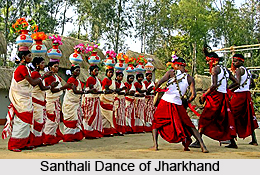
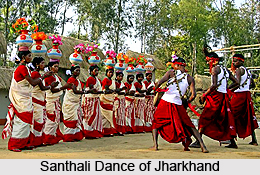
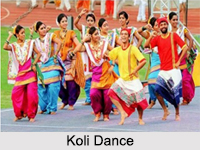
Folk Dances of Andhra Pradesh are varieties in forms and styles. Andhra Pradesh is considered as rich in its folk culture. Its folk culture comprises of the various folk dances like the Gobbi Dance, Bathakamma Dance, Dhamal Dance, Mathuri Dance, Dandaria Dance, Veeraanatyam, Butta Bommalu, etc.
Some of the folk dances of Andhra Pradesh are as follows:
Gobbi Dance
Gobbi Dance is one of the popular dance forms from coastal regions of Andhra Pradesh. It is the main attraction during the Sankranti festival and during this time, the courtyards of all houses are cleaned and decorated. The flowers are used with different kinds of rangolis, for decoration purposes. "Gobbillu" i.e. balls of cow dung are placed in the middle of these rangoli designs. In the evening, young girls gather around this gobbillu to dance and sing. One can say that this dance is a derived form of Garba dance of Gujarat performed in circular direction.
Dhamal Dance
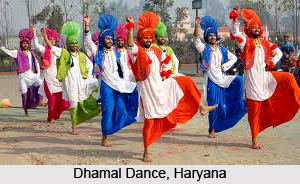
Dhamal Dance is one of the typical and ceremonial dance forms of Siddis of Hyderabad region. This is actually a mimetic martial dance performed by them. They use swords and shields held in their hands while performing various steps involved in the dance. This dance is ceremonial in nature performed especially on the occasion of marriage. Many musical instruments are used to accompany and make noises of `how wow`. This dance presents a fascinating co-ordination of rhythmic body movement. The whole picture of dance is attention grabbing.
 Mathuri Dance
The Mathuri dances are special tribal dances by the Mathuri tribes, of the Adilabad district of the Andhra Pradesh, performed during the rainy month of Shravana. It is a dance in which men and women folk participate together, women participants forming the inner circle and men the outer semi-circle. The dancers sing themselves devotional and secular songs at the time of performance. It is said that the Mathuri dances have a close resemblance to Raslila of Uttar Pradesh.
Dandaria Dance
Dandaria Dance is one of the popular Folk dances of Andhra Pradesh. In this dance, a group of male dancers, dressed in colourful special costumes, visit the nearby villages as a part of course of dance, where they are heartily welcomed by the host party. Then both these parties dance together in anti-clockwise direction, along with drums, trumpets and striking of sticks in their hands. The musicians lead the procession. It is exclusively a male performance and the female roles are also performed by the young men, dressed as women and girls.
Veeraanatyam Dance
Veeraanatyam Dance is mostly devotional and involves vigorous ritual practices and owes its origin to the Veeramusti community. The people of this community claim direct descent of Lord Shiva. Actually performance of Veeraanatyam occurs in almost every Shiva Temples of Andhra Pradesh and it involves skilful steps and dexterous hand movements.
 Butta Bommalu Dance
Butta Bommalu Dance is a popular folk dance form in Tanaku of west Godavari District of Andhra Pradesh. During the performance of this dance, each dancer wears different masks over the head and shoulders.
Dhimsa Dance
Dhimsa Dance is one of the folk dances in Andhra Pradesh. This dance is performed by 15-20 women forming a chain in the Araku Valley of Vishakhapatnam district. The costumes of this dance are typical tribal cloths with proper ornamentation. Dhimsa dancers give their performances during the festival seasons, village fairs and at the marriage ceremonies. There are eight different categories in the Dhimsa dances.
Bathakamma Dance
Bathakammas are mainly performed by female participants in a region, Telengana of Andhra Pradesh during the time of Bathakamma Festival.
Bonalu Dance
This dance is performed by female folk balancing pots on their heads. This is performed in the Telengana region during the time of Bonalu festival.