Dhopkhel is a very famous indigenous ball game played in the Assam state of India. Dhopkhel is also called as "dhop khel" and `dhoop khel`. Players in this game need great speed and other requisite athletic skills. Dhopkhel is played during the Spring Festival called Rangoli Bihu. This traditional sport really blossomed under the royal patronage of the Ahoms.
Playground of Dhopkhel
The field of the play is 125 m in length and 80 m in breadth, the central point is in the right middle of the playing area. Two lines (kai) are drawn at a distance of 12 ft on each side of the point at the centre. After that is done, four flags are placed at the four points. Further, four flags are planted in the four corners (chukor nishan). The central point which is equidistant from the two halves is surrounded by a circle known as gher.
Playing of Dhopkhel
A rubber ball is used to play this game which is called `Dhop`. There are two teams comprising of 11 players each. The play begins with the dhop being thrown in the air, by one of the players. If the ball fails to land in the opponent"s court, it has to be thrown again. And if it lands, the dhop has to be caught by the opposition team else the other team gets a chance to throw.
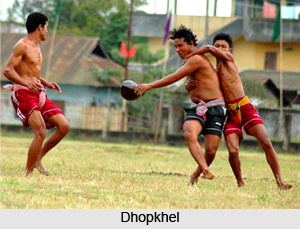 The player who catches the throw gets a chance to stand on the gher of the court and throw the dhop to the opposition`s katoni (one standing on the other gher). In case the thrower is unsuccessful, they lose their chance to throw at the katoni and the player has to give an easy high lob to the opposing team, similar to the one with which the game began. In the event of the katoni being hit under the waist, it becomes a kota, and the katoni turns into a hoia or a bondha, and is no longer a ghai - which all the players are at the start of the game.
The bondha then has a tough task on hand. He has to switch over to the opposing team, stop them from catching the dhop and try the throw himself. This strategy is called aulia. However, even if he successfully catches the dhop, his next task is to cross over to his team"s side before being touched by anyone on the opponents` side. If he is successful in completing this task, he becomes a ghai again. Such a move is called hora. He also has to ensure that he does not go out of the field of play i.e. the kais while attempting to re-cross to his own team.
Suppose a team loses ten ghais i.e. they become a bondha, then the only one left in the team will be named ghai katoni. If the opposition manages to perform a kota on him, then it is a piriutha, which means the team has won the game. Alternately, if both teams have equal number of ghais, the game ends in a draw.