 Botanical name: Capparis spinosa Linn.
Family name: Capparidaceae
Indian names are as follows:
Hindi:Kabra
Kannada:Mullukattari
Marathi:Kabur
Punjabi:Kaur, Barar
Telugu:Kokilakshamu.
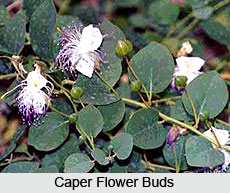
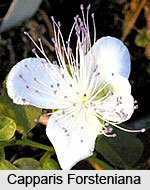
A spiny shrub of straggling habit, a little less than a meter high, it is valued chiefly for its flower buds, which are picked and sold as `Capers`. It may be grown as a greenhouse plant in colder areas and outdoor in warmer parts. It is deciduous with almost round leaves. The most conspicuous feature of the fleeting white flowers is the mass of purple-tipped stamens.
The tiny buds open when the sun rises and close when it sets. Once cut, they remain closed. The capers are graded on copper sieves, and the smaller the bud the higher the grade. Usually, they are cured and prepared in salt. The bitter salty taste is epicurean, and very few capers are necessary to give the added flavor sought for.
Commercial European capers are the pickled flower buds of the plant. They have an acrid, burning taste, and are considered useful in scurvy. In India, the buds and also the fruits, are similarly taken.
 Flower buds contain a glycoside, rutin, which on acid hydrolysis gives rhamnose, dextrose and querctin. On hydrolysis, by the enzyme rutinase, it yields the sugar rutinose and quercetin. The former, on acid hydrolysis, gives rhamnose and dextrose. Flower buds contain about 4% pentosans on dry basis. They also contain rutic acid, pectic acid, a substance with garlic odor, a volatile emetic constituent and saponin.
Many European and American cooks use capers most expertly. Fish and meat sauces are especially delicious with a few capers added; and as a garnish for cold roasts and salads, capers are unequalled in flavor. Many of the famous Italian dishes are well known for the taste because of use of spices appropriately including capers. Besides, capers are also used for flavoring pickles and relishes; caper sauce with boiled mutton is a great favorite worldwide.
 The fruits though edible, are not eaten raw, except as an appetizer in East India. The dried pericarp is of great value for its delicate taste and flavor. The dried rind possesses antiseptic properties. The rind contains 30% acid (calculated as citricacid) on the dry basis. It is used in medicines for ailments such as rheumatism, rickets, and enlargement of spine and for treating animal disorders. The dried rind also finds use in polishing gold and sliver and for coagulating rubber latex. On commercial scale, the concentrates of the dried rind are manufactured largely capturing the flavor of the dried fruit.
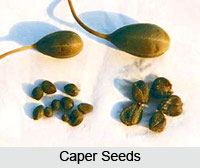
Caper seeds yield 34 to 36% of a pale yellow oil. Its Iodine value reported to be 115 to 125. It is basically a unsaturated oil, with fatty acid composition as given below:
Oleic:42 to 46 %
Linoleic:45 to 51 %
Palmitic and Stearic:7 to 9 %.
The process of harvesting or picking of caper is easy and simple and can be done by ordinary village folks. Grading of capers after picking can be done easily with the help of copper sieves.