


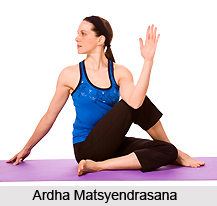
 Ardha Matsyendrasana is a variant of the Matsyendrasana, a posture that was described in the Hatha Yoga Pradipika (1400 AD) and several later yogic texts. It is effective in alleviating the symptoms of a host of ailments, ranging from dyspepsia to asthma. Ardha Matsyendrasana is a variant of the Matsyendrasana, a posture that was described in the Hatha Yoga Pradipika (1400 AD) and several later yogic texts. It is effective in alleviating the symptoms of a host of ailments, ranging from dyspepsia to asthma.
Ardha Matsyendrasana is essentially the original Matsyendrasana simplified for beginners, the only difference being that in Matsyendrasana the folded leg is placed at the root of the thigh below abdomen, in Ardha-Matsyendrasana it is placed by the side of the opposite buttock. Meaning of Ardha Matsyendrasana Ardha Matsyendrasana translates to the half Matsyendra posture in Sanskrit. Essentially a simplified variant of the Matsyendrasana, the ardha, or half merely indicates that it is a pared down version of the same. Matsyendranath, or the lord of the fishes, was a legendary saint in the Hatha Yoga Tradition, and the guru of Gorakhanath, the putative (or legendary) author of the Goraksha Paddhathi. He is credited with founding the Hatha Yoga school with his foremost disciple, Gorakhanath. Placing the right foot at the root of the left thigh, encircling the (right) knee by the left leg, holding (the two feet by the opposite hands), twisting the body and staying in this posture is the Asana. Matsyendranath was the legendary teacher of yoga. The twist based on his name energizes the spine and stimulates the digestive fire. Traditional texts say that Ardha Matsyendrasana increases appetite, destroys most deadly diseases, and awakens Kundalini. Yoga Texts and Ardha Matsyendrasana The following is a quote taken from the Hatha Yoga Pradipika, one of the definitive Hatha Yogic texts, compiled around 1400 CE. "Having placed with the right foot at the root of the left thigh, let the toe be grasped with the right hand passing over the back, and having placed the left foot on the right thigh at its root, let it be grasped with the left hand passing behind the back. This is the asana, as explained by Sri Matsyanatha. It increases appetite and is an instrument for destroying the group of the most deadly diseases. Its practice awakens the Kundalini, stops the nectar shedding from the moon in people." Matsyendrasana, and by consequence, Ardha Matsyendrasana are highly important in the asana compendium, and have been recorded in almost all major classic yoga treatises. The Gheranda Samhita, an 18th century Hatha Yoga text, includes it in its corpus of 32 major asanas, and the Hatha Ratnavali includes it in its compendium of 84 Classic Yoga Asanastaught by Lord Shiva. Practice Ardha Matsyendrasana: A sequential process for performing Ardha Matsyendrasana follows. 1. Sit on the floor, extending both the legs together in front, hands by the side, palms resting on the ground. The buttocks can be supported on a folded blanket. Fingers should remain together pointing forward. 2. Bend thee knees, put your feet on the floor, then slide left foot under right leg to the outside of right hip. 3. Now folding the left leg, bringing it from above the right knee, place it by its side on the ground. The knee of the left leg should remain towards sky. 4. Now bring the right hand on the left side of the left knee. The left knee should remain at the left side of the right armpit. 5. Now straighten the right hand and hold the toe or ankle of the left leg. 6. Twisting the body to the left side, look backwards, place the left hand bringing it from the back on the right thigh. Gaze should be towards back. 7. While returning to the original position first release the hand from the thigh and turn head forward. 8. Now bring the back to normal position after loosening the right hand. 9. Bring the left leg in original position. 10. Now bring the right leg also original position. 11. Repeat it similarly from the other side by folding the left leg first. Effects of Ardha Matsyendrasana 1. It is very much useful in constipation and dyspepsia. 2. This Asana improves liver efficiency and removes debility of kidney. 3. It is very beneficial for the muscles of shoulder and back. 4 Stimulates the liver and kidneys 5. Stretches the shoulders, hips, and neck 6. Energizes the spine 7 Stimulates the digestive fire in the belly 8. Relieves menstrual discomfort, fatigue, sciatica, and backache 9. Therapeutic for asthma 10. Traditional texts say that Ardha Matsyendrasana increases appetite, destroys most deadly diseases, and awakens kundalini. Precautions for performing Ardha Matsyendrasana 1. Some persons may experience difficulty in practicing it. If they cannot hold the toes of the left by right hand they should hold the ankle. 2. If that also is not possible then hold the knee. 3. While twisting backward twist the backbone turning well. 4. Before resorting to the practice of this Asana practice Vakrasana. 5. Those suffering from stiffness in spine should practice it very carefully. In this version of the pose, the opposite-side arm is wrapped around the outside of the raised-leg upper thigh. This may be impractical, and potentially harmful, for beginning students. Be sure to sit up well on a blanket support and for the time being just wrap your arm around the raised leg and hug the thigh to your torso. |
| |||



Ardha Matsyendrasana
| Ardha Matsyendrasana is a cultural asana derived from Matsyendrasana, a posture named after Matsyendranath, a legendary saint of the Hatha Yoga tradition. |
| ||||||||||||||||||||||||||||

