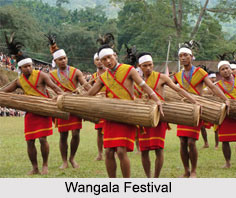
 Wangala Festival is a most popular festival among the Garo Tribes of Meghalaya. It is a harvest festival held in honour of "Misi Saljong", the Sun God of fertility. The festivities happen in Tura, the largest town of the Garo Hills. One of the specialities of this festival is the use of 100 drums, which also gives the festival the name "100 Drums Wangala Festival". The celebration of the Wangala Festival marks the end of harvesting season and labour in the fields. It also signifies the onset of winter. The celebration falls amid the second seven day stretch of November every year.
Rituals in Wangala Festival
Wangala Festival is the occasion when the tribals offer sacrifices to please their main deity Misi Saljong - the Sun God. It is generally celebrated for two days and sometimes continues for even a week. The ceremony performed on first day is known as "Ragula" which is performed inside the house of the chief who is referred as "Nokma". The second day is known as "Kakkat". People young and old, dressed in their colourful costumes with feathered headgears dance to the tune of music played on long oval-shaped drums. This is the occasion to relax and for days the hills and valleys echoes with the extraordinary beat of drums.
Music and Dance in Wangala Festival
The music and dance forms the major part of the festival. The popular Wangala dance is performed during the festival itself has certain subtle variations, the main motif being a queue of two parallel lines - one of men and other of women clad in their festive fineries. Young and old join the festivities with equal enthusiasm. The major attraction of the festival is the music using 100 drums. The men gather with their drums and create a harmonious rhythm that is followed by the dance moves. Thus the festival gets its alternate name, "100 Drums Wangala Festival". The "orchestra" of men includes drums, gong and flutes, punctuated by the sonorous music of a primitive flute made of buffalo horn. There is a notable sense of tempo in the performers, young and old, and the energetic dance leaves a lasting impression upon the beholder.
Hence, the Wangala Festival is a way to preserve and promote the cultural identity of Garos in Meghalaya. This is one way to exhibit the culture and tradition of the region.