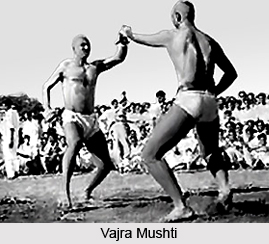
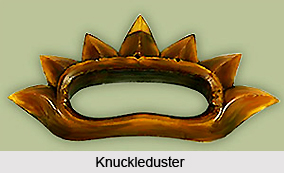
 Vajra Mushti is a unique Indian martial art that incorporates various techniques of hand-to-hand combat like grappling, wrestling and striking techniques. Vajra Mushti, which literally means Thunderbolt Fist, is characterised by the utilization of a knuckleduster, a small metal weapon. The knuckleduster, also known as Vajra Mushti, usually made of animal horns, is worn on the knuckles of the fighter. The main objective of this Indian martial art form is to neutralize the opponent and counter his weapon.
Etymology of Vajra Mushti
The name of the martial art is derived from the Sanskrit word, Vajra, which means Thunderbolt or Diamond and is of much religious significance in both Hinduism and Buddhism; and the Sanskrit word Mushti, which means closed or clenched fist. Thus Vajra Mushti literally means Thuderbolt fist or Diamond Fist.
 History of Vajra Mushti
The ancient Indian martial art form known as Vajra Mushti can be traced back to the 5th century. Vajra Mushti is eloquently described in the Buddharata Sutra, which is considered as the one of the earliest transcripts of the Kshatriya caste. Vajra Mushti is also described in Manasollasa of Somesvara III (1126-1138 CE). It was ardently practiced by a group of wrestlers, called Jyesti Malla, who would fight by holding the knuckleduster in one hand. Thus it was named Vajra Mushti.
Training of Vajra Mushti
The training of Vajra Mushti is very rigorous and intensive. The practitioners were taught various types of striking techniques that have many similarities with modern martial art forms like Karate, Boxing and Kung Fu. The grappling moves are similar to Jujitsu.
Technique of Vajra Mushti
The fighters usually wore loincloth during the fight. The fundamental stance required the fighter to hold is left arm out to the front, keeping his hand open. The right arm was held beside the waist, holding the knuckleduster firmly. The fighter`s left foot was placed forward and the right foot was kept in the side. This was the initial stance before the commencement of the fight. Generally the fight tournaments were held during the festival of Dussehra.
Vajra Mushti is a no holds barred combat form, where the various strikes are aimed at crucial pressure points, called marman, to immobilize the opponent, which marks the end of the fight.