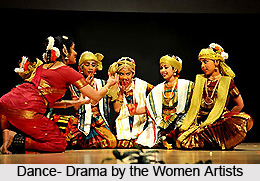
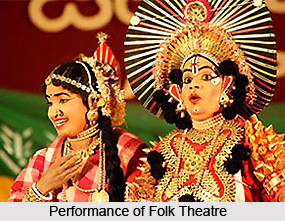
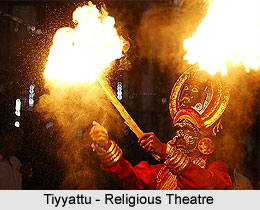
 Types of Kerala theatre can be divided into three parts. Almost all the various types of stunning entertainment are characterized by a religious atmosphere, sometimes intrinsic and in other times extrinsic, which may be made the basis of division. So it can be fairly said that the types of Kerala theatre are; religious, semi religious and secular types.
The forms of theatre that fall under the religious heads are mentioned (i) Bhagavatipattu. (ii) Tiyyaitu (iii) Pana (iy) Pattu (v) Kaniyar Kali and (vi) Mutiyettu. Under the purely secular variety may be mentioned (i) Elamuttipurappatu (ii) Tullal (iii) Ror a ttiy attain, (iy) Mohiniyattam (v) Kayyukottikkali (vi) Pathakatn and (vii) Kathakali. Under the religious head the following can be placed (i) Sanghakkali (ii) Kuttu and (iii) Krsnattam.
These types of Kerala theatre holds good so far as the language is concerned: the first two varieties (religious and secular) are purely in the local vernacular, while the last, semi-religious variety is mainly Sanskrit language.
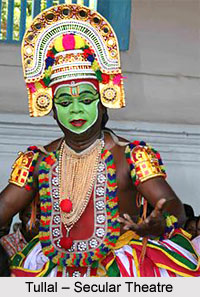 They are also capable of a classification from the prominence of one or other of the elements of acting, dancing and music. In Kathakali and Kuttu proper acting occupies the most important place; in Kovattiyaitam and Mohiniyattam dancing takes the place of importance, while in Kayyu-kottikkali we have practically only vocal music and a very simple kind of dance.
Religious Theatre of Kerala
Religious theatre of Kerala can be categorized into six different parts, namely; Bhagavati Pattu, Tiyyattu, Pana, Pattu, Kaniyar Kali, and Mutiyettu have been characterized as religious, for the simple reason that they are invariably found celebrated in Bhagavati shrines in honour of the goddess, sometimes as an annual festival conducted by the temple itself and at other times as a votive offering by the pious villagers in the temple or in their homes. These are intended to glorify the Bhagavati mela cult and deal exclusively with the glorification and thus the popularization of that cult which, by the way, is one of the theistic Hindu cults most popular in Kerala.
Secular Theatre of Kerala
Importance of this type cannot be over-estimated for its contributive value to the enrichment of Malayalam and Sanskrit Literatures. The development and popularization of the varied types of secular entertainment have definitely contributed to the growth of Malayalam Literature and to its elevation to the status of a literary language. The more important of the types under this head are (i) Elamutti-purappatu, (ii) Tullal, (iii) Rorattiyattam, (iv) Mohiniyattam, (v) Kayyukottikkali, (vi) Pathakam and (vii) Kathakali, which represent between them all varieties of singing, dancing, and acting with the appearance in public of characters in costume.