
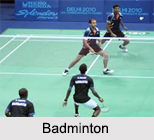
 Badminton is extensively played throughout India, although it lacks the recognition of games such as cricket. Indeed, the modern version of the game has its origins in Pune, when British army officers introduced the net and devised the first rules of the game. Tournaments at various levels including the state, regional and national level are held in India and a few Indian practitioners of the sport have attained international acclaim. Badminton is popular in the Indian states like Kerala, Tamil Nadu, West Bengal, Andhra Pradesh, Telangana and Mumbai.
Badminton in India
Badminton in India is played at both national as well as regional levels. This sport is regarded as hugely popular and it is played under the control of the Badminton Authority of India. Badminton is also popular among the school and college students also like cricket and football.
Introduction
Badminton is extensively played throughout India, although it lacks the recognition of games such as cricket. Indeed, the modern version of the game has its origins in Pune, when British army officers introduced the net and devised the first rules of the game. Tournaments at various levels including the state, regional and national level are held in India and a few Indian practitioners of the sport have attained international acclaim. Badminton is popular in the Indian states like Kerala, Tamil Nadu, West Bengal, Andhra Pradesh, Telangana and Mumbai.History of Badminton in India
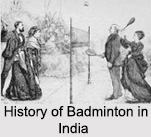 Known to be the second most played sport in India after cricket, the history of badminton in India suggests that the contemporary version of the game was invented in the city of Pune in the state of Maharashtra. Badminton can be well described to be a descendent of battledore, which was the bat or racket and shuttlecock were played in ancient Greece over 2000 years ago.
One of the most popular games since the medieval era, the modern version of badminton has its roots well laid in India. British Army officers posted in Pune gave badminton its present form in the 19th century and played it competitively. As the city of Pune was formerly known as Poona, the game also became known as Poona at that time. Poona was developed from the children`s game, battledore and shuttlecock.
Modern History of Badminton in India : The sport of badminton gets its name from the Badminton House in Gloucestershire, England, which was the home of the Duke of Beaufort, where the sport was played in the last century. Before that, history of badminton predates to the Indian subcontinent, where the sport was known by the name of Poona and before that there was Jeu De Volant, played on the European Continent. Going further back, the origins of badminton can be traced in China, where it was called Ti Jian Zi, the ancient art of Shuttle kicking.
 Introduction of Badminton in India : Badminton was definitively launched in the year 1873, when the Duke of Beaufort hosted it at a lawn party in his residence, Badminton House, whence the game derived its modern name. The game, earlier known as `Poona` after the city in which it was first played regularly, became a pastime of the British elite. In the year 1877, the first club dedicated to badminton called the `Bath Badminton Club` was founded. This club is credited with forming and developing the primary official set of rules of the game.
Target Audience of Badminton : In India, the sport of badminton began as a recreational activity in certain elite clubs. It acquired some organization in India around the 1920s, and in a decade`s time tournaments were held at both the national and regional level. Presently, the sport of badminton in India is managed by the Badminton Association of India.
The game is now ubiquitous in India, and the country has produced several world renowned players like Prakash Padukone, Chetan Anand, Saina Nehwal, Pullela Gopichand. P. V. Sindhu and many others to name a few.
Rules of Badminton
 Badminton is extensively played throughout India, although it lacks the recognition of games such as cricket. Indeed, the modern version of the game has its origins in Pune, when British army officers introduced the net and devised the first rules of the game. Tournaments at various levels including the state, regional and national level are held in India and a few Indian practitioners of the sport have attained international acclaim.
The following are the badminton rules in a nutshell:
* Service in badminton must be delivered underhand. There are four types of service-short, high, drive and flick.
* The server must stand with both feet within his service court and neither foot should touch the line.
* The receiver may stand anywhere within his service court.
* Some part of the feet must be in contact with the floor at the same spot, until the shuttle is hit.
* Who will serve first is decided by tossing a coin. Only the server can add to his/her score.
* If the receiving side wins a rally, the score remains static but service change takes place.
* In doubles, two partners serve consecutively except that at the starting of the game only one service is allowed. After both lose the service, the service changes to the other team
* A side loses the relay if: a) the shuttle falls outside the boundary; b) the service fault is committed; c) the shuttle is held on the racket.
* Double hit: This is a term commonly used when a shuttle is struck by two distinct touches of the racket. Until 1968, any double hit was a fault. But in 1968, the rule of double hit was changed to invalidate a hit only when a player made two strokes at the shuttle.
* Wood shot: This term is used for miss-hits when the shuttle is totally or partially struck by the frame of the racket. Clean hits off the frame of the racket or the wood shot are valid since 1963.
* A `let` occurs only as a result of any unforeseen or accidental hindrance such as a shuttle from a neighbouring court interfering with play or a shuttle being caught in or held on the net. When a let occurs, the whole rally is replayed.
* If the score reaches 14-all, the player or pair, which first reaches 14 points, has to give the defending player/pair the option of `setting` the game for a further three points. If the game is extended by three points, then the score is called` love-all` and the first side to score three points wins the game, if 14- all, then the game may be completed straight or extension of three points may be allowed.
* The women`s singles game is of 11 points. If a game reaches 9-all, it may be set for three points and at 10-all, for two points.
* In the third game the opponents change ends halfway through it, i.e., when one side`s score reaches eight in a game of 15 and six in a game of 11.\
Equipments of Badminton
 In India, the sport of badminton began as a recreational activity in certain elite clubs. It acquired some organization in India around the 1920s, and in a decades time tournaments were held at both the national and regional level.
The game is now ubiquitous in India, and the country has produced several world renowned players like Prakash Padukone and Chetan Anand to name a few. Some of the major equipments needed for the game are:
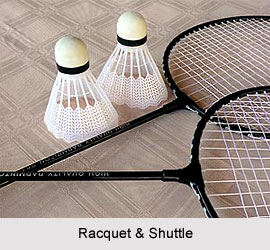
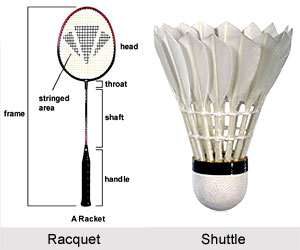
Shuttles : There are two types of shuttles - 14 to 16 feathers with light fan 64 mm to 70 mm and the other of nylon. The base of the feather shuttle is of cork, which is completely rounded except by what is generally known as the skirt weight 4.74 to 5.50 gm.
Racquet : The modern badminton racket is made of either hickory carbon alloys or steel. It has about 16 horizontal and vertical strands of thin gut strung tightly. It is 680 mm long and the head is 230 mm in width. Though there is no stipulation in the rules as to its dimensions or composition, a racket weighs 92 gm to 156 gm.
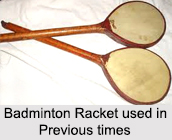
Mainly the badminton racquets are light weight and of top quality. These racquets are made of various materials like graphite reinforce plastic to solid steel, and different other material. The carbon fibre is excellent material and is stiff, and also helps in exceptional kinetic energy transfer. Prior to the use of carbon fibre, badminton racquets were made of aluminium. Even earlier, racquets were made of wood.
 Nowadays racquets are also made of steel to make it cheap, but the manufacturers have done away with the production of wooden racquets. In order to provide durability racquets are also made of nano-materials like fullerene and carbon nanotubes.
Strings : The string used for badminton games are usually high performing and thin and the thickness range from .62 to .73 mm. But the ones that are thin are actually more durable. The tension of the string is mainly of 80 to 160 N (18 to 36 lbf). It is often said that low string tension helps to generate more power and high string tension is for improving control.
Grip : Grip plays a crucial role in terms of handling a racquet. The thickness is essential as it helps a player to handle the racquet properly. A player can build up a perfect grip for handling by using one or more grips. There are varieties of materials to choose from, and the most commonly chosen material is the PU synthetics or towelling grips. The choice of grip depends on the players and varies from person to person. As sweat becomes a problem, so a drying agent can be applied on the grip or hand, or sweatbands can also be used, or a player may also choose to change the grip or use a different grip material.
Generally two main types of grips are there, namely over grips and replacement grips. While replacement grips are thicker and used to enhance the size of the handle, the over grip are generally thinner, and used for final layering. Many players choose the former as final layer. Towelling grips are always replacement grips.
Replacement grips have a sticky backing but over grips have only a tiny patch of adhesive at the beginning of the tape and must be used under tension.
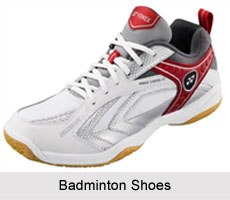
Shoes : Shoes used in Badminton are generally light weight with soles made of rubber. It helps to provide proper grip and are made of non-marking material. Badminton shoes, when compared to running shoes, have less lateral support. High level of lateral support is necessary for action where lateral movement is not necessary. This game requires powerful lateral movement. Since swift and agile footwork is a necessity for badminton so, proper shoes are also crucial.
Badminton Court and Net : The court is laid out on a level and smooth surface, wood and composite flooring, being common. The floor must not be slippery. A minimum of 2 m clear space is essential on all four sides. The markings are in white paint or by white tape and must be 4 cm in width. For doubles play, the entire court is used but for the singles the court is 91 cm narrower, on the sides.
It is made of cord with a mesh of 1.5-2 cm. White tape should be doubled over the top and strained over the top of the post. The net is 1.550 m high at the post and 1.524 m high in the centre.
Badminton Association of India (BAI)
 The Badminton Association of India (BAI) is the managerial body that is responsible for supervising and organizing various events related to badminton at all levels in the country. The organisation performs a range of functions such as vetting new talents, keeping track record details of registered badminton players and organizing tournaments with affiliated associations across the nation. Currently Dr.Akhilesh Das Gupta is the President of the Association and Dr.Himanta Biswa Sarma, Vinod Dhawan, T.P.S. Puri, Pradeep Gandhe, Arvind Singhal, Devender Singh - IAS, S. Muralidharan, S.A.Raval, O.D.Sharma and Abdul Bari Siddique are the acting Vice Presidents of Badminton Association of India (BAI).
History of BAI : The Badminton Association of India (BAI) was originally formed as the All India Badminton Association and was established in 1934 by Sarat Mitra. He was also instrumental in the founding of the West Bengal Badminton Association, one of its first affiliated organizations. Under the aegis of the then All India Badminton Association, the first (men`s only) All India badminton tournament was held in Calcutta (now Kolkata) in the year 1935. The All India Badminton Association was rechristened in the year 1940 in order to form Badminton Association of India, which is active till the present date. Presently this badminton association has almost 40 affiliated organizations under it in several states of the nation.
Functions of BAI : The Badminton Association of India (BAI) encourages potential candidates by properly controlling and developing the sport in the country. This body organizes regular coaching camps, periodical tournaments as well as exhibition games; liaising with affiliated bodies on a part-time basis for increasing the popularity of the game in the ground level. This body helps prospective talents in getting proper aid, support and sponsorship for achieving excellence in the game of badminton. Moreover, the Badminton Association of India (BAI) is also in charge of keeping all the track details and follow-up records of the registered badminton players of the country. This association is also responsible for issuing ranking of the players.
The Association makes the ranking of the players on the basis of their consistent performances. It is considered accountable for player selection for any international badminton tournaments or events. The Badminton Association of India is also held responsible for issuing official appointments to any coach and for generating sponsorships for this game.
The game of badminton enjoys a modest popularity in India due to the efforts of the Badminton Association of India (BAI) and its long history attests to its dedication to the sport.
Indian Badminton League
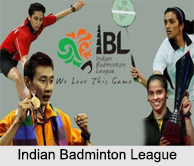 Indian Badminton League in actuality is a franchise league organized and managed by Badminton Association of India (BAI). The inaugural edition of Indian Badminton League took place in India from 14th to 31st August 2013. It is now renamed as Premier Badminton League. In 2013 edition of Indian Badminton League, Hyderabad Hotshots won the inaugural IBL title at Mumbai on 31st August 2013. The second season of the 2016 Premier Badminton League was held from 2nd to 17th January 2016. Delhi Acers defeated Mumbai Rockets in the final to clinch the title. The third season began on 1st January 2017.
Premier Badminton League in 2013 : The first season auction of Premier Badminton League was scheduled on 30th June 2013 which was postponed to 19th July 2013 and again postponed to 22nd July 2013. The 2013 auctions were held in Delhi and were conducted by International Auctioneer Bob Hayton. The franchise cities of Indian Badminton League suggested are Delhi, Mumbai, Bangalore, Pune, Hyderabad, Nagpur and Lucknow.
2016 Premier Badminton League :
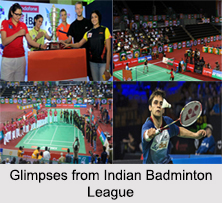 The 2016 edition of Premier Badminton League was commercially known as Star Sports Premier Badminton League 2016 and was the second edition of the Premier Badminton League. The season was held from 2nd–17th January 2016. The opening ceremony was held in Mumbai and the finals in Delhi. Delhi Acers became the champions after beating Mumbai Rockets in the final.
2017 Premier Badminton League : The 2017 edition of Premier Badminton League commercially also known as Vodafone PBL 2017 for sponsorship reasons is the third edition of Premier Badminton League. Vodafone PBL 2017 started on 1st January 2017 and concluded on 14th January 2017. It consisted of 15 league ties and the top four teams progressed to the knock out stages. Sachin Tendulkar became a co-owner of Bengaluru Topguns before the season and they were renamed as Bengaluru Blasters. The Awadhe Warriors, Mumbai Rockets, Chennai Smashers and Hyderabad Hunters entered the semi-finals after topping the league table. Chennai Smashers beat Awadhe Warriors in 4-1 and Mumbai Rockets beat Hyderabad Hunters in 3-(-1) to proceed to the final. Chennai Smashers won the tournament after beating Mumbai Rockets in 4-3.
Teams of Premier Badminton League : The teams along with the Indian Badminton players in Indian Badminton League or Premier Badminton League are Hyderabad Hunters, Banga Beats (now closed), Awadhe Warriors, Chennai Smashers, Mumbai Rockets, Pune Pistons and Delhi Acers.
Indian Badminton Players
India has a strong badminton scene at the domestic level, which teems with young talents. These youngsters draw inspiration from legendary Indian Badminton Players like Prakash Padukone, Aparna Popat and Pullela Gopichand. Apart from these legends, India has also produced many top ranking players such as Saina Nehwal, Chetan Anand, Abhin Syam Gupta, Nikhil Kanetkar and Sachin Ratti.
Badminton in India is becoming popular thanks to the efforts of these luminaries. In contemporary India, the women`s singles player Saina Nehwal was ranked first in the world in 2015. Prakash Padukone and Pullela Gopichand won the All England Open in 1980 and 2001 respectively. Saina Nehwal is also the first Indian badminton player to have won an Olympic medal when she won the bronze medal at the 2012 Olympics. At the 2016 Summer Olympics, P.V. Sindhu became the first Indian woman to win a silver medal. She is the student of Pullela Gopichand at Pullela Gopichand Academy.
Badminton in India is becoming popular thanks to the efforts of these luminaries. In contemporary India, the women`s singles player Saina Nehwal was ranked first in the world in 2015. Prakash Padukone and Pullela Gopichand won the All England Open in 1980 and 2001 respectively. Saina Nehwal is also the first Indian badminton player to have won an Olympic medal when she won the bronze medal at the 2012 Olympics. At the 2016 Summer Olympics, P.V. Sindhu became the first Indian woman to win a silver medal. She is the student of Pullela Gopichand at Pullela Gopichand Academy.
Recently updated articles in Athletics in India
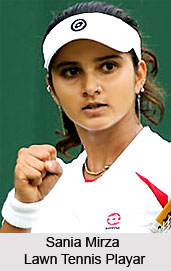
Arjuna Awardees in Lawn Tennis
Arjuna Award is given by the Ministry of Youth Affairs and Sports of Government of India to recognize outstanding achievements in sports. Between 1961...
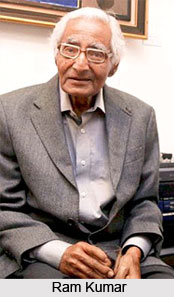
Ram Kumar, Basketball Player
Ram Kumar is a former basketball player who is known for his impeccable 3 point shooting. He is the recipient of various prestigious Arjuna award.
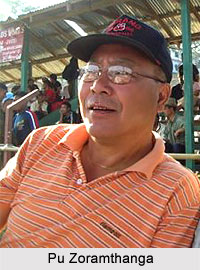
Pu Zoramthanga, Burmese Indian Boxer
Pu Zoramthanga made his state and country proud by winning several national and international awards.
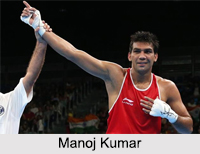
Manoj Kumar, Indian Boxer
Manoj Kumar is a popular Indian boxer who won Bronze at the 2018 Commonwealth Games held at Gold Coast in Queensland, Australia.
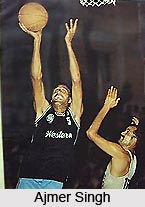
Ajmer Singh Chopra, Indian Basketball Player
Ajmer Singh is Indian basketball player earned fame after competing Asian Basketball Championships. Later, he was awarded Arjuna Awards in the year 19...
Related articles in Athletics in India
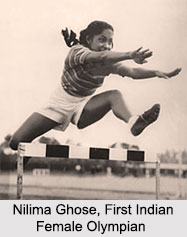
History of Indian Athletics
India enjoys a long history of athletic sportsmanship from the Vedic era to the modern period, and is now actively involved in contemporary forms of a...
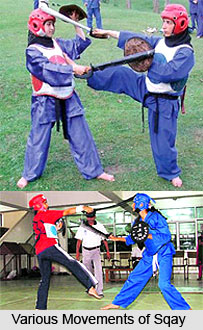
Sqay Martial Arts
Sqay is a martial art form from Kashmir. Sqay is a Persian word which means `knowledge of war`.
Handball in India
Handball in India with its entire verve has earned the status of one of the most sought after sports in the country. Handball is concentrated in Andhr...
Indian Martial Arts
Indian Martial Arts exhibit great variety in their form and style. In modern India, martial arts have become one of the necessities especially for gir...
Pole Vault
Pole Vault is a part of Olympic event since 1896. Pole Vault is in recent times gaining popularity for the best performances of V. S. Surekha, Karamji...