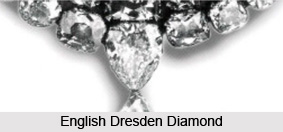
 Edward Z Dresden`s agents in Rio de Janeiro on his behalf bought this stone. And the diamond was named after this London merchant, Edward Z Dresden. The agents dispatched it to London, from where the gem was sent for cutting to Coster in Amsterdam. Amsterdam was the premier diamond-cutting center at that time. This utterly colorless and flawless stone was fashioned into a finely proportioned pear shape that was cut down to 78.53 carats.
Dresden wrote in an account that it was the best diamond in the world after seeing the resulting stone, as it was so pure. He had it harmonized against the Koh-i-Noor at the jewellers, Garrard. Garrard said that the Koh-i-Noor color had appeared yellowish in comparison to Dresden`s diamond drop, which had been perfectly white.
Who saw the gem; most of them were awestruck by its transparency and exquisiteness. But when it was offered for sale to various members of the European royal family, it was refused and it stayed unsold for quite a while. The English Dresden then caught the interest of an anonymous maharaja. This unidentified Maharaja went to London in 1863 with the particular intention of acquiring the beguiling gem. Yet, he had to return home disappointed, as he did not agree to the asking price of £40,000. An English cotton merchant had accompanied him from Bombay who fell in love with the diamond and determined to buy it.
An agent was appointed by the English merchant who offered Dresden £32,000 on his behalf. However, in the bargain, the agent cautiously pocketed £8,000 and informed his client from Bombay that Dresden`s price was quoted around £40,000. The English Dresden made its journey to India as soon the deal completed, but soon after its arrival in Bombay, the merchant unexpectedly suffered heavy losses in his cotton business. The merchant died leaving large debts that had to be paid off through the sale of the diamond as one catastrophe followed another. It was the only reasonable that the captivating gem be offered to Mulhar Rao Gaekwad of Baroda who was a keen collector of jewellery. The diamond was bought by him for £40,000.
The English Dresden along with the magnificent Star of the South, The Gaekwad had set in a necklace, and it remained in the magnificent Laxmi Vilas Palace in Baroda till 1934. Later Cursetji Fardoonji, another collector from India was believed to have bought the diamond and is considered to be still in his family`s custody.