 Community radio is a type of radio service that caters to the interests of a particular area in need of mass awareness. The broadcasting material of community radio has to be popular to the local audience but can be a secondary issue for more powerful broadcast groups. In India, the campaign of Community radio started in the mid 1990s, soon after the Supreme Court of India approved the idea, passed on its judgment in the month of February 1995, and declared "airwaves are public property". This notion of the Indian government was passed on as an inspiration to groups across the country and community radio started with only educational (campus) radio stations under somewhat strict conditions.
Anna FM is India`s first campus `community` radio that was launched on 1 February 2004, controlled by Education and Multimedia Research Centre (EMAýRC) and the students of Media Sciences at Anna University produce all programmes. On 16 November 2006, the government of India advised a set of new Community Radio Guidelines that allowed the NGOs and other civil society organizations to possess and operate community radio stations. According to government sources, about 4,000 community radio licenses had been on offer across India. By 30 November 2008, the Ministry of Information and Boadcasting already received 297 applications for community radio licenses, including 105 from educational institutions, 141 from NGOs and other civil society organizations, and 51 for `farm radio` stations to be run by agricultural universities and agricultural extension centers like the `Krishi Vigyan Kendras`. Among these, 107 community radio stations have been approved for licensing through the issue of Letters of Intent. 13 Grant of Permission Agreements (GOPA) was signed with license applicants under the new scheme by the Indian Government.
By 30 November 2008, there had been 38 operational community radio stations in India. Of these, NGOs and educational institutions control majority of the radio stations. The first community-based radio station in India was licensed to an NGO that was completely separate from campus-based radio and was launched on 15 October 2008. The `Sangham Radio` in Pastapur village, Medak district, Andhra Pradesh state was switched on at 11.00am unanimously to hear the shows. Sangham Radio, which broadcasts on 90.4 MHz, is applicable to execute the Deccan Development Society (DDS). This is an NGO that works with women`s groups in about 75 villages of Andhra Pradesh. `General` Narsamma and Algole Narsamma manage this community radio station. The second NGO-led community radio station in India was started on 23 October 2008 at `TARAgram` in Orchha, Madhya Pradesh state. This community radio channel was named `Radio Bundelkhand` after the Bundelkhand region of central India where it was mainly broadcasted. This radio station is licensed to the Society for Development Alternatives (DA), a Delhi-based NGO.
Under the new community radio policy accredited by the Government, any not-for-profit `legal entity`, other than individuals, political parties and their affiliates, criminal and banned organizations can also apply for a CR license. Central funding is not available for such radio stations, and there are stern limitations on fundraising from other resources- only organization that is registered for the minimum of three years old and with a `proven` path record of local community service can apply. License conditions unreservedly favour well-established stations as against low-priced low power operations, several of which include Mana Radio in Andhra Pradesh and Raghav FM in Bihar that run successfully on shoe-string budgets before the obligation of any community radio policy.
Indian Government approved a community radio license that entitles the channel owners to operate a 100 watt (ERP) radio station, with a coverage area of almost 12 kilometres radius. A maximum antenna height of 30 meters is permissible and these radio stations are expected to produce at least 50% of their programmes in the local range and the programmes should be presented in the local language or dialect at the maximum extent. The prime focus is on developmental programming, though there is no clear restriction on entertainment. News programmes are prohibited on community radio in India, as also on commercial FM radio.
The government, however, has recently opened some new categories of news and varied forms of communication that are permitted on radio, including sports news and commentaries, information on traffic and weather conditions, exposure of cultural events and festivals, information on educational events, civic announcements adhering to the utilities like electricity and water supply, disaster warnings and health alerts. Five minutes of advertising per hour is allowed on the Indian community radio. Sponsored programs are strictly prohibited except when the program is sponsored by the Government at the Centre or State.
Activists and community workers coming from all across the country have gathered together under the sponsorship of the `Community Radio Forum` in order to organize training and support for community radio stations, as well as to maintain the petition for a more practical community radio policy. The Community Radio Forum, India, was registered as a `Society` and `Trust` on 26 February 2008. In the intervening time, mobile telephone operators have started to offer commercial broadcast services over GSM, escaping completely the government limitations built around traditional concepts of broadcasting technology, especially community radio in India.
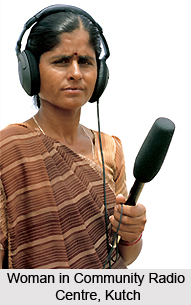 History of community radio in India can be traced back to the period when the country was engulfed in acute poverty particularly in the rural regions and individual organizations were not permitted to establish their own radio stations in India though radio was an effectual medium for voice-based communication. However, the need for community radio increased with every passing day for the purpose of democratization and
 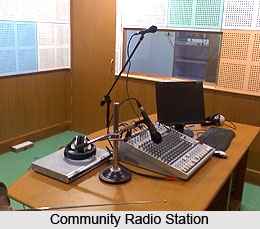 Common policies for community radio in India direct the various procedures and regulations for establishing a community radio station. Community Radio (CR) is a radio service which offers their services to a specific community categorized on the basis of interest or geography. Relevant or popular content for a particular community which is mostly overlooked by mass-media or commercial broadcaster are covered by this service. Policies for community radio, in addition to directing the course of the establishment of community radio, also suffer from a few loopholes which expose their inability to serve the main purpose efficiently. Despite of this fact the rules and regulation covered under these policies serve as significant for proper set up of community radio stations.
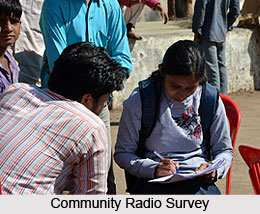 The application for CR license can be filed only by the non profits which have over 3 years of functioning. Although this policy is needed for the accountability, it restricts the ventures of new organizations which are keen to step into the field of community radio with full dedication. In fact the older NGOs which are eligible to acquire a licence are mostly engaged in health, low-cost housing and micro-finance and consider community radio as an extension of their existing programs. The purpose of community radio is however much broader and requires much dedication for its development.
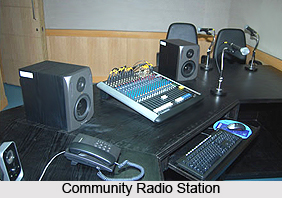 Challenges for Community Radio in India create both technical and infrastructural obstruction in the smooth and effective operating as well as development of Community Radio. The most prominent challenges faced by Community Radio in India deal with the technology and financial sustainability. Community Radio usually has the permission to feature five minutes of advertising every hour. In case of good marketing, these advertisements are very helpful to provide the operational costs of running the Community Radio Station and in paying salaries to the staff of the setup. However, practically the scenario becomes quite infeasible for the Community Radio Stations. It becomes quite difficult for the operators, who lack in affluent resources, to seek good advertisers with excellent business skills as well as provide great quality content at the same time. In such cases it has been inferred that a central agency for assisting these radio stations by searching advertising on their behalf would be much helpful.