
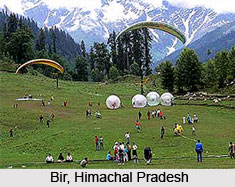
 Bir is a small hilly village located in the west of the state of Himachal Pradesh in northern part of India. This hill station is famous for eco tourism to the foreign travellers and the national travellers also. Bir is now a hotspot for the tourist who visit this spot in the month of springs and autumns.
Bir
Bir is a hill station in Himachal Pradesh. This hill station is noted for eco tourism in Himachal Pradesh.
Introduction
Bir is a small hilly village located in the west of the state of Himachal Pradesh in northern part of India. This hill station is famous for eco tourism to the foreign travellers and the national travellers also. Bir is now a hotspot for the tourist who visit this spot in the month of springs and autumns.Location of Bir
Bir is located at in the Tehsil (administrative subdivision) of Baijnath, in Kangra District Himachal Pradesh. Bir is situated in the western part of Himachal Pradesh. This spot is popular not only for the eco tourism, but also for the people who love tribal and Aryan history of India. It is situated approximately 50 km, southeast of Dharamshala, Himachal Pradesh at a distance of two to three hours by road. It is 14 km south of Billing, which lies on the way to the Thamsar Pass leading to Bara Bhangal. Bir is situated in the Joginder Nagar Valley, Dhauladhar Range of the foothills of the Indian Himalayas.
History of Bir
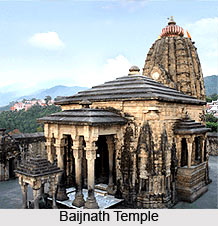 History of Bir includes the early history of Bir and later the medieval history of Bir. This history of Bir is associated with the Pala Dynasty rule.
Early History of Bir : Bir was ruled by Pala dynasty of Chandarvanshi lineage the last Raja was Raizada Prithi Pal who was a descendant of the Rajas of Bhangahal, who appear to have maintained their rights until the time of Raja Prithi Pal in the early part of the eighteenth century. Raja Prithi Pal fell a victim to his father-in-law, Raja Sidh Sen, who in the year 1728 invited him to Mandi, Himachal Pradesh in the pretext of seeking his assistance against the Raja of Suket. He was kindly received but within a month of his arrival he was beguiled into the Damdama Fort, and there murdered. It is said his body was duly burnt, but his head was buried in a tank facing the Mandi Raja`s palace. A pillar was erected on the spot, and a light was kept burning on it for years. The object of Siddhi Sena in murdering Raja Prithi Pal was to seize his territory, but in this he only partially succeeded. The forts at Jagapur, Tika Thana and the Patgana of Nir, with eighteen villages of Ilaga Chuhar (all of them until then forming part of the Bhangahal kingdom) were annexed to Mandi. Subsequently, Sidh Sen attempted to seize Karanpur, which also belonged to Bhangalahl, but he was repulsed by Raja Raghunath Pal who had succeeded his father Raja Prithi Pal. He penetrated on a second occasion, as far as Kotharli Gulu, then in Bhangahal, but Raghunath Pal was able, with the assistance of Raja Thedi Singh of Kulu, not only to check his advance, but also to beat him back with considerable loss.
Medieval History of Bir : The Mughal Emperors in Delhi always appreciated the loyalty of the Bhanghal chiefs, and when the news of repeated aggression of the Mandhi Raja on Bhangahal reached the Emperor at Delhi, he deputed Adina Beg, Governor of Jullundur, to drive him off. But the Khan died on the road at Dinanagar in 1732. The affair ended unfortunately for Raghunath Pal, who went to meet the Governor, as Sham Sher Singh, Raja of Mandi, took advantage of his absence to seize the much-coveted Quila of Karanpur. Raghunath Pal died in 1749, and was succeeded by his son, Dalip Pal, whose reign was rendered memorable by a combined, though un-successful attack made on Bhangahal by the Rajas of Mandi, Kulu, Kahlur, Nalagarh, Guler and Jaswan. The united forces of these chiefs encamped at Tika Changar, and made an attempt to capture the Raja and his brother, Mian Bhim Pal, but were eventually driven back with great loss. The Raja commemorated the victory by erecting several mounds composed of the heads of his slaughtered foes. One of these mounds exists in the pine forest in Bir, and another stands on the banks of river Pun river within the limits of Bhangahal.
Modern History of Bir : With the advent of colonial powers and the decline of Mughal Empire of Delhi, Bir taaluqa was annexed in 1779 by the Raja of Kulu shortly before the death of Dalip Pal, whose son, Man pal, succeeded only to the taaluqas of Lanod and Paprola. He died on his way to Delhi; whither he was proceeding with the object of enlisting the sympathies of the Mughal Emperor in an attempt to make the recovery of his patrimony. The Rajas of Kangra and Guler took advantage of Man Pal`s absence to seize villages and lands, Kangra appropriating Lanod and Paprola and Guler the remaining property. Man Pal`s widow and her infant son, Uchal Pal sought refuge at Rehlu with Raja Rai Singh of Chamba, who gave her a home and allowed her a small "Jagir". In the year 1785, when Raja Sansar Chand of Kangra married a daughter of Man Pal, he lent Uchal Pal a small force to help him in recovering his lands from Mandi Raja. This latter Chief had recourse to stratagem. He bought off Sansar Chand`s principal officer and persuaded Raja Rai Singh of Chamba to carry war into Katoch dominions. When Sansar Chand found that Rai singh had advanced within a short distance of Kangra, he had to muster all his available forces, including the portion he had lent to Uchal Pal. After the battle of Nerti, in which Raja Rai Singh was defeated and killed, the Mandi and Kullu Rajas secured the possession of Bangahal by paying Sansar Chand five lakh rupees. Upal Pal died after leaving three sons and a daughter, who lived under - Raja Sansar Chand Katoch protection. The girl subsequently married the Raja of Siba. Ram Pal, the eldest son of Uchal Pal died childless in 1843. The efforts of Bahadur Pal, his younger brother, to recover the family estate, were always opposed by the Raja of Mandi. Mathru, the father or Barar Pal, the head of the family in 1909, succeeded in obtaining from the British Government a pension of Rs.500 per annum for his cousin, Mian Bahadur Pal, and this he enjoyed until his death in 1854. Barar Pal was given the title of Rai Sahib in 1895. He was a Divisional Darbari, Lambardar and Kotwal of his circle and a member of the Local and District Boards. His family held 80 acres as proprietors in Bir Bhangahal and Bir, yielding Rs. 2,200 per annum. He died in 1912. The last head, Mian Prithi Pal, was a Zaildar and lived in Bir. He was very well spoken of by his people. In 1966 the third Neten Chokling (1928-1973), an incarnate lama of the Nyingma lineage of Tibetan Buddhism, brought his family and a small entourage to Bir. With the help of foreign aid, Neten Chokling purchased over 200 acres of land and established a Tibetan settlement where 300 Tibetan families were given land to build houses.
Population of Bir
Population of Bir is primarily Indian agriculturalists. There is also a sizable community of Tibetan refugees in the Bir Tibetan Colony and a small community of international expatriates and long-term students, volunteers and visitors.
Tourism in Bir
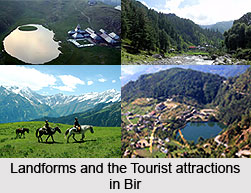
 Tourism in Bir is dealing with the eco tourism sites and the pilgrimage tourism sites and the leisure tourism sites. Bir is a hilly village located in the west of the state of Himachal Pradesh in northern part of India. Some of the tourist importance sites in Bir are Deer Park Institute, Dharmalaya Institute, Chokling Gompa, Chokling Gompa, Bir-Billing area, Bir Tibetan Colony and many other tourists" importance spots.
Deer Park Institute : The Deer Park Institute is a centre for the study of classical Indian wisdom traditions, which is established by Dzongsar Khyentse Rinpoche in March 2006 under the patronage of the Dalai Lama. Deer Park Institute hosts frequent guest lectures and workshops with reputed scholars and meditation teachers.
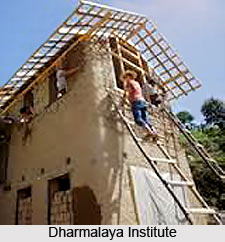
Dharmalaya Institute : Dharmalaya Institute is an eco-campus for service-learning and contemplative practice. Dharmalaya is an Indian charitable society (NGO) devoted to education, service, and compassionate living, with a practical focus on sustainable village development, contemplative service-learning, and immersive ecotourism Dharmalaya hosts work retreats and meditation retreats, providing opportunities for long-term volunteers and meditation students to do karma yoga (mindful service work with an unselfish, altruistic intention) for various charitable projects to benefit the local community and the natural environment. The programmes include green building, green job skills training for local villagers, organic farming, and a tree-planting project.
Chokling Gompa :
 Chokling Gompa is the monastery of Neten Chokling Rinpoche, a reincarnate Lama in the Nyingma tradition of Tibetan Buddhism and the director of the film Milarepa (2006). The Tibetan architecture and large Stupa are the principal attractions for casual visitors. In addition to its ongoing programmes for its full-time monastic students, the monastery periodically hosts Buddhist ceremonies open to the public. There is a guest house and restaurant on the premises.
Bir Tea Factory : Bir Tea Factory is a longstanding Bir cooperative, which offers tours for those interested in the process of tea production.
Bir-Billing Area : Bir-Billing area is a popular destination for ecotourism and adventure travel, offering paragliding, hang-gliding, trekking and camping.
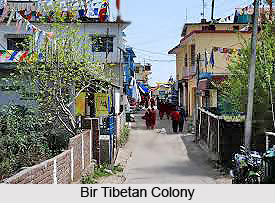
 Bir Tibetan Colony : Bir Tibetan Colony is a Tibetan refugee settlement located at the west end of the village of Chowgan on the south-western edge of the village of Bir. Bir Tibetan Colony was established in the early 1960s following the exile of the Dalai Lama and other Tibetans from Tibet. Bir Tibetan Colony houses several Tibetan monasteries (representing the Nyingma, Kagyu, and Sakya traditions), a Tibetan handicraft centre, a Tibetan Children`s Village school (Suja), a branch of the Tibetan Medical and Astrological Institute (Men-Tsee-Khang), a medical clinic, and the Deer Park Institute.
Recently updated articles in Hill Stations in India
History of Male Mahadeshwara Hills
The history of the Male Mahadeshwara Hills is deeply rooted in legend and devotion, tracing back nearly six centuries. Associated with Saint Mahadeshw...
Kullu - Himachal Pradesh
Kullu is located in Kullu District of Himachal Pradesh. Kullu is one of the most beautiful hill stations of the country. Kullu is popularly known as t...
Lalit Grand Palace
Lalit Grand Palace is 5 Star Hotel, which was earlier the summer residence of Maharaja Pratap Singh of Dogra Dynasty.
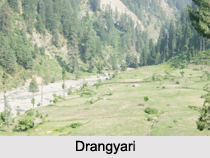
Drangyari
Drangyari is hill station in Kashmir Valley of Jammu and Kashmir which attracts tourists for the natural beauty.
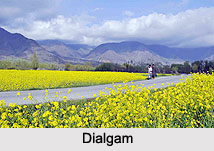
Dialgam
Dialgam is a hill station in Jammu and Kashmir. For its location, this hill station is noted to the tourists as the spot of refreshment.
Related articles in Hill Stations in India
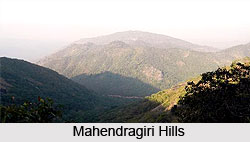
Mahendragiri Hill
Mahendragiri is a place of great scenic beauty. The place is surrounded on three sides by hills and thick growth of wild trees.
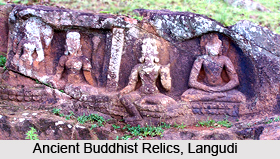
Langudi Hill
Langudi Hill, Odisha is a significant Buddhist archaeological site containing ruins of Pushpagiri University, rock-cut caves, Buddhist stupas and nume...
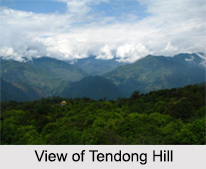
Tendong Hill
Tendong Hill in South Sikkim is located at an altitude of 8530 ft. The hill is deeply revered by the local villagers.
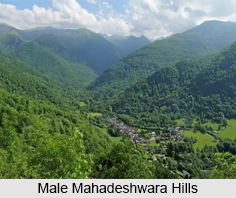
Male Mahadeshwara Hills
The Male Mahadeshwara Hills is one of the popular sites of tourism in the state of Karnataka and is known for the sacred Male Mahadeshwara Hills Templ...
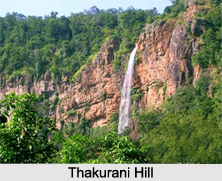
Thakurani Hill
Thakurani Hill is a residual sedimentary hill in Odisha and it is the place of attraction in Keonjhar District.