 Carnatic music, associated with the southern part of India is one of the important sub genres of the Indian classical music. Confined to mainly four modern Indian states like, Andhra Pradesh, Kerala, Tamil Nadu and Karnataka, Carnatic music with its taala, laya and raga, is more than just an amalgamation of musical notes, rhythm and melody but is an eternal journey amidst the vibrancy of euphony ; a sheer musical sojourn representing the Indian heritage.
Like all art forms in Indian culture, Carnatic music is believed to have a divine origin, thus it has its origins deeply rooted in the antiquities of the Vedas. Even in the Upanishads there are references to music and musical instruments. Epics like Ramayana and Mahabharata also have some references to music. However, the music system which was practiced during Bharata`s period can be attributed as Carnatic music in its rudiment form. Bharata`s Natyashastra mentions many musical concepts that continue to be relevant to Carnatic music today. The Tamil works like Silappadikaram, Tolkappiam and other Sangam literary works offers archaic Dravidian names for the seven notes in the octave and also portrays the secrets of the technique of modal shifting of existing scales. The concept of Pann which was much in vogue in the old Tamil literature corresponds to that of the modern raga, now used in Carnatic music. The rhythmic meters found in several sacred musical forms like Tevaram, Tiruppugazh, etc., resemble the talas that are in use in Carnatic music today. However, some of the musicologist suggests that in the ancient days Tamil music was practiced by the native Dravidians in the southern part of India. Carnatic music also prevails there, hence scholars believe that the ancient Tamil music to be an important source from which the legacy of Carnatic music began.
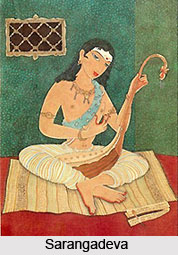
Although Carnatic music prevailed in the age old days yet it was only after the composition of the musical treatise, Sangita Ratnakara by Sarngadeva, the word `Carnatic` was first introduced to represent the typical style of South Indian classical music as a separate genre of music. The clear demarcation between the Hindustani classical music and the Carnatic music as two distinct forms of Classical music was witnessed during this time at the fag end of the 14th century Sangita Ratnakara therefore stands out as a link between the two new systems that gradually split and evolved separately after his period, namely, the Hindustani music and Carnatic music.
In the capital cities of South India, especially in Tanjavur and Vijayanagara Classical music flourished to a great extent. It was during this time a number of treatises tracing the concepts of Carnatic music were written. The Sangeeta Sara written by Vidyaranya was the first to classify ragas as Melas and also coined the word Janya ragas. The present form of Carnatic music is based on historical developments that can be traced to the 15th - 16th AD and thereafter. Music as an art form was handed down from the teacher to the student through direct oral instruction and this form of imparting the education has been a special tradition in Carnatic music.
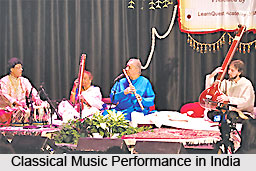 Carnatic music composition has two elements, one is the musical element and the other represents the element which is conveyed in the composition. And it is for this reason most Carnatic music compositions are ideally composed for singing which brings out the knowledge and personality of the composer. The main emphasis is therefore on vocal music; and even when played on instruments, they are meant to be performed in a singing style (known as gayaki).The most common and significant forms in Carnatic music are the however varnam and the kriti (or kirtanam).
Words and melody accompanied with the divine presence of the taala and raga further contours the structure of the Carnatic music whilst making it an emblem of the rich musical heritage of India. Raga is the Pivotal concept of Carnatic music and is India`s proud contribution to world music. The ideal of absolute music is reached in the concept of Raga which is much more than a being a mere scale. Carnatic raga elaborations are generally much faster in tempo and shorter. The opening piece is called a varnam, and is a warm-up for the musicians. Next follows the devotion and a request for a blessing follows. A series of interchanges between ragas (meter less melody) and thaalams (the ornamentation, equivalent to the jor) then follows. This is intermixed with hymns called krithis and is ideally followed by the pallavi or theme from the raaga. Beat or taala for the Carnatic music is important and the Carnatic music singers usually keep the beat by moving their hands up and down in specified patterns, and using their fingers simultaneously to keep time. Tala is formed with three basic parts (called angas) which are laghu, dhrtam, and anudhrtam, though complex talas may have other parts like plutam, guru, and kaakapaadam.
Improvisation in raga is the soul of Carnatic music and is indeed an essential aspect in silhouetting the structure of the music. "Manodharma sangeetham" or "kalpana sangeetham" as it is known in Carnatic music, espouses several other various improvisations. However, the main traditional forms of improvisation in Carnatic music consists alapana, niraval, kalpanaswaram, ragam thanam pallavi, and thani avarthanam.
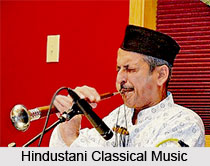
The theme of Carnatic music is to purify one whilst uniting him with the infinite. The idea is to unite one`s breath with that of the spaces and to correlate one`s vibration with the vibrations of the cosmos. Quite ideally therefore Carnatic music is essentially spiritual entwined with the rich philosophies of the Hindu religion. This sublime integration of various themes, religion, philosophy, emotions, intellect, entertainment and others with Carnatic music, has created a vibrant life and tradition in Hindustani classical music.
The divine timber, the philosophic overtones, the melodic rhythm and indeed the spiritual facets make Carnatic music a separate entity, a divine way to become one with the Divine.
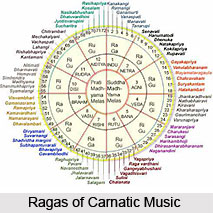
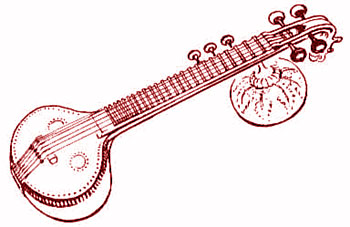 Raagas in Carnatic music are quite similar to the Hindustani style. As in Hindustani ragas, specific pitches are associated with a specific raaga in the case of Carnatic Music as well. In the Raaga theory of Carnatic music, it is common to think in terms of a tetrachord structure. The selection of pitches in the Raagas, as also seen in the case of Hindustani music, must be must be enumerated for both ascent (arohana) and descent (avdrohana), which sometimes differ in pitch content. For instance, in the case of Raga Mayamalavagaula, the raga on which the first lesson taught to the students of Carnatic Music, the same seven pitches are used in both ascent and descent. This kind of a raga is said to be a Sampurna Raaga. Traditionally, it is required that a Raaga should have at least five pitches, however it may have only four in ascent or descent. The theory in Carnatic music holds that only one form of the seven basic pitches can be used in context. This rule is very strictly adhered to in Carnatic music. There are some Carnatic Raagas which are characterised by melodic patterns (sanchara) that are not particularly associated with ascent or descent. Raga Darbar is one such raga. It is marked by an ascent and descent, as well as two sanchar. Descriptions of Carnatic raagas frequently cite sancahra, which are phrases that may occur frequently but do not necessarily play a role in distinguishing one raga from another.
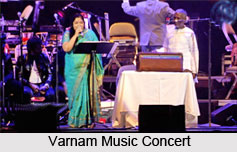 Varnam is a kind of composed music with which a typical concert in South India begins.
 Pitch in Carnatic music stems from the same ancient system as the Hindustani tradition. It utilizes seven basic pitches- Sa, Ri (instead of the Hindustani Re), Ga, Ma, Pa, Dha, and Ni. These symbols are the abbreviations for words. Sa stands for Sadja, pa for Panchama, Ri for Risaba, Ma for Madhyama, Dha for Dhaivat, Ga for Gandhara and Ni for Nisada.
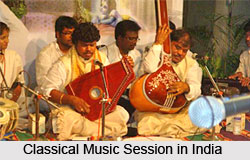
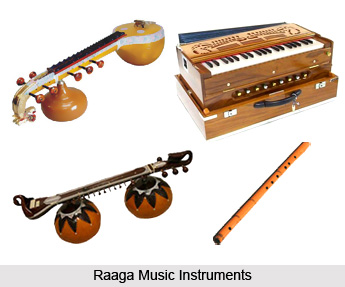
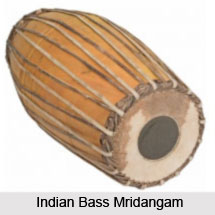 Carnatic drumming mainly takes place on the mridangam. In the performance of Indian music, North or South, a solo melody instrument is complemented by a drone instrument and a drum. A vocal solo is accompanied by an ensemble that includes drum, drone, and a stringed melody instrument. The major percussion instrument employed in Carnatic Music is the mridangam.
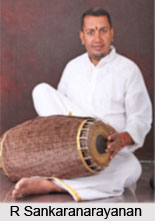 Presumably, such syllables were originally meant to imitate the sounds of the strokes to which they referred, but with time the use of syllables became more complex. Single strokes are combined into stroking patterns, and, thus, single syllables are combined into euphonious, easily recited syllable patterns that indicate such stroking patterns.
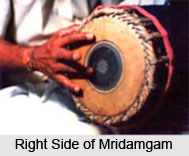 Students beginning to study mridanga learn to produce the basic strokes, then basic patterns. From the earliest lessons, they learn the principle and technique of playing in levels of speed (the only means of acceleration allowed in Carnatic music). At a later stage of training, the student of mridanga begins to put the ideas of germinal motive and gradual elaboration into the framework of a tala. He also learns how to create other shapes. For example, he may start with a long pattern and gradually reduce it. This is called gopuccha, the shape of a cow`s tail - thick at the beginning and tapering to thin. These shapes can be used in the mora.
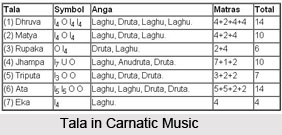
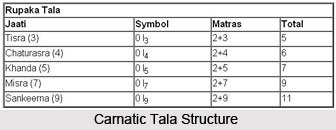 Tala in Carnatic music, though consisting of a cycle, is organized around principles that are quite different from the Hindustani talas. In the Carnatic tala (or meter), some tals consist of one single unit without subdivision. However most of them subdivided. This concept of subdivision in Carnatic music is quite different from the Hindustani concept of the same. In the practice of Carnatic music, the terms used in speaking about the subdivisions of a tala cycle, refer not only to the initial count of a subdivision but also to the duration of the subdivision as a whole. In the major Carnatic talas, there are three kinds of subdivision.
 Even more than in the case of audiences in the North, South Indian audiences keep the tala during performances. The means of keeping it (kriya) is by claps and waves. To indicate the finger counts of the laghu, one touches the thumb to the little finger and progresses toward the index finger.
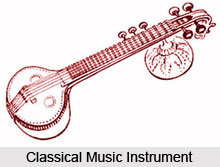 Carnatic music is one of the most ancient music systems in the world with its history dating back to the age old days of the Vedas. The well defined theoretical principles govern Carnatic music whilst adding to the practical and aesthetic appeal of this genre of Indian classical music.
 Tala is formed with three basic parts (called angas), which are laghu, dhrtam, and anudhrtam, though complex talas may have other parts like plutam, guru and kaakapaadam. There are seven basic tala groups, which can be formed from the laghu, dhrtam, and anudhrtam:
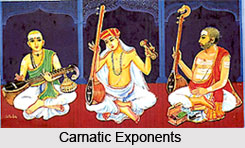 Genres of Carnatic Music are mainly of three types. These include varnam, kriti and ragam-tanam-pallavi. Varnam is kalpita sangita, composed music. Through varnam, the tripartite structure (pallavi-anupallavi-charanam) was introduced. Along with this there was the inclusion of solfege passages within that form, and the srotovaha principle of melodic and rhythmic development. Kriti is the major kalpita sangita genre in the tradition of Classical Carnatic Music. It can be a combination of both kalpita sangita and manodharma sangita (improvised music), because it can include kalpana svara and niraval. If kriti is preceded by even a brief alapanam, then the progression from un-metered to metered is present. Otherwise, both varnam and kriti are entirely metered. Within the kriti are found existing the possibilities for flexibility and expansion of the formal structure. Basic principles herein are the prominence of the tala, since it is tied so closely to the text throughout, and the ever present contrasts in speed through mathematical proportions.
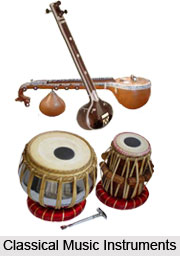 Composition is an important element of Indian classical music. A musical composition portrays a concrete picture of not only the raaga but also presents the emotions imagined by the composer, eloquently. Composition in Carnatic music is varied and is thus a beautiful combination of timber, music and indeed a high flown poetry
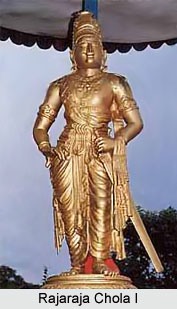 During the pre-independence period, the royalty and Carnatic music went hand in hand in South India. The early rulers of South India like the kings of Chera, Chola, Pandya and Pallava dynasties patronised all kinds of artistes including those of the Carnatic music.