There was a remarkable contribution by the Gujjars in Indian freedom struggle. For instance, during India`s first war of Independence, known as the Sepoy Mutiny, 1857, a Gurjar called Kalyan Singh had terrorised the British forces for several years. The Sepoy Mutiny was a remarkable event in the Indian history. From 1822 to 1825, the Gujjar community held a fierce armed protest against the British rule. Several times, when the British were transporting their treasury from one place to another, they were killed and looted by the Gujjar protestors. Most of the Gujjar-occupied areas, like Ladhora, Prikishatgharh, and Samther, had their boundaries reduced by the British. The Estates of thousands of villages were reduced to only a few hundred villages. Revolts in western Uttar Pradesh (
Saharanpur district) during 1821 to 1825 led to the killing of thousands of Gujjars. Many were hanged, and thousands of them were given life sentences. Thus, in this way, the entire Gujjar community considered the British as their main rivals.
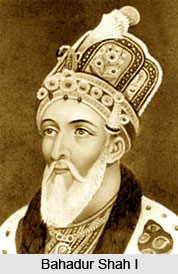
Gujjar soldiers of the Meerut camp revolted in 1857 under a Gujjar leader from Panchli Village. They elected the Mughal emperor,
Bahadur Shah I, as their leader. Then Gujjars of
Uttar Pradesh and
Delhi region joined the rebellion against the British rulers. Gurjars ended the British rule for some period, disabled the postal system, sped the transportation, and killed both British officers and civilians. Further, they handed over the British treasury to Mughal King Bahadur Shah Jafar. Moreover, Gujjars in the Saharanpur district gave some horrible times to the British officers. Gujjars in several districts like
Gurgaon, Karnal, Muradabad, Muzafarnagar, and Bijnor emerged and revolted against the Britishers and they gave them a very tough time. They destroyed police stations and district courts.
Gurjars of Bijnor were fighting under the leadership of Gurjar leaders Kadam Singh and Dulal Singh. In the whole revolt, Gurjars were fighting along with the Muslims. Gurjars in the Mathura and Agra region also fought against the British and gave them a horrible period. That is why when the revolt ended, the properties of the Gurjars were impounded. Gurjars in Ludhiyana, Firozpur, Gujaranwala, Sialkot,
Gujarat,
Jalandhar district, and Kangada revolted against the British and tried to end the British rule, but when the revolt failed, the properties were impounded by the British. Hundreds of villages in the district of Bulandshahar were ruined by the Britishers, but Gujjars fought with full strength. Not only had the Britishers declared the Gujjars as a criminal tribe by defining the Criminal Tribes Act. However, in the freedom struggle of India, Gujjars were working as the main leaders of the
Non Cooperation Movement of
Mahatma Gandhi in the country. History states that there were freedom fighters in each and every single Gujjar village of the country.

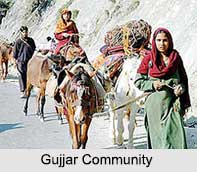 Gujjar Community, also known as the Gurjar community, are an ethnic group and caste of the Indian subcontinent. The Gujjars belong to the north-western part of India. Traditionally, the Gujjars belong to the Kshatriya Indian caste in Hinduism. However, they are mostly Muslims, a few being either Hindus or Sikhs. In India, Gujjars are categorized as "Other Backward Classes".
 History of Gujjar Community is quite uncertain and vague. There are several references that talk about the origin and history of Gujjars. For instance, in
 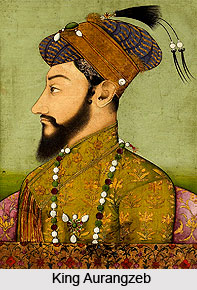 In the beginning of the 17th century, the decline of the Mughal emperor
 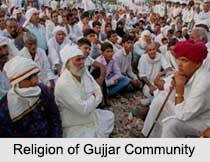 Religion of the Gujjar Communities has two endogamous religious sections and these are
 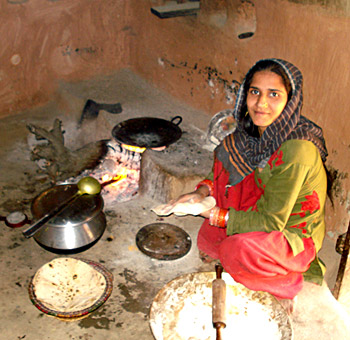 The Hindu Gurjars believe in the supremacy of the traditional joint family system. The head of the family is the eldest male member in the family whose decision in the family matters is final and is respected. However, nowadays, a change in the family structure is seen where they share the same roof, not the same kitchen. When the differences among members surface too frequently, the joint setup splits into nuclear types. The elders in the family are given due regard and respect. They are consulted and obeyed by the younger ones. The family property runs along the male line. However, a daughter can claim the property of the father in the absence of a son. Normally, if a father dies without making a will, the property is transferred to the collaterals.
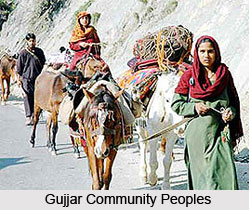 Gujjars are simple, thrifty and industrious and desire nothing better than to be left alone in peace with their cattle and fields. The Gujjars are cultivators only in the plains. In the hills they are mainly pastoral, selling milk and ghee. Cultural exuberance of this Gujjar community has nicely being depicted in several of its aspects like dancing, religious rites, customs and others.
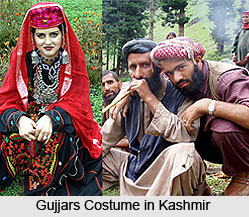 Early marriage of girls is fairly common among the Gujjars. Caste barriers and untouchability are declining gradually. A comparatively wealthy Gujjar family may own a camel, a horse, two oxen, two buffaloes and a few goats. Being pastoral, some Gujjars observe a regular `siapa` or mourning on the death of a buffalo. The women mourn almost as if they had lost a relative.
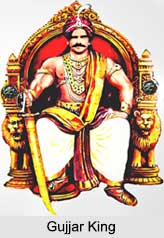
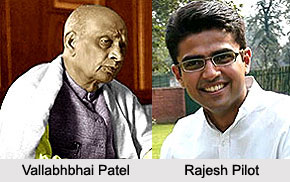 The Gujjars considers themselves as the protectors of the country and its faith. The Gujjar leaders in India are known for their bravery, courage and huge sacrifices. The Gujjars sacrifice themselves to perform their duty towards the country. Further, it is on records in history that not even a single Gujjar accepted the subordination and faith of the invaders to save their domain or land or estate.