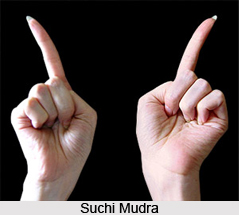
 Suchi mudra is vital for health to have daily and good elimination. Elimination is an important process in body-mind healing, not confined to the body alone, but the cleansing is also vital for the mind, soul and consciousness as well. Prolonged constipation, apart from the discomfort, leads to several other medical problems. Intestinal cleaning is essential in yoga. Castro and anorectic disorders are caused by stress, and if one doesn`t have good daily elimination, the stress increases and can result in more medical and emotional problems.
Steps of Suchi Mudra
•Clench both fists and hold them in front of chest.
•Inhale and stretch the right arm to the right and point the index finger upwards.
•Also, simultaneously, stretch the left arm to the left. Hold this for six breaths and return to the starting position.
•Repeat six times on both sides.
If the constipation is serious, do this mudra four times a day. For constipation that is not so severe, repeat six to twelve times in the morning and at noon. When travelling or in acute cases, one can practice every morning before rising for 5 to 10 minutes while comfortably lying in bed. This mudra often helps the first time one does it. If one practices it in the morning at 7, one can usually "unload" before 9.
Benefits of Suchi Mudra
•Suchi mudra is helpful for chronic constipation.
•This mudra tames uncontrolled behaviours such as impatience, temper tantrums, clinging to others, etc.
•It helps in keeping the body in perfect condition.
•It also helps an individual to reject the thoughts of negative nature which will help in mood elevation.
Use of Suchi Mudra in Dance
Suchi mudra is also used in dance and theatre to create context and express emotional states or specific actions. This mudra is the thirteenth hand gestures of the 28 single-hand mudras (Asamyutta Hastas) as described in the Abhinaya Darpana. It is noted in the Natya Shastra as well. According to mythology, it originates from Brahma, when he declared "I`m unique". Its sage is Sun, its race Deva, its colour white and its patron deity is Visvakarma.