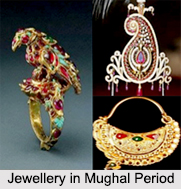
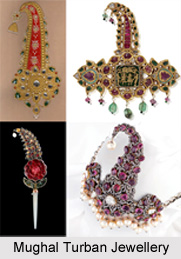
 Turban Jewel is an enamelled gold set with diamonds, rubies, emeralds, a sapphire, and a pendent pearl and was found in Bengal (Murshidabad District now called) and these jewels were presented to Admiral Charles Watson by the Nawab of Bengal on 26th July 1757, following the Battle of Plassey.
The jewels are typical of the Murshidabad court fashion at the time. A painting of Aliverdi Khan of century 1750-55 shows the Nawab with his young grandson Siraj-ud-Daula; both wear turban jewels of exactly the same form.
Sarpech also known as an aigrette is an early and medieval India turban ornament that was worn by significant Hindu and Muslim princes. "Sar" means head or front and "pech" means screw. Hence, the word Sarpech literally means that which is screwed onto the front (of the turban). It was also worn in Persia where it was known as jikka or jiqa which means crest or tuft and in Turkey it was known as Sorguch which is considered a corrupt form of the Persian word sarpush. In India, dominantly two kinds of turban ornaments exist: Sarpech and Kalgi (ornament).
The ornament is a gold set with rubies, diamonds, emeralds and pale beryls enamelled in translucent green on the stem. This was found in Rajasthan in the early 18th century. This turban jewellery is an incomplete turban jewel and it is an enamelled gold backed with lac. The jewelled front of this has been removed, exposing the lac layer. This was said to have been one of the products of Jaipur itself. This turban ornament is made from enamelled gold, this jewel demonstrates the technique of basse taille where the gold is chased with a design, which can be seen through the translucent enamel. The technique is found with reasonable frequency in Mughal jewellery. This turban jewellery is an enamelled gold set with rubies possibly found in early 18th century. This was also part of the Jaipur treasury and was said on acquisition to date from the first half of the eighteenth century. It is notable for the excellence of its enamelling which does not show a trace of `flooding`. It has a holder for a long feathered plume at the back.
This form of art is made of enamelled gold and this is the last of the group from the Jaipur treasury. It is enamelled in colours, which are usually thought of as the typical Jaipur palette: a red, white, blue and green mixture with touches of opaque powder blue and yellow. It may originally have had pearls in the outer border of floral calyxes; however, these are extinct.