
Kolam tribes of Madhya Pradesh are also identified in different names like Kolamboli, Kulme and Kolmi. The main concentration of this tribe is on the plains and mountainous region. These tribal groups are reckoned as scheduled tribes and apart from Madhya Pradesh they reside in some parts of Maharashtra and Andhra Pradesh. The Kolam people are divided in different clans like Chal Deve, Pach Deve, Saha Deve, and Sat Deve. Marriages between the same clans are not permissible. The Kolams use the name of their clans as their surnames. Some of the clans of this tribal community are Bhurchi, Lakhu, Vadang, Aanzi, Konde, Shilekar, Kodape, Bode, Rampure etc.
The early history of this tribal group says that the Gond tribes regarded the Kolam tribes as their priests in the 12th century. Change came to them in the first decades of the twentieth century, when outsiders acting as agents of the wider money economy penetrated into tribal regions, and governments with their Societal structure of this Kolma tribal community too follows the norms and practices of any of the other tribal communities of the Indian subcontinent. Some of them also consider themselves as the descendants of Pandavas of Mahabharata.
Due to close affinity with the Gond tribes, the culture of the Kolam tribes resembles with them in the fields of rituals and ceremonies. The people of this community take up agriculture as their major occupation. Some of them are also engaged in forest works, hunting, making wooden articles etc.
Kolam tribal community uses the beautiful language of Kolami. This language belongs to the famous Dravidian language family. Quite a handful of these Kolam tribes even speak other languages like Marathi, Telugu or Gondi quite fluently. For writing, this Kolma tribal community uses the famous Devnagari script. These Kolam tribes have a preference of the homemade medicines. They adapt to cultivation and farming and sometimes shifting cultivation is also practiced. In the earlier times of 1940 and onwards, these Kolma shifting cultivators observe subsistence farming. Till date, this system is dominant amongst people of the distant areas.
Some of the members of this Kolam tribal community are also there who work as laborers in lieu of daily wages. Other occupations include animal husbandry, hunting and also food gathering. The Kolam food gatherers mainly produce various producers from the forest areas and also sell them in the markets. The villages of these Kolam tribes are known as `pod` which is well planed and a Chavdi is located at the centre of the `pod`. A village goddess is established in front of the Chavdi.
The Kolma society is exogamous. It mainly follows the patriarchal norms. Amongst these Kolma tribes, there has been an increasing trend to follow the nuclear family organization. Dowry system is prevalent, though there has been increasing trend to adapt to the practice of paying bride price amongst the Kolam tribes. Nowadays, since many of these Kolam tribes are maintaining contacts with the people of the modern day society, they also get involved in to services of other communities also. However, their interaction with them is still quite limited.
The Kolam people consume non vegetarian and vegetarian foods. Their staple food is jowar and sometimes rice and wheat are taken instead of jowar. Consumption of liquor is common among the people of this tribal group mainly during the time of festivals and occasions.
Although the Kolam tribes use to share very good relation with the other tribal communities, these Kolma tribes use to keep an individual burial land. Also in order to administer the society more efficiently, these Kolma tribes create a council comprising of all the chiefs of the village families in order to solve social and economic conflicts. The Kolam tribes chose a council comprising of members for a period of 5 years and this council carries on the responsibility for maintaining social order.
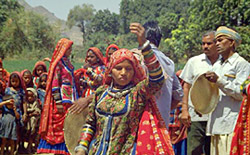
The male costumes of the Kolam tribes include shirt, dhoti, a cloth for shoulder which is known as `shela`, turban and cap. The youths of this group wear shirt, pant. The female of this tribal group bedeck themselves with Didki, Lugda, choli, saree and blouse. Ornaments are favoured by the women groups of this tribal community. Sakli sari, Sikke masrya, Bavatya, Mukkeram, Patlya, Jodve etc are some of the ornaments used by the women folks. Silver is mostly used as a metal for these ornaments. Men wear Kardoda or silver strap round the waist and kada round the wrist. Moreover the people of this tribal group are fond of tattooing in different parts of their body. Some also engrave the totems of their clans.
The Kolams are the believers of animism and they also believe in nature. They worship different objects of nature and their ancestors. A number of tribal and Hindu gods and goddesses are in the list of their religious deities. They are also followers of Hinduism and a number of religious festivals and occasions are celebrated by them. They revere goddess Renuka, Jaitur, Maroti, Bhairum, SanSurayak, Jelayak eyc.
The Kolam people celebrate different rituals that include Matya or Churaghali, Bai-Baki, Sati, Jaitur Pooja, Waghai Pooja, Chait, Mohdombari, Bhimayak, Korod, Morang Dev pooja etc. Their festivals include Kargul, Dussehra, Nag Panchami, Akharpakha, Atari, Pola, Fulzadni, Holi, Diwali, Aaichi, Pettadiyam, Metti-Diyam etc.
Kolam Tribe
Kolam tribes, also known as Kolamboli, Kulme and Kolmi, occupy a major portion of Madhya Pradesh.
Recently updated articles in Tribes of India
Arakh Tribe
Arakh Tribe is one of the ancient tribes located in several parts of central India. Their origin dates back to the Tughlaq era. Arakh tribe appears to...
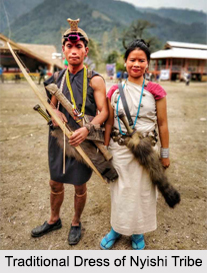
Traditional Dress of Nyishi Tribe
Traditional Dress of Nyishi Tribe is worn during festivals and social gathering. Men wear a cane helmet surmounted with the beak of the great Indian H...
Pasi Community
Pasi is an aboriginal race of India and are mainly distributed over the northern region of the country. The traditional occupation of Pasi is the extr...

Bhojas
Bhojas have been described as a very important tribe in the Aitareya Brahmana. Historical records have said that the Bhojas were settled towards the s...
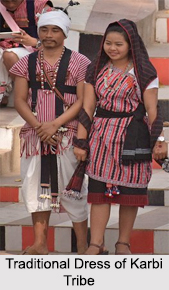
Traditional Dress of Karbi Tribe
Traditional Dress of Karbi Tribe can be easily recognized by the artistic designs inherited from their forefathers. Karbis have their own traditional...
Related articles in Tribes of India
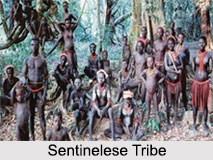
Sentinelese Tribe
Sentinelese tribal community is one of the most isolated and secluded tribes that are found in the whole world.
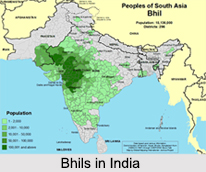
Bhil Tribe
The people of the Bhil tribe are the most widely distributed tribal groups in India.
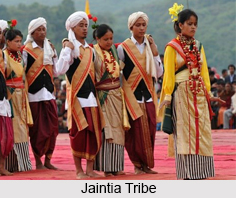
Jaintia Tribe
Jaintia Tribes are located in the Jaintia Hills of Meghalaya. They are also called the Pnars. They are famous for weaving of carpet, making of musical...
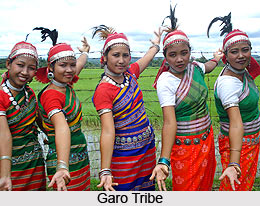
Garo Tribes
Garo Tribes are one of the matrilineal tribes of North-East India who reside in the Garo hills of Meghalaya. Historically, the tribe originated in Tib...
Garasia Tribe
The Garasia tribal community holds a significant position within Indian culture, renowned for their distinctive way of life and rich cultural heritage...