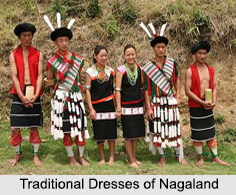
 Traditional Dresses of Nagaland are very attractive and colourful. Their traditional dresses are quite different to compare with other regional costumes in India. The decorative shawls of Nagaland are very popular tradition dresses among other traditional dresses. For instance, the ornate warrior-celebrating shawl, called "Tsungkotepsu" is a characteristic of the Aos clan. Apart from the shawl, the normal working dress is a kilt generally of black colour. It may be embroidered with cowries. People of Nagaland give very priority to their tradition and culture.
Traditional Dresses for Women of Nagaland
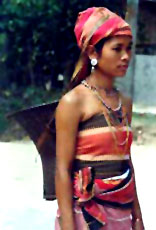
Women in general are clad in plain blue cloth and a white cloth with black marginal bands of changing breadth. The casual costume of a dress of Angami women includes a petticoat called "Neikhro", a sleeveless top called "Vatchi", a white skirt called "Pfemhou". The Ze-liangs-rong, a mixed group of Zemis, Liangmais and Rongmei exhibit themselves in costumes, considerably same with that of the Angami tribe. The commonest costume is a white cloth, contrasted with six black bands of varying measurements at both ends. The costume of the Zemei women is restricted to white-coloured clothes and skirts with very narrow black and red border.
 The costume of the Ao women is a skirt, which is one and a quarter meter long and about two thirds of the meter, is draped round the waist and the surface outer edge is implanted for the grip. The skirts come up in an inexplicable variety. They differ from village to village and also from clan to clan. The popular types of the Ao skirts involve "Azu jangnup su", endowed with red and yellow-black stripes, the "Ngami su" or fish tail skirt, and finally the "Yongzujangau" or cucumber seed skirt, woven in red on a black base. The women of the remaining groups go for diversity.
Traditional Dresses for Men of Nagaland
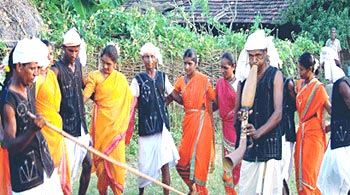
A daily costume, meant for wear and tear, is the black shawl called "Ratapfe". Men wear black kilt, decorated with embroidered cowries in three or four lines. The western Angami villages have their unique style of costume-design. Shawls of Lothas are graded by the number of gennas or festivals arranged by the wearer. Thus, a man who has given the first genna wears the "Phangrhup". With the performance of the second genna, the strip broadens accordingly. The third genna allows a man to put in the "Ethasu". With the fulfilment of the mission, the successful man resorts to stone-dragging which permits him to wear "Lungpensu". This latter one is a dark blue cloth with five stripes of light blue and with thin marginal stripes on either side. There is only one cloth in the wardrobe of the Angamis, which is indicative of social prestige. The "Phichu-pfe" is the priest"s costume.
Significance of Naga Shawls
"Tsungkotepsu" signifies affluence of the owner, and the depictions of elephant and tiger speaks of the courage of the concerned man, while the human head attests accomplishment in head-hunting and other tasks like wielding spear and dao.
The plethora of designs, motifs, patterns and vibrant shades make the world of Naga costumes a rainbow world.
Traditional Dresses of Nagaland
Traditional Dresses of Nagaland mainly comprise shawls which are an extensively used item of the state. It is the most significant item used by the Naga people. The traditional dresses of Nagaland are worn mostly during the festivals.