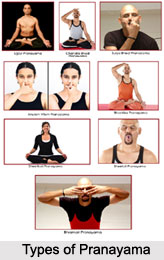
 Pranayama is the Yogic science of breathing. It is one such part of Yoga which helps one in mental and spiritual healing process. Oxygen is the most vital nutrient for the integrity of the brain, nerves, glands and internal organs.
Steps to Perform Pranayama
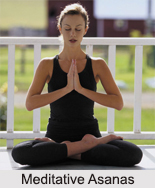
The Pranayama process involves a series of regulated breathing exercises that is used to purify the Pranic Nadis by controlling, regulating, and channelizing the Prana or the life force in the body. Pranayama techniques are best practiced while sitting on the floor on a folded blanket. It must be performed in empty stomach. Early morning is the best time to practice Pranayama, preferably before sunrise when the pollution is at its lowest level. One must dedicate at least 30-40 minutes to complete the entire pranayama series.
Major Types of Pranayama
Different types of Pranayama have different effects on the health. The correct choice of Pranayama depends on many factors such as body constitution, season, purpose and many more. Some major types of pranayama yoga are as follows:
Nadi Sodhana: Pranava mudra is made by bending the index and middle finger towards the palm and slowly inhaling through the left nostril and exhaling through the right nostril and vice versa.
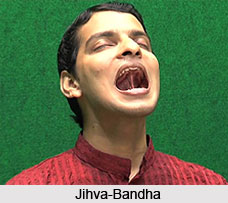
Shitali Pranayama: Shitali involves the inhalation of air through the tongue and then very slowly expelling the air using both the nostrils.
Shitkari Pranayama: In this yoga, one has to breath in air externally, both right and left nostrils will be used emphatically.
Ujjayi Pranayama: Ujjayi Pranayama is a diaphragmatic breathing technique- first filling the lower belly, activating the first and second "chakras", rising to the lower rib cage to activate the third and fourth "chakras" and finally up to the upper chest and throat.
Kapalabhati Pranayama: Kapalabhati is a breathing exercise where various breathing techniques are moulded to soothe the Yoga practitioners.
Chandranga Bhastrika: It is practised through left nostril, and it influences Ida nadi. It is relatively coolaning in nature. Hence it will not increase Pitta, but increases Vata and slightly Kapha.
Sooryanga Bhastrika: It is done through right nostril, and it influences Pingala nadi and increases Pitta more than Vata.
Bhramari Pranayama: It is more targeted towards mind and spirituality than the body. It balances all the three Doshas.
Surya Bhedana Pranayama: It generates heat. It increases Pitta Dosha and decreases Kapha Dosha.
Some other types of Pranayama are Bhastrika Pranayama, Bahya Pranayama, Udgit Pranayama, Anuloma and Viloma Pranayama, Agnisara Kriya, Vedhene Bandha etc.
Benefits of Pranayama
Practice of Pranayama has been reported to be beneficial in treating a range of stress related disorders, improving autonomic functions, relieving symptoms of asthma, stammering and also effective for depression cure. Pranayama helps to develop a steady mind and strong will-power. In addition, regular pranayama helps extend life and enhance perception. Hence, Pranayama is considered to be an overall treatment of body to survive and stay healthy.