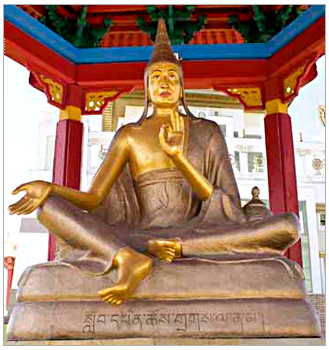
 Dharmakirti was a major Buddhist philosopher. He was born around seventh century. He was one of the founders of Indian philosophical logic. Dharmakirti was a South Indian Brahmin who became a teacher of the Nalanda University and was a poet as well. He agreed with Dignaga, that objective reality is a change of momentary unique particulars that are inexpressible and incommunicable. Each has its own fundamental effectiveness.
Dharmakirti asserts that the activity of conceptual construction is a process of thought that involves a representation which is capable of being expressed in words. Sense perception on its own has no practical application as it has no discrimination. Judgements using concepts lead to successful activity. It is a natural mistake to suppose that concepts are copies of reality.
Dharmakirti says that true cognition is the presupposition of all successful human activity. There is direct perception and inference. Perception is free from conceptualisation and is reliable. He rejects the view that thought and language go hand in hand and claims that thought is prior to language. Perception is divided into four types - sensory impressions; a mental image produced from these impressions; the self-awareness of every thought and feeling and finally yogic awareness which are produced by meditative insight into the truth. Perception is the unique momentary particulars. They are objectively real because reality means the capability for causal effectiveness. Sensory awareness leads to knowledge when it is truly related to the object. Image copies the impressions and the constructive mind. While some complicated concepts are ultimately derived from sensory impressions and others are produced by creative imagination.
Synthesis of Dharmakirti is the apex of Buddhist philosophy. Dharmakirti himself was a lay Buddhist and not a pious monk. Leaving Nalanda, he went back to his home in the south, where he founded a monastery.
Dharmakirti wrote a treatise on the nature of the mindstream in his `Substantiation of other mindstreams`. Dharmakirti described the mindstream as a temporal sequence, and there are no true beginnings or true endings. He claimed that every person is a transitory being. He influenced Mahayana Buddhism and South Asian philosophy as a whole. His theory is more than a self-contained phase in the evolution of Buddhist logic. He was one of the main scholars of the Yogachara School.