 The rules of `Squash` though similar to those of other racquet games, have enough unique features that evolved to accommodate the game`s features. They are set by the World Squash Federation.
The game of Squash is normally played by two (in the case of Singles) or four players (in the case of Doubles). The principal object of the game is to hit the ball in such a way that the opponent can`t reach it before it bounces twice. Usually the players hit the ball alternately. The general Rules of Squash are stated below:
General Rules:
Service:
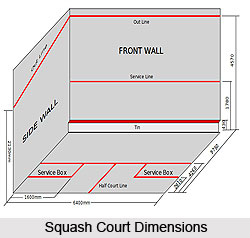
According to the rules set by the World Squash Federation, the right to serve first is usually decided by the spin of a racket or coin. For a proper service, the player must drop the ball onto the floor and then hit directly onto the front wall between the board/tin and the out of court line without bouncing it. If the opponent fails to volley the ball in return, the ball must fall to the floor within the back quarter of the court opposite the server`s box. The server can serve again if he does one false serves, but if it is two consecutive faults, he will loose the point and also his serve.
A serve will be called as false if the following instances occur:
(1) If the server fails to have at least one foot in contact with the floor within the service box at the time of serving. This is called as a `foot-fault`.
(2) If the ball touches the back wall before touching the floor. However, the Serve will not be considered as false if the ball touches one of the sidewalls before touching the floor.
(3) If the ball fails to land in the correct back quarter of the court after hitting the front wall.
(4) If the player does not drop the ball on the floor before serving.
(5) If the player serves the ball onto or below the board/tin.
(6) If the player serves the ball against any part of the court other than the front wall.
Return
After a good service has been delivered, both the players should try to return the ball alternately until one of them fails to make a good return. If the ball player can hit the ball against the front wall before it bounces twice, it will be considered as a good return. The player can hit the ball onto the front wall either directly or via the other walls.
Scoring
Only the server can score points. When the server wins a rally he scores a point and if the receiver wins a rally he or she becomes the server.
The players can score points by either player serving. If the server wins a point, he or she keeps the service and if he serves a fault or fails to make a good return, then the opponent will win the point and get the chance to become the server. A player can win a point in a number of ways,
including the following:
1) If the opponent player fails to return the ball before it bounces twice on the floor.
2) If the opponent hits the ball out of bounds.
3) If the ball touches the body of the opposing player or anything worn by the opposing player including the player`s racquet. But there is a condition and that is if the return seems to be good and the ball also seems to strike the front wall without first touching any other wall, the striker wins the rally, provided he did not "turn".
4) If the ball either had struck or seems to have struck any other wall and the return seems to be good, a let is played. However, if the return does not seem to be good, the striker loses the rally.
5) If the opposition player hits the ball twice. Such occurrence is called `Double Hits`.
Winning a Match: Squash matches usually consist of either three or five games. If any player wins two or three games respectively, he is announced as the winner. In the game, the player who becomes the first player to reach 15 points is the winner except when the scores are 14-all. In this position, the game is reset to `the best of five points` and the player who scores three points first, wins the match.
There are some regional variations in Squash rules, but the above mentioned guidelines are followed in almost all parts of the world.