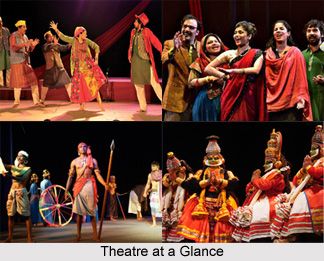
 Modern Indian theatre developed due to the change in the socio political set up in India. Theatre before the independence of India was primarily a weapon to protest against the "British Raj". However it is certainly not an overstatement to say that the two hundred years of British colonialism brought the Indian theatre into a direct contact with the western theatre. Curiously, the very kernel of the modish aspects of the contemporary theatre was sown at that period. The harmonious blend of eastern and western culture gave birth to a rather modern form of Indian theatre.
To entertain the British soldiers and the citizens for acclimatizing themselves to a foreign country like India, Indian theatre gradually became a replication of the western plots. Also, for the first time in India, the practice of writing and theatre was running full fledged. Realistic approach and naturalistic presentation marked the change in the thematic development of Indian theatre. Gone were the days of the lives of heroes, Gods, celestial beings and myths of the ancient India; on the contrary it is the common man, their daily chores, their fears and tears were ideally portrayed in the modern Indian theatre. That was just the beginning of the journey of modern Indian theatre. However, it was with the thriving development of the different "Brand Theatres" during the beginning of the 19th century the varied contemporary aspects, in the Indian theatre made its presence felt in quite a distinct way. Calcutta and Madras were the first two metropolises to introduce their theatre brands. Classically based on the London models these theatre brands are still reckoned as the pioneer of modern Indian drama and theatre.
Change was marked during this time not only in the socio political level and in the economic condition but also in the artistic and cultural aspects of India. Indian drama and theatre also went through a sea change, which not only altered the traditional aspects of "roopaka" and "natya" in Indian drama, but also at the same time added a whole fresh enunciation to the theatrical and narrative forms. The overdramatic aspects were rationalized. The themes also witnessed a change and for the first time the ardent fervor of the religious, historical and mythological aspects were not given that importance.
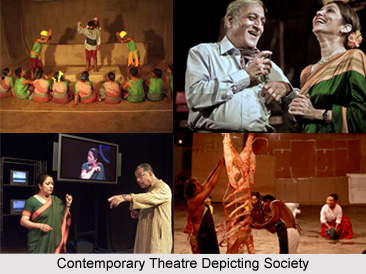 The modern Indian theatre started to grow more in the 1850s as the theatre enthusiasts started to perform their own play on different languages which were based on western style. It passed to Bombay and to many North as well as in South Indian states. These new form of the Indian theatre started to grow at the cost of extinction of other traditional form of theatre. This new hybrid form of Indian theatre turned to a ticketed theatre in the 1870s as it slipped from the hands of the riches. At the end of the 19th century, this modern form of Indian theatre became the source of earning of bread and butter to many. It moved to the hands of common public and turned into a commercial unit.
In the Post Independence era, many small and large units engaged in giving the theatre its due. Few of them are Safdar Hashmi`s `Janam` (1973-89) in Delhi, Badal Sircar`s `Satabdi` (Calcutta) and RP Prasanna`s `Samudaya` (Karnataka, 1975 to mid 1980s).
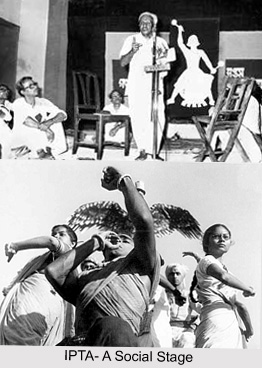
However, the modern Indian theatre got a turn at the 20th century and World War I. It became a commodity for sale and confined into the auditorium. As the freedom movement gained momentum, the creative side of the theatre got dimmed. In 1922, the Communist Party of India was founded and with this enters the India People`s Theatre Association (IPTA), which served as its cultural wing. Many talented middle class people joined IPTA in Bengal and Bombay (now Mumbai) with a dream of a classical society. They brought the idea of portable theatre and these were based on various political agenda and were classified as anti-facist.
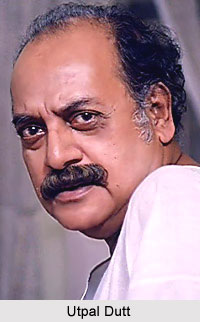
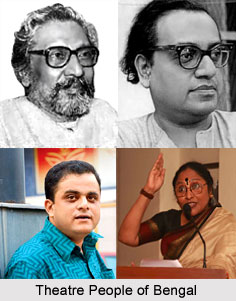
The formation of IPTA turned a new page in the history of Indian theatre and supported modern Indian theatre in taking a leap further. The formation of IPTA was a direct reaction of the Bengal feminine. Bijan Bhattacharya, one of the founder of IPTA in Calcutta wrote play `Nabanna`, which was based on the exploitation of the peasants. Subsequently, the songs and dances became a part of the modern Indian theatre and thus dancers like Shanti Vardhan, Narendra Sharma and even musician Ravi Shankar joined the IPTA central troupe. The modern Indian theatre then came with Marxist version of consciousness for example, the plays of Utpal Dutt
 In January 1953, `Sangeet Natak Akademi` was set up and it gave a cultural confidence and drama got a new footing in India. Later, Ebrahim Alkazi dictated the newly found National School of Drama and worked for the growth of modern Indian theatre. The theatre pattern was mixed in various styles and techniques from Sanskrit and western theatre and got a broader approach at every level of creativity. Few of the pioneers of modern Indian theatre were, Ranchhodbhal and Nanalla Kavi in Gujarat, Verasalingam, Guruzada Appa Rao and Ballary Raghavachari in Telugu, Santakavi Varadachari and Kailasam in Kannada, Laxminath Bezharua in Assamese, Kerala Varma Thampuran and C.V. Raman Pillai in Malayalam, Ramshankar Rai and Kalicharan Patnaik in Oriya and P. Sambandha Mudaliar in Tamil.
In the year 1972, the Vernacular theatre of contemporary India got a new rise. Vijay Tendulkar`s Marathi`s play `Ghashiram Kotwal` used traditional folk forms in modern theatre. The Hindi theatre got its stronghold in Calcutta in 1976 when Usha Ganguly and her husband Kamal Ganguly launched a theatre group named `Ranga Karmee`. The first Indian to earn International recognition in the theatre was Manjula Padmanabhan with her play, `Bitter Harvest`, which dealt with the exploitation of human body in the 21st century. Mahesh Dattani is another promising playwright, who has done one play named, `Do the needful` for the BBC among his 13 plays. He got the `Sahitya Akademi award` for his play, `Final Solutions`, which was based on the issue of communalism.
Although Bengali, Marathi and Tamil were initially the medium of expression yet in the late 20th century Gujrati, Kannada, Hindi, Oriya, Urdu and English drama added another wing to the recent scenario of Indian drama. Furthermore it is with the introduction of the street drama, modern Indian drama actually broke the barrier of stage, orchestra, pits and gallery while reaching the heart of the common people
Modern Indian theatre was thus not only the amalgamation of art, dance, music and dialogues but was a means of reaching people and addressing their issues and was of course the main element in changing the social and political ailments of independent India.