Devadasis , Female Servant of God - Informative & researched article on Devadasis , Female Servant of God
 Indianetzone: Largest Free Encyclopedia of India with thousand of articlesIndian Religion


in  
 Art & Culture|Entertainment|Health|Reference|Sports|Society|Travel
Forum  | Free E-magazine  | RSS Feeds  
Indian Religion : Vastu Shastra |Indian Religions |Indian Myths |Indian Mythology |Gods of India |Goddesses Of India |Religious Thinkers of India |Types of Religion in India |History of Indian Religion |Indian Yogis |Ajivikas |Sacred Scriptures in Indian Religion |Tantrism |Shaivism |Indian Communities |Sacred Animals in India |Roman Impact on South Indian Art and Society |Bhattacharyas |Indian Classical Terms
Home > Society > Indian Religion > Types of Religion in India > Hinduism > Devadasis
Devadasis , Female Servant of God
The ancient system of marrying young girls to Gods persists even today and is popularly known as the "Devadasi" system.
More on Devadasis , Female Servant of God
  Origin of Devadasi System   Initiation of Devadasis    

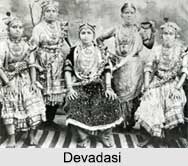
 DevadasiDevadasi is a Sanskrit term meaning female servant of God and a Hindu religious practice in which young girls were "married" to a deity. This system of offering of votive girls to the deities in Brahmanic temples is a system found in all parts of India but most prevalent in the south. In addition to taking care of the temple, they learnt and practiced Bharatnatyam and other classical Indian art tradition through which they expressed their devotion to the deity or Almighty. The office of Devadasi was hereditary but this does not mean they were allowed to work without adequate qualification. Devadasis have been referred in Kalidasa`s Meghadoot and also in the Puranas and therefore it is believed that this custom of dedicating girls to Gods started from the 6th century BC. The Devadasis were known by various names as Jogins ,Basavis ,Kalawants,Paravatis or Mathammas.It was customary for the elite to invite devadasis at marriages and family function .By the end of the 10th century the total number of Devadasis in the temples increased .During the medieval period their status was elevated and occupied a rank next only to the priests. The popularity of devadasis seemed to have reached its pinnacle around 10th and 11th century B.C. Devadasis, as a community, developed distinct customs, practices and traditions that were best suited to enable them to live as artists without suppressing their physical and emotional needs. This professional community was controlled by women and was matriarchal. Following the demise of the great Hindu kingdoms the practice degenerated.

Originally Devadasis were celibate all their life. Though they had a glorious past, later these girls were forced into a life of poverty, misery and in some cases were also further degraded. In modern India the tradition has become associated with commercial sexual exploitation as described in recent report of the National Human Rights Commission of the Government of India. However, the Government of Karnataka and Andhra Pradesh declared this practice of dedicating devadasis illegal in 1982 and 1988 respectively. It is widely prevalent even today as a profession, which has the sanction of religion and culture, seldom considering it as a violation of human rights. Efforts are being made to abolish the `evil` of devadasi system.

(Last Updated on : 27/01/2009)
 
 
Aghora Vaishnavism Nath Siddhas
Sarvam Khalvidam Brahma Aham Brahmasmi Ayam Atma Brahma
Ekam Evadvitiyam Brahma Tat Tvam Asi Prajnaman Brahman
Brahma Satyam Jagan Mithya Mahavakyas Mahavidya Goddesses
Theory Of Creation Hindu Gods Hindu Goddesses
Shraadh Yajna Havan
Gotra Aarti Agnihotra
Devadasis Ishvara In Hinduism Devi
Grihya Sutras Dvija Hiranyagarbha
Brahman Cremation Puja
Janmotsava Shradh Anteshti Kriya
Homa Hindu Vrata Days of the Week
Ahalya Kachwaha Jyotirlinga
Brahmin Castes in India Panchangam Ashta Dikpalas
Astomi Brahmaloka Sannyasi
Samakara Hindu Sacred Places Origin of Hinduism
Hindu Religious Texts Hindu religious leaders Marudeva
Sarvesvara Lokas Papa
Maharudra Swahaakaar Yagna Conch Shell Punarjanam
Aghori Heaven Parting with money after sunset
Shraavana Sashtanga Kshama
Agrasya Sanskaras Libation
Kerari Kusha Maharajas
Chandrayana Bhagat Jiva
Devarshis Months of Hindu Calendar Varna System in Ancient India
Purohitas Hindu Rituals Pancharatra
Gorakhnathis Citta Ramanandi Sampraday
Omkara Cult of Draupadi in South India Development of Hinduism
Shaktism Places of Worship Mantra
Hindu Iconography Teachings of Hinduism Kalpa Sutras
Saura Goddess Tara in Hinduism Vaikhanasa
Matangi System Basvi System  
Recently Updated Articles in Indian Religion
Lord Subrahmanya
Lord Subrahmanya Swamy is considered to be the universal lord who blesses human beings and helps them get rid of their sins.
Gods of India
Gods of India form an inseparable part of the life of the people. Indian Gods are considered to be mysterious superhuman beings who are worshipped in this country in various forms.
Folk Gods of Kumaon
Folk gods of Kumaon have a rich history and they provide expression to the famous and popular ideas of the people.
Seven Sisters
Seven Sisters are the most famous among Dravidian deities in Southern India. The seven sisters also have a younger brother Potu Eazu.
Savitr
Savitr is a solar deity and off-spring of Vedic deity Aditi. Savitr has been mentioned in eleven hymns of Rig Veda.
E-mail this Article | Post a Comment
Forum
Forum on Indian Religion
Free E-magazine
Subscribe to Free E-Magazine on Society
 
 
Devadasis , Female Servant of God - Informative & researched article on Devadasis , Female Servant of God
Sitemap
Contact Us   |   RSS Feeds
Copyright © 2008 Jupiter Infomedia Ltd. All rights reserved including the right to reproduce the contents in whole or in part in any form or medium without the express written permission of
Jupiter Infomedia Ltd.