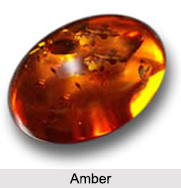
 Amber is a hard, translucent orange, yellow or brownish yellow fossil resin used for the purpose of crafting jewellery and other ornamental objects. It is heterogeneous in composition and is relatively soft and can be easily carved.
Amber is considered the birthstone of the astrological sign of Cancer. Although amber is believed to be a gem but it a wholly organic material, which derived from the resin of some extinct species of trees. These trees were in the dense forests of the Middle Cretaceous and Tertiary periods and when they fell, the rivers to coastal regions carried them away. As geological time passed on the forests were buried and the resin became covered with the sediment and hardened into a soft, warm and golden gem called Amber. Many components of amber are similar to that of the modern resins. The best-known amber in the world occurs at the coast of the Baltic Sea.
Origin of Amber
The history of amber can be traced back to ancient times when it was regarded as a highly valued material. The word "amber" was derived from the Middle Persian word "ambar". It was believed to have magical healing powers and was also used to make varnish. Powdered amber was valued as incense. Amber was traded to a wide extent all over the globe. Popular scholars can also determine the geographical extent of the amber by identifying the timber of amber used in ancient artefacts. 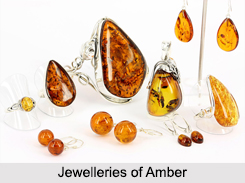
Appearance of Amber
Amber is a soft gemstone and can be easily scratched. The fossils of amber are three-dimensional with life like colours and patterns and even the internal cell structures are often intact. It is also a common name for the fossil resin and is accepted and appreciated by all alike for its intrinsic and fascinating mixture of shades.
Colour of Amber
Amber occurs in a range of different colours, but it is mostly yellow, orange or brown. Golden-yellow amber is usually hard. Amber can also be whitish to pale lemon-yellow and brown to nearly black. There is also rare blue, green and red coloured amber.
Varieties of Amber
The types of amber available are Blue amber; Baltic amber, Dominican amber, Delatynite, Cretaceous amber. The last type is also believed to be more than 65 million years old and is very brittle.
Benefits of Amber
Since long, Amber has been carved and worked into beads, jewellery and other distinct types of ornaments. It is also used for medicinal purposes and is said to be rubbed on sore eyes and sprained limbs or worn for chest ailments. Capable of being highly polished, it is the oldest decorative substance known all over. Amber is also used for the manufacture of beads, mouthpieces, amulets, cigarette and cigar holders, pipes and other small ornamental objects.