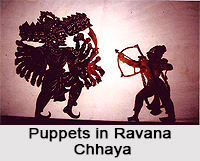
 Puppets in Ravana Chhaya are of many different types and uses. Strictly according to the tradition the Ravana Chhaya shadow puppets are made only of deerskin. The process of making the puppets is an indigenous one. First, the skin is dried and tanned. The hair is then removed and the outline of the puppet figure is cut out. Ravana Chhaya puppets have no joints. Therefore, the conception and delineation of the puppet figures are highly stylised. The cut-outs are perforated very simply yet imaginatively to give a characteristically posed outline of the characters, and also to delineate the fashioning of the clothes and accessories etc. The figures are held erect by the grip of a split bamboo stick which runs through the middle line and down a few extra inches to give handling space.
The puppets used in the performance of the Ravana Chhaya are of different sizes. The largest is about 18 inches while the smallest is about 6 inches. More than 700 puppet figures are required for the complete Ravana Chhaya show. The show was performed for seven nights, and each night only one kanda of the Ramayana was presented. Each of the major characters of the Ramayana is represented by one puppet figure. In a few cases there are two figures for one character. For example, there are two figures, one small, the other larger, for Hanuman. According to the demand of the dramatic situation either the larger or the smaller one is pressed into service. In the episode of Lord Rama asking Lord Hanuman to go to Lanka in search of Sita, in the beginning the smaller figure is used, but it is substituted by the bigger one suggesting expansion of his body when Hanuman actually takes the leap across the sea to land on Lanka.
Almost all the plays employ certain stock characters such as the village barber and his grandson who appear on the screen at the commencement of the play. There are also a number of figures for many props, such as, trees, mountains, chariots, arrows, missiles like naga-pasha, houses, palanquin etc. for creating an appropriate setting.
It may be noted here that there are a number of interesting conventions and traditions which are followed as regards the puppets. These rituals are followed when a puppet figure is first commissioned to the performance and also when being torn a figure is required to be rejected. After a puppet figure is complete a sort of `puja` is performed to breathe `life` into it. Thereafter it acquires the status to remain in the basket where other `live` puppets are kept. The basket usually is kept in the bedroom of the puppeteer when there is no performance. When a puppet figure dies of ageing or it accidentally gets torn in such a way that it no longer remains worthy of being used, a kind of funeral rite is observed. Preferably at the time of sun-set the unusable puppet figure is taken to a river all the way with chanting of mantras and respectfully immersed in the flowing waters of the river.