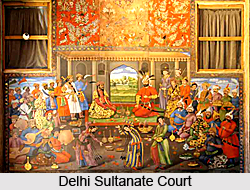
 During the reign of the Delhi Sultanate, the society was divided into different sections. After the advent of the Muslims, the society constituted of the foreign Muslims, the Indian Muslims and the Hindus. Among them, foreign Muslims constituted the ruling class. The next section was that of the Indian Muslims who were either converted to Islam or were the descendants of the converted Muslims. The Hindus also formed the part of the society at that period and were divided among themselves on the basis of castes.
The foreign Muslims enjoyed the most respected and the privileged section of the society. All high offices of the state were kept reserved for them. They yielded great influence in society and administration. But the foreign Muslims were not united. They belonged to different nationalities such as the Persians, the Afghans, the Arabs, the Turks, and the Abyssianians etc. The Turks claimed and maintained their superiority over all others up to the thirteenth century. Their position broke after the Khiljis captured the power of the state. The foreign Muslims looked down upon the Indian Muslims because most of them were converted to Islam from among low-caste Hindus. The foreign Muslims regarded them neither of blue blood nor conquerors of this country. Therefore Indian Muslims were not given equal status with foreign Muslims either in society or in administration. During the total period of the Sultanate only few Indian Muslims enjoyed high offices of the state.
The caste-system of the Hindus affected the Muslims, especially the Indian Muslims. They continued to maintain divisions among themselves on the basis of their previous castes. Thus, both the foreign and Indian Muslims were divided among themselves on the basis of their different nationalities and birth. The Muslims were also divided on the basis religious sect, education and professions. Sunnis and the Shiahs differed from each other on the basis of sects while soldiers and scholars were divided among each other on the basis of their professions. There was another class, the Ulema who constituted the religious community among the Muslims and claimed pre-eminence over all others.
The slave system was prevalent among the Muslims and the Hindus and slaves were sold am purchased in open market. The slaves were treated well though their property and lives were the property of their masters. The slaves of the Muslims were better off as compared to the slaves of the Hindus. The Sultans and nobles kept slaves in huge numbers, provided education and gave them training and opportunity to rise in their lives so that many of them rose to the position of prominence in the state.
The women in the Hindu society enjoyed respect in the family and participated in the religious ceremonies.
 They received education and many of them had acquired scholarly fame. Yet, in general their status had deteriorated in the society and they suffered from many social evils. There was no widow remarriage and the widows either became sati at the pyre of their husbands or passed their lives as women-hermits. The Purdah system and child marriages adversely affected the education and position of women in the society. Devadasi system was another social evil which was prevalent among the Hindus. Muslim women did not enjoy a respectable status in the society. Polygamy was extensively prevalent among the Muslims. Every Muslim had a right to keep at least four wives while the rich among them kept hundreds or thousands as wives or slaves. Purdah system was strictly observed among Muslim women. They were devoid of education because of this social custom.
Generally the Hindus were vegetarians and the Muslims were non vegetarians. Among the Muslims, the Sufis, or the people who were under their influence avoided eating meat. Both the Hindus and the Muslims built good houses for themselves where all comforts of life were procured. There was a marked progress in the use of clothing and ornaments. All sorts of clothes made of silk, cotton and wool were used by the people and there was improvement in them. Both the Hindus and the Muslims liked to use ornaments. All types of ornaments from head to toe were used by both males and females and were made not only of gold and silver but of pearls, diamonds and precious stones. The people engaged themselves in all sorts of entertainments. Different sports such as hunting, duels among men, fighting among animals, horse-polo etc. were their usual entertainments. Fairs and religious festivals were also common among both Hindus and the Muslims.
The Hindus and the Muslims influenced each other in many fields. Historians have differed regarding the relations between the Hindus and Muslims during the period of the Sultanate. The Muslim rulers over their Hindu subjects according to Islamic-laws, and in no way tried to shape their administration and judicial system on a secular basis. Therefore, the Hindus could not expect to get justice or equality from their Muslim masters. Besides, except Ala-ud-din Khilji, all Sultans accepted the influence of the Ulema in matters of the state. It is acceptable that the common people wished to live a peaceful life and they had no religious or political ambition. The religious preachers and saints of the Bhakti movement during this period and the saints who believed and preached religious tolerance belonged mostly to the class of the common people. The policy of religious intolerance of Sultans and the privileged position of the ruling class and the Ulema did not allow a happy synthesis between the culture and values of the Hindus and the Muslims and did not permit cordial relation between the two.
Thus the culture, religion and the people had great impact in shaping the society of the Delhi Sultanate.