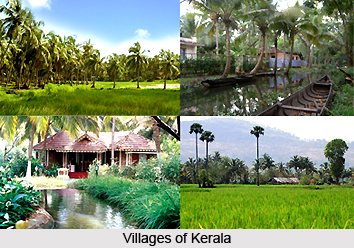
Villages of Kerala bear little resemblance to the tight, squalid settlements of northern India, which huddle along a single street or in a knot of houses for mutual protection. Because of its geographical isolation, Kerala has rarely experienced invasions like those that have been a recurring feature of life in north India; even Tipu Sultan was halted on the borders of Travancore. Malayalis, among whom dacoits or bandits are unknown, fear neither strangers nor neighbours, and feel no need to cling together in close communities. Their villages are the most open in the world, with the possible exception of Malayan kampongs; the dwellings are scattered wherever there are trees to give them shade, and with so little sense of the need to concentrate around a focal point that the stranger is at a loss to know where one community ends and the next begins in the broad ribbon of settlement that runs, broken only by a few stretches of stony wasteland, almost all the three hundred miles from Cannanore to Trivandrum.
In spite of their unorganized appearance, the Malayali villages have quite elaborate social structures.
 Each will have at least one school and a public library; it will have a public health service, trade union branches and political party groups, places of worship (often a church, a temple and a mosque) and always a few teashops which serve as gathering-places for the various communities. Many Malayali intellectuals and officials return to their native villages in middle age and take an active part in local activities, so that there is even a cultural sophistication about rural life in Kerala; in many respects it is almost urban. But the various institutions which represent the corporate life of the villages are usually so scattered that only the small knot of stores and teashops, with a trampled field as a market place for fish merchants and potters, serves as the centre around which the settlement unobtrusively clusters.
Thus the appearance of the countryside is shaped by the taste of the people. Every Malayali likes to live apart, even if, as most villagers do, he lives on the land of someone else and cannot even pick the coconuts from the trees that give him shade. His tiny hut may be overcrowded, and he may be, but he has fresh air and sun, room to grow a yellow-flowered cucumber vine and a couple of banana trees, and the minimal privacy that his-sense of dignity demands. Because they cling to this kind of village existence, many country people in Kerala become habitual commuters, and sometimes they travel even twenty miles or more to a job in an office in the towns.
So well concealed in the subaqueous shade of the palm trees are the huts of most Malayali villages that it is very much difficult to believe the statistics which show that in such coastal areas the rural population is not very much lesser than the urban population. At the evening, as the villagers return from work, they entirely fill the country streets and roads at the hour the office closes. Most of the Malayalis are still villagers, and even those who live in the towns like to feel that they have kept an acre or two among their native coconut groves to which they can return some day.