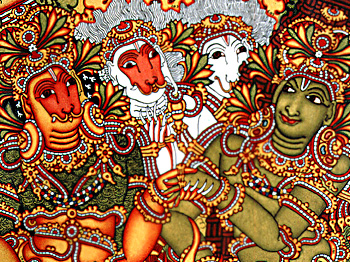
 Kerala Murals closely reflect the Dravidian and the Pallava style of art. Rather it can be said that Mural Paintings of Kerala resemble the kalamezhuthu Dravidian style. In the present age only sketchy outlines of the Kerala Murals exist in the temples, the palaces and the churches. But initially during the ninth and tenth century the Murals had flourished hugely in the state of Kerala.
Archaeological evidences point to the fact that the most prolific period of Kerala Murals were during the mid-sixteenth century. It can be said that the Mural Paintings of Kerala were an intelligent combination of both aesthetic as well as technical features.
The subject matter of Kerala Murals was mostly religion. Various aspects from Hindu as well as Christian religion profusely decorated the temples, the palaces and the churches of Kerala. The representation of Hindu gods and Goddesses did not just spring from imagination of the artist but on the other hand they were produced from the descriptions which were found in the invocatory Dhyana slokas which were dedicated to the gods and goddesses. Nature had also been given due importance in the Kerala Murals as they were represented by flora and fauna in the backdrop. The representation of flora and fauna were in highly stylized forms.
In fact it can be said that the Mural Paintings of Kerala are an important cue to understand the art and culture of the state of Kerala. The Kerala Murals were open to all the styles with which it had come in contact but at the same time till date it has retained its individuality and an aesthetic style. At the same time it can be said that no other Murals in the country can match the linear accuracy of the Kerala Murals.
Padmanabhapuram Murals in Kerala reflect the native architecture as well as the artistic styles of the state. But even the native styles of art are resplendent with the images of gods and goddesses from the Hindu pantheon.
Christian Murals occupy an important place in the Mural Paintings of Kerala. A very common feature of Church Murals is paintings in oil on the wooden altars. Murals also decorate the walls around the altar and also the roofs above the altars were not deprived from the glory of Mural Paintings. The themes of Church Murals in Kerala are generally from the Christian mythology as well as from the Holy Bible. Some of the churches in Kerala also represent some gruesome details which bring out the horror and the mercilessness of the war. Thus it can be said that some of murals in Kerala churches serve as a cue to solve many of the historical questions.
The use of colour plays an important role in the Mural Paintings of Kerala. For instance in churches ochre have been used to represent the robe of Christ but on the other hand in Hinduism the colour yellow is related to mysticism and spirituality.
If a comparison is made between the Temple Murals and the Murals of the Church it can be said that temple muralists were keener on representing the highly imaginative and idealistic idea of person and things. On the other hands the Mural painters of the churches had an expertise to represent realistic features of human anatomy.
A drawback of Kerala Murlas is that it has stayed confined within the stipulations of iconography and the tone of almost all the murals in Kerala are heavily religious.