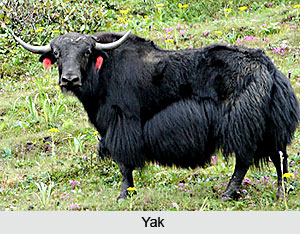
 Yak is probably a vanishing species, though it occurs in regions so remote and politically inaccessible that no reliable surveys have been carried out in recent times. In the subcontinent, they only survive in small numbers in the Changchenmo valley in northern Ladakh but their total range extends across Tibet into Kansu province of China. The wild Yak (Bos grunniens) is blackish brown all over, with perhaps a little white around the muzzle. An adult bull stands one hundred and seventy centimetres at the shoulder and many weigh up to five hundred and forty five kilograms. As in all the wild oxen, both sexes bear horns and those of the bull yak are smooth cylinders sweeping up like handlebars and measuring up to seventy five centimetres in length. Their appearance is made more massive by the fact that their chest, shoulders and flanks are fringed by long hair hanging almost to the ground. Their tails are likewise covered in a thick and busty tuft and this appendage is often used as a fly-whisk and badge of state by high dignitaries in the lamaseries.
Yaks have been domesticated since time immemorial and are widely used as pack animals in the northernmost reaches, from Chitral in the west through Ladakh, to Nepal and Sikkim in the east. There are solely hybrid forms with domestic cattle locally called zho. Domestic yak are almost indistinguishable from wild yak except that they frequently are picbald and even dun-coloured, with less massive horns, whilst the zho are considerably smaller.
Amongst all the bovines this animal is perhaps best adapted not only to extreme cold but also to desert conditions. Yak can subsist on the scattered clumps of Astragalus and other thorny cushion plants and eat snow when water is unavailable. Unlike the domesticated oxen and buffaloes of the plains their faeces are voided in small rounded pellets with a very high dry content, resembling closely those of a camel.
The voice of Yak is a deep grunt from which its scientific name is derived. Domesticated yaks are normally found at altitudes from four thousand two hundred and seventy up to six thousand one hundred metres and wild yak have seldom been observed below five thousand metres. They are gregarious, living in small herds, and in the wild are shy and wary beasts relying on an acutely developed sense of smell rather than keen eyesight to detect danger. The rutting season is late autumn, with calves being produced in the month of April after a nine month gestation period. Domesticated yak have a habit of grinding their teeth audibly, a trait probably connected with the fact that they generally infested with intestinal tapeworms.