Rabari or Raika tribe which is also known as Rewari tribe resides predominantly in Gujarat, Punjab, Haryana, Madhya Pradesh and Rajasthan in India. They are also known as Desai, Dewasi and Hirvanshi. Traditionally the Rabaris have been the camel-breeders of Rajasthan. The origin of the Rabaris or Raika tribes is steeped in mythology. It narrates the tale of Mahadeva, an incarnation of Shiva, who created the first camel for the amusement of his consort, Parvati. Subsequently, he created the first Rabari to take care of the animal. This is how this community of Rajasthan came into being. However, a more credible explanation may stem from the immense knowledge of the desert that the Rabaris possess. The name could be a variation of `rehhan` or a person who shows the path. The community is nomadic and moves from place to place in search of pastures for their camels, sheep and goats.
As per the story of the origin of Rabari or Raika tribe is that the men of this community used to marry celestial `apsaras`, the daughters of the gods and due to this reason they were called "the goers out of the path" or Rabari. This community is said to be the sub-castes of Rajputs because they are ramified in many clans like Rathod, Solanki, Bhati, Parmar etc. with Rajputs. These clans are called `Nakh` in Rabaris and are further sub-divided in `Shakhs` (Branches) that are one hundred and thirty three in number. The Rabaris are said to be the founder of Indus civilization and the part of Huns.
The word "Rabari" stands for outsiders and they earned this particular name because of their occupation. The main business of this community was to raise cattle, camels and goats. For pasturing their cattle, the people of this community instead of living in towns, started living on the outskirts of towns and beyond. As per another common myth the Rabaris are the descendant of lord Shiva. Keeping pace with the modern world, a huge percentage of the Rabaris have settled down in their original communities, and some are engaged in commerce and agriculture and many other occupations because of the development of education in their community.
Rabari are the worshippers of Mata Devi and they worship her in all her natural elements, the most popular being the peacock feather and the conch shell. The Rabari in Saurashtra region in Gujarat are the followers of Momai Mataji. Punj, a community function, is celebrated every year on Navratri festival.
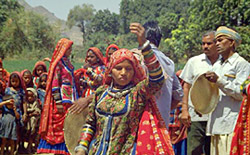
The Rabari women are distinct in their appearance and their long, black headscarves that make them different from others. The women wear ornaments of distinct style though they are different from the nomadic people. Their dresses and jewelleries reflect their modest life style in comparison to other tribal women. The Rabaris continue to wear their traditional garments. Being a nomadic community every effort is made to maintain their community identity. Hence, the changes in costume over the past several decades seen in other groups have been slow or almost absent here.
The attire of an unmarried girl consists of a `puthia`, a `pothdi` or `ghaghra` and, sometimes an `odhna`. The `puthia` can be made with several kinds of fabric like white `pichodi`, plain coloured poplin and block-printed fabric with small to medium floral prints. The `puthia` is generally in red, pink, blue or green. `Mashru` or `mem`, a blend of silk and cotton, is also used in making garments. Mashru is distinctive in its design as it has stripes in red, yellow and brown. The length `puthia` decorated with gota is used. The nature of their occupation dictates that the men s clothing is both minimal and functional.
The dhoti of the Rabari man is draped to mid-calf length. The dhoti fabric is `reza` and it is worn in the `tevata` style. In winter, a blanket is draped for warmth. Headgear is a yellow or white turban. On festive occasions, they wear red turbans embellished with `gota` work. Headgear is in the `gol safa` style. It is the older men who usually wear the white turbans. The more popular colour for the turban is the traditional red. The men wear the `murki` in their ears and also the `jhela`. The women of this community wear small gold nose ring and silver and gold chains around the neck with protective amulets. They also wear simple glass bracelets to bedeck their arms.
Rabari Tribe
Rabari or Raika tribes of Rajasthan are the sub-castes of Rajputs and carry a distinct socio cultural setting .