Introduction
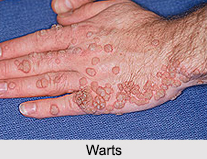 Warts are small lumps on the skin that normally does not cause pain. Wart is also known as `Verruca`. It is a small, rough tumour that occurs typically on hands and feet but often on other locations too. Though, this skin disease is harmless in the beginning, yet if not treated upon, can spread very quickly. Warts are a common disorder in childhood, just after infancy and upsurge of small benign tumours of the skin in various shapes and sizes are seen. Common warts occur most frequently on the hands. They may be either scattered or grouped and some can be either like thread or flat in shape. Eventually these warts dissolve on their own.
Causes of Warts
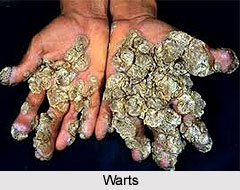 Warts are skin disorder that has been a factor of great concern over the ages. This skin disease is a contagious ailment and people are affected from one another. Causes of Warts thus are identified as the results of a DNA-containing human papilloma virus or HPV. There are at least sixty three genetically different types of HPVs. The virus enters the skin after being in direct contact with recently shed viruses which remains alive in warm, moist environment. Furthermore, viruses enter in a human body through an area of recent injury. The incubation time from when the virus is contracted until a wart appears, can range from one to eight months.
Causes of Warts are virus as the virus which attacks the skin cells causes them to grow at a faster rate than they should. Therefore, it creates a benign tumor which is commonly called a wart. Several types of HPVs have been detected that infect skin or mucous membranes. HPVs cause common warts by affecting the skin lids. In addition to that certain "high risk" types of HPV are identified that infect the mucosal tissue that lines the genital area. These are responsible for the carcinogenic or cancer-causing effects. However, there are "low risk" HPV types also that lead to the development of benign lesions in the genital area and resulting genital warts. Other HPV types infect skin and cause warts in various locations on the body. Moreover, other HPV types cause very small growths, or papillomas, on the vocal cords.
Virus that is responsible for the causes of Warts are categorrised as types 1, 2, and 3. Type 1 is associated with deep plantar sole of the feet and palmar warts palm of the hand). Type 2 causes are known to be the result for the common warts, filiform warts, plantar warts, mosaic plantar warts. Type 3 causes plane warts, or commonly known as flat warts. Anogenital warts are caused by various other types others. Furthermore, HPV is associated with oral cancer, laryngeal cancers, tracheal and lung cancers.
Warts can be avoided by wearing something on the feet at the pool or gym. In addition to that, avoiding sharing of the personal items with other people such as razors and towels can also prevent the upsurge of the disease. Though wart is a common skin disease yet it is seen that only younger children are affected by the virus. Younger people under the age of 30 and people with reduced immune function are prone to warts. Furthermore, not everyone exposed to the human papillomavirus will get warts because most people have antibodies in their system that prevents the ailment.
Symptoms of Warts
Warts present certain symptoms which include rough elevation in the skin that occurs more frequently on the fingers, elbows, knees, face and scalp. They usually appear as small raised painless lesion with a rough-dry surface. Where there is pressure such as on the soles of the feet, they may be hardly raised, but tend to be painful. They flourish in the moist areas of the body.
Types of Warts
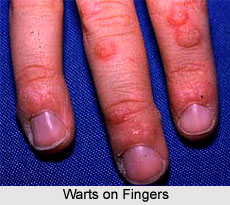 The common but infectious skin disease warts are caused by a group of viruses that appears anywhere in the skin. Warts are quite painful disease which is of special concern because it is highly contagious. There are about sixty different types of warts. The most common types of warts appear on the hands, fingers and arms. The warts are generally characterized by burning, itching and oozing and needs proper treatment. Thus, the Warts are benign thickenings in the skin or mucous membranes which are the result of human papilloma virus. Warts are available as Common wart (Verruca vulgaris), Flat wart (Verruca plana), Filiform or digitate wart, plantar wart (verruca, Verruca pedis), Mosaic wart and Genital wart (venereal wart).
The different types of wart has varying shape and site. Warts are also known as verrucae or condylomata. Warts occur when the individual`s immune system is affected. Thus, the situations that reduce immunity make it easier for the warts to spread and become more susceptible. Certain warts are curable with proper treatment, but some warts do not resolve without treatment. Warts can affect individuals of any age and in any location. Furthermore, they are particularly common in children and teenagers.
Among the types of warts, common wart (Verruca vulgaris) is raised wart with roughened surface. These are most common on hands and knees. Common wart is thickened bumps called papules or plaques. These warts have small tiny spots which occur from blood vessels that have clotted. These warts are dome-shaped and are usually grayish-brown. Flat wart or (Verruca plana) are small smooth flattened wart, flesh coloured, which can occur in large numbers. These are the kinds of warts which are common on the face, neck, hands, wrists and knees. Flat warts are about the size of a pinhead and have flat tops. They may be pink, light brown, or yellow is appearance. They are commonly seen on the face of women and spread easily by shaving.
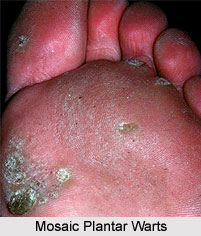
The typical types of warts include Filiform or digitate wart. It is a thread- or finger-like wart. They occur commonly on the face, especially near the eyelids and lips. These warts resemble miniscule finger. Plantar wart (verruca, Verruca pedis) is a hard type which appears to be quite painful lump. It is often concerned with multiple black specks in the center. They are usually only found on pressure points on the soles of the feet. They vary in size is covered with a callus. These warts reveal very small black, brown or red spots inside blood vessels. The human papilloma virus (HPV) that causes wart, are found inside the body. Thus once removed, this wart does not necessarily cure the disease. Planter warts are contagious in nature and can be contracted by simply walking barefoot in public places. Mosaic wart is yet another type of warts. These are a group of tightly clustered plantar-type warts, commonly on the hands or soles of the feet.
 Genital Warts or venereal wart, Condyloma acuminatum, Verruca acuminata are another contagious type of warts which appear in the genital peri-anal skin. These warts come in a variety of appearances. They look like common warts or appear in skin colour or small papules. They vary in size from tiny papules to much larger typically warty growths. They are also found to be pigmented. The genital warts are associated with carcinoma of the cervix, Bowenoid papulosis and Bowen`s disease.
The warts appear in specific location are transmitted by skin to skin contact. The transmission of warts depends in part on the immunity and susceptibility of the individual involved. Certain warts only affect adults where certain types of warts affect children must be treated as soon as possible.
Diagnosis of Warts
Diagnosis of warts begins with the identification of the specific type. A variety of wart treatment exists. In addition to that various vaccines are intended to prevent some strains of HPV. However, HPV once been contracted cannot be cured.
Treatments of Warts
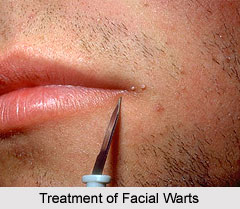 The skin disorder wart is quite a disease of concern as it is contagious and spreads from one person to another. Due to the viral nature of warts, treatments of warts are necessary to cure the disease. However, the process of strengthening the immune system is recommended to prevent the disease. A weakened immune system is a breeding ground for viruses. Treating the warts depend on the basis of the various types of warts. A biopsy conducted can confirm the diagnosis. There are specific tests to type the human papilloma virus although these are not done routinely.
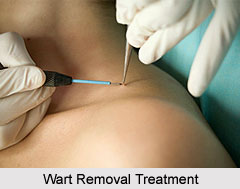
Treatments of warts depend on the particular type, condition and location of the disease. The treatment also is offered according to the age of the patient, as well as the size and immune status of the individual. Either destructive use of liquid nitrogen or an immunological approach to boost the patient`s own immune system is provided as remedial measures for warts. Other treatment through conventional method include removal of the dead surface skin cells, cryosurgery, surgery as well as laser treatment are offered. Thus the medicine recommended for common wart is liquid nitrogen cryotherapy. Flat warts frequently occur on the face and on the legs. These needs care and proper use a treatment. Very light liquid nitrogen cryotherapy can be used. Aggressive use of liquid nitrogen cryotherapy is used for plantar warts. Podophyllin or podophyllotoxin can be applied every few days for the genital warts.
Naturopathy is the way of providing proper treatment of Warts. The best method of curing the disease through nature care includes a change in dietary. Balanced and nutritious diet suggested by naturopathy can be helpful to subside the wart, as soon as it appears. To begin with, the patient should be kept on an all-fruit diet for about two or three days. During this period, he should take three meals a day of fresh juicy fruits such as grapes, orange, apple, pineapple, mango, pear and papaya. The warm-water enema should be taken to cleanse the bowels during this period and afterwards, if necessary.
After this diet, the patient may gradually embark upon a well-balanced diet of natural foods consisting of seeds, nuts, grains, fruits and vegetables. The emphasis should be on fresh fruits and raw vegetable salad. Further short periods on all-fruit diet at monthly intervals may be necessary until the skin condition improves. However, the patient should avoid tea, coffee, flesh foods, white flour sugar and all products made from them. He should also avoid refined foods, tinned and frozen foods, as well as spices, condiments and pickles.
 Certain home remedies are also beneficial in the treatment of warts. The most important of these is the use of castor oil. This oil should be applied generously over the affected parts every night. The treatment should be continued for several months. Milky juice of the figs is another valuable remedy. This juice should be extracted from the fresh, barely ripe fruits and applied on warts several times a day and should be continued for two weeks. Raw potatoes have been found beneficial in the treatment of warts. A potato should be cut and rubbed on the affected area several times daily, again to be continued for at least two weeks for good results.
Onions irritate the skin and also stimulate the circulation of the blood. Warts sometimes disappear when rubbed with cut onions. The herb dandelion is another valuable remedy for warts. The milk from the cut end of dandelion should be applied over the affected area two or three times daily. The herb marigold`s leaf juice can be applied beneficially over warts. The sap from the stem has also been found beneficial in the removal of warts.
The oil extracted from the shell of the cashew nut being acrid, vesicant and rubefacient, has proved useful in warts. It should be applied externally over the affected area in treating this condition. Certain other applications have also proved beneficial in treating this condition. These include juices of papaya and pineapple fruits and chalk powder mixed with water. Other home remedies include adhesive tape therapy. According to this therapy, several layers of waterproof adhesive tape are placed to over the wart region. Even duct tape is also beneficial. The tape is to be kept for 6 1/2 days. Then take off the tape and open the area to the air for 12 hours.
Treatment of Warts through Salicylic acid therapy can help warts to cure. Salicylic acid comes either as a liquid to paint on the wart or as a plaster to be cut out or placed on the wart tissue. Nonprescription freezing methods can be method to set right the skin disorder. Aromatherapy has proved to heal the contagious disease. Add three drops lemon and 4 drops tea-tree in 30ml (1fl oz/6 tsps) olive oil for the treatment of warts.