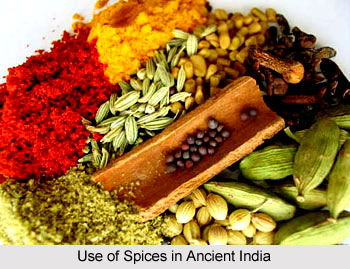
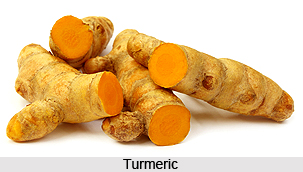
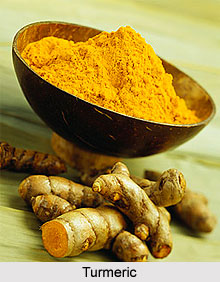
 History of turmeric has always asserted and acknowledged it as a 5000 year old herb that belongs basically to Zingiberaceae, the family of Ginger. Its rootstalk, in powdered form, is extensively utilised as a spice and also as a dye all through the world. This tropical herb plant is generally 3 to 5 feet in height, bearing flowers of dull yellow colour and is largely cultivated in the parts of Southeast Asia most precisely and expansively in India. Turmeric as spice is deep yellow in colour, possessing a characteristic pungent flavour. To convert it into a powdered form, the rootstalk is boiled, dried, cleaned and polished and then powdered for advanced and sophisticated employments. However, as can be understood, the herb has been in India since perhaps unrecorded times, which calls for a brief enumeration of the history of turmeric to all the gastronomic connoisseurs present in contemporary India.
According to the historical evolvement of turmeric, it is known to be one of the oldest spices that have been used in India since ages. That is why it is also avowed that this spice belongs to India indigenously and also referred to as `Indian saffron`. Turmeric has played its part in umpteen Hindu rituals; so much so has been the herb`s influence that even now Indians tend to be attached to it emotionally. The spice has been, since historical times, been utilised as a medicine for stomach-aches and disorders, a feature, which can still be seen exploited.
The exact origin and history of turmeric in India however is still unidentified, but it is understood that it had originated in the precise parts of western and southern India. The spice has been used in India for more than 5000 years now. Initially, it was cultivated as a dye as its vivid yellow colour works brilliantly as a colouring agent. Then with time, ancient population came to know about its highly developed uses and they started using it for cosmetic and beautification purposes and eventually as a medicine. Originating in India, Turmeric had reached China by 700 A.D., East Africa by 800 A.D. and West Africa by 1200 A.D., and also had begun to become popular all through the world. It is also known that the Arab traders had carried with them turmeric to Europe in the 13th century. Marco Polo, while on his several legendary voyages to India via the Silk Route, was so impressed by turmeric that he had mentioned it as a vegetable that possesses properties of saffron, but actually is not saffron. Ancient Indian medical pharmacopoeia, Ayurveda, also extensively mentions about the historical turmeric being an exceptionally effective herb for stomach disorders and food poisoning.
Since its historical inception, turmeric has assayed an extremely crucial role in Hindu and Buddhist ceremonies. It has served an important role in umpteen traditional cultures traversing the East. Turmeric`s historical passage states that the herb/spice has been associated with purity, prosperity and fertility. In contemporary times, turmeric mixed in water is poured on idols of deities as a part of the ritualistic `abhishekam`. Turmeric paste is also anointed over the idols as mark of veneration, especially in south Indian temples. This is respectfully referred to as `manjal-kappu`. The Patala root is one of the ten ingredients in `Dashamula`, a popular Ayurvedic formula for fatigue, which has been prescribed by Ayurvedic gurus since historical periods. The flower is used for disposing off intestinal worms and is also utilised to treat mental disorders, jaundice and venereal diseases. The leaf extracts from turmeric are also known to act against breast tumours. The oil from turmeric is made use in perfumes and medicines.