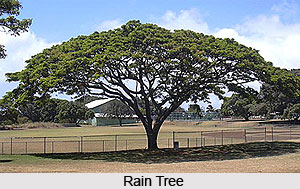
 Rain tree is a very large tree of India that can very easily be identified. It has a wide shelter of evergreen, soft foliage and also the drafts of pink flowers. `Samanea Saman` is the scientific name of this tree. The rain tree belongs to the family of Leguminosae and the name of the sub family is `Mimoseae`. In Hindi and Bengali languages this tree is called as Belaiti Siris. Tamil speaking people call it Enal-vakai; and in Malayalam language, this tree is called as Plavu.
In spite of having widespread twists, the shape of the tree is very much balanced and this is the main reason why this is being planted in groups frequently. Generally, it grows till the height of 27 metres and it has the characteristics of being very tough and having long spreading branches. The bark of the tree is dark grey in colour and bear horizontal weal. It is a suitable tree to be grown as host for ornamental epiphytes. The green cover remains dotted all over with pink and white colours during the period starting from the month of March to May and also towards the end of the year. Usually only a few flowers can be found during the rest of the year. The flowers of the tree appear like encircled and silken bunches. However, each flower stalk bears one central and a surrounding crown of florets that goes up to 20 in number. The flowers have a tube-shaped calyx and a little, yellow-lobed, cherry trumpet. The half pink and half white bunch of long stamens stick out from each flower.
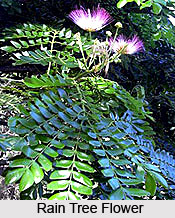
The weighty and long leaves are feather like. Each pinna contains four to eight pairs and it bears three to seven pairs of leaflets. They are oval-shaped and do not have any stalk. They become bigger and curvier towards the end. They spread horizontally. However, in the deep darkness of night or in dry weather, or during the rainy season, the pairs of the leaflets fold together, the leaf stalks bow and each pinna spins on its thickened base in order to make sure that the leaves all lie sideways. In India people strongly believe that the name `Rain Tree` was given because the tree posses an interesting habit of occasionally spraying the ground beneath with moisture. However, later botanists discovered that the spraying was caused because of the innumerable minute insects. The fruit of the rain tree is a fleshy pod. People use the leaves as fodder. The timber of the tree is soft and light.