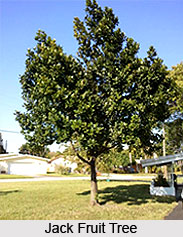
 Jack Fruit tree is a very large and evergreen tree and Jack fruit is one of the largest edible fruit of the world. The scientific name of Jack fruit tree is `Artocarpus Heterophylla`. The tree possesses one of the most popular and most important fruit of India. The tree came from the Moraceae family. There are different names of Jack Fruit tree in different languages of the country. Like for instance, it is famous in Hindi language as Chakki, Panos and Kanthal. In Bengali language the tree is known by the name of `Katthal`. Both in Tamil and Malayalam languages, the tree is called as Pila or Pilavu. Jack Fruit tree is cultivated widely in western region of India. In the other places including the warmer provinces of India, Burma and Sri Lanka, it is cultivated and grows naturally as well.
Jack Fruit tree has a solid crown of dark green leaves and the fruits and they hang from the branches, from the trunk and even on the roots of older trees. They look like massive and unattractive parasites. The rapidly growing tree has variation in its size depending upon the characteristics of soil. It grows high and spreads well in the sandy soil. In stony soil, it cannot grow tall and remain short and thick and in other places where the roots have contact with the water, the tree remains fruitless. The colour of the bark of the tree is grey-brown and rough. Moreover, the leaves of the Jackfruit tree grow in close clusters at the ends of the branchlets alternating each other. They are large, thick and tough and in rectangular shape. They also have a rounded end and they point towards the short stalk. Usually, they remain in the whole stalk except being lobed in very young trees occasionally. In the top of the tree, they are deep green in colour and silky, but in the lower parts they are pale and awkwardly hairy.
 The flowers of Jackfruit tree are not that common. In a tree, both female and male flowers grow separately. The young trees bear only the male flower heads. The abundant flowers cover a small cylindrical accessory and the whole stays together with this in two green cases. Male appendages grow at the end of short leaf and bear branches. They are not noticeable amongst the leaves when in bud. They are revealed by the falling sheaths as dense, yellow catkins. The female flowers remains making groups together in large spiny heads straight on the trunk or limbs. The flowers of the tree normally appear in the months of February and March.
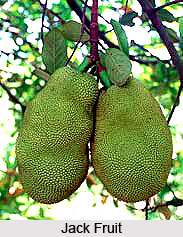
The huge fruits of the Jackfruit tree can weight as much as 45 kg in some occasions. They are normally oblong or round in shape. Several pointed studs cover their rough skin. They are green in colour when unripe and with the course of time, they become more yellowish and brown in the final stage. There are a lot of tiny cavities inside the fruit and each of them contains one seed. A soft and yellowish pulp surrounds them as well. The young trees bear fruits only on the branches, but on the older trees one can find them in great clusters down the trunk. The ancient trees can bear the fruits even in the bare roots. The people in the eastern region of the country eat these fruits in huge quantities. People can get good nutrition from the ripe fruits. The unripe fruits are astringent, but still people cook and eat them as vegetables. Amongst a number of varieties of Jackfruit, the honey-jack is considered to be the sweetest and the best. People eat these fruit raw or boiled or fried in curries and in pickles. They eat it dried like figs as well. The mature seeds that are surplus can be roasted also.
Uses of Jack Fruit Trees
Jackfruit tree has a lot of economic values as well. The fruit can produce rubber. The tree has some medicinal uses also. A fomentation obtained from the leaves can be applied to the injuries and their juice can relieve the puffiness of the glands. The timber named as Jack-wood is used for making furniture as it is termite-proof. The Nambudri Brahmins of Malabar produce sacred fire by the resistance of dry Jackfruit branches. Hence, it is clear that Jackfruit tree is one of the very popular and widely used Indian trees.