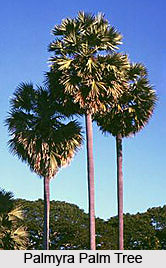
 Palmyra palm tree is a tall and swaying tree well known as `Borasus Flabellifer`. The word `Borasus` was derived from a Greek word and it means the leathery covering of the fruit and `Flabellifer` means fan-bearer. Palmyra palm tree belongs to the `Palme` family. This tree bears a lot of names in various languages in India. For instance, in Hindi and Bengali, the tree is called as Tal, Talgachh and Tarkajhar. It is known as Pannei in Tamil language. In Telugu, it is called as Lulu or Tacli and in Malayalam this tree is named as Karimpana. In English, the tree has some other names except the Palmyra Palm Tree and these names are the Fan Palm, Brab Tree, Toddy Palm and Tala Palm. This tree is found in the drier areas of India, Sri Lanka, and Burma and also in most of the tropical countries.
In its ideal condition the Palmyra palm tree can grow up to a height from 12 metres to 18 metres when it becomes matured. However, in some special occasions, it can achieve the height of 30 metres and a diameter of 60 metres. The tree can be very easily recognized amongst a gathering of trees by its large and fan-shaped leaves. The stem of the tree is black in colour and looks like cylinders. It is also ridged by the semi-circular scars of fallen leaves. In the young trees, the dry bases of the leaf stalks remain wavered in a plaited manner at the top. The old trees to some extent thicken above the middle and their base is always puffed-up by a thick network of root fibres.
Further, the huge leaves of the tree spring in a cluster from the top. They are usually very hard and bear thick stalks. The leaves of Palmyra palm tree are palm-shaped and have the maximum size of 5 metres. The heaving segments are normally 60 to 80 in number. They remain linked for a part of their length. After that they stretch out like stiff and shining lances, folded up along the midribs. The male and female flowers are never contained by one single Palmyra palm tree and they are held by two different trees. Both the kinds of flowers stay together in the side with split wrap. The male flowers of the tree are relatively smaller than the female ones. The female flower cover bears only a few dotted flowers. The flowering in the tree usually takes place during the months of March and April and again later in the year.
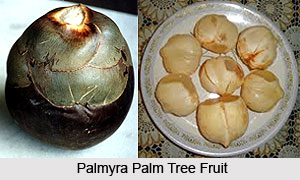
The flowers of the Palmyra palm tree are followed by the green circular fruits. The fruits grow in loose bunches at the base of the leaves. Each of them contains three nuts within its fleshy pulp. This tree is considered amongst the most valuable and significant of Indian trees. Though India is not the native of this tree, it is now expansively cultivated here. As it has the capability of propagating readily in its suitable regions, it is also found growing wild.
 Uses of Palmyra Palm Tree
Palmyra palm tree has numerous uses. Almost every part of the tree has some kind of utility. People generally use the hard outer wood to posts, beams and for domestic purposes. The vacant stem of the Palmyra palm tree is considered as best for making water pipes. The leaves of the tree itself have a large number of uses. People can make fans, mats, baskets, buckets, hats, umbrellas and sandals from them. They can also be used as a very good thatch. People also enjoy eating the jelly like pulp of the fruit and the soft kernels of young fruit very much. The developed nuts and their enlarged, fleshy embryos are also cooked and eaten as vegetables. Moreover, the midribs of the leaves and the fibres from their stalks has the ability to be used in making brushes and people use the net-like material at the base of the young leaf for making into torches as well.
The chief product of the Palmyra palm tree is the Toddy. Further, the Palmyra palm tree has a number of medicinal uses. If the fresh Toddy is mixed with rice flour and gently heated until it ferments, it makes a precious stimulant poultice. The fruit is popular as aperients and the ash attained after burning the flowers is used in prescriptions for biliousness. In the young age, the wood of the tree is soft and it slowly hardens. However, the heartwood remains less hard. The tree has some religious values as well. They use the leaves and fruits on their ceremonial occasions by hanging them on doorways and also they use them on marriage Shamianas. It can be said that the Palmyra palm tree also posses inestimable value to the people of the country.