 There are different types of Kraits as the Common Indian Krait, Branded Krait etc.
Common Indian Krait ( Bungarus caeru/eus)
Local Names: Urdu Kala gandait; Gujarati Kala taro; Marathi Manyar, KaT. dar; Oriya Chitti; Tamil Kattu viriyan, Yennai viriyan, Panai viriyan, Yettat viriyan; Malayalam Valla pamboo (Malabar), Yet/adi virien (Travancore).
The species name of the Indian Krait is caeru/eus. The Kraits are harmful variety of snakes. The snake has enlarged hexagonal vertebral scales and there are narrow white crossbars on the back more or less distinct in pairs. Its scales are shiny. Its neck is not evident and its iris is black. Its body is long and cylindrical and its tail is one-sixth to one-eleventh of its total length. It is lustrous black or bluish black above with paired narrow white crossbars indistinct or absent anteriorly. In the young ones the cross bars are conspicuous. In old snakes the white is in the form of a series of connected spots with large spot on the vertebral region. A peculiars spot may be present; upper lip and ventrally, white.
The Common Krait inhabits in fields, low scrub jungles and is common in the vicinity of human habitation. It is commonly found living inside houses and is commonly found near or in water. It is found at nighttime only. It bites only under provocation.
The Common Krait mainly feeds on snakes including other kraits. Occasionally frogs, lizards, and small mammals are also taken. The male are longer than the females and also has a longer tail.
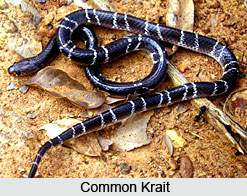 The kraits are among the few snakes whose bite is fatal to man. The poison, secreted by glands is clear and amber colored fluid when freshly secreted. The secretion varies from 0.2 to 51.4 mgm of dried venom. The venom is more toxic than that of the cobra and acts both as a neurotoxin and haemotoxin, paralyzing the respiratory center of the prey and as a result the red blood corpuscles are destroyed as also the lining of the smaller blood vessels. The major cause of death is asphyxia through paralysis of the respiratory center. The Krait is one of the deadliest among the poisonous snakes of the world.
The symptoms of the bite are a `fiery` pain at the site of the bite that goes after some time and later there is violent abdominal pain probably due to hemorrhage and paralysis. The eyelids and lower lip droop and the person are unable to walk and to breathe. The only remedy is to inject polyvalent serum immediately after the bite is detected. Till medical attention is available the victim should be kept warm and given hot stimulating drinks. Death occurs in five to twelve hours after the bite.
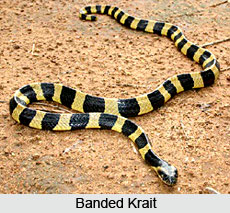
Banded Krait (Bungarus fasciatus)
Local Names: Bengali Sankni, Sankhomuti sap; Oriya Raona
The species name of the banded krait is fasciatus. Its body is smooth and glossy and tail is short. It is alternately banded with broad canary-yellow and black completely encircling the body. It usually inhabits in open tracts and scrub. It lies on the grassy areas, pits or drains that are moist. It is commonly seen in rainy season. It feeds on snakes as rat snadhaman, Indochinese rat snake Ptyas korros, cat snake, chequered keel buff striped Keelback. It swallows the prey after it is dead caused by the poison injected by it. If the prey is longer in length a portion may keep protruding out from its mouth for a day till the portion in the stomach is digested.
The snake is poisonous but there is no record of bite by this species. The poison is less powerful than Cobra poisoning.