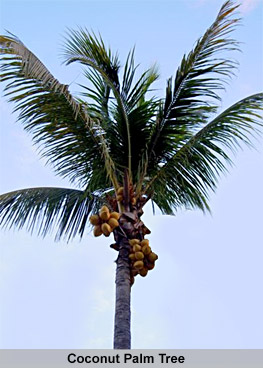
 Coconut Palm Tree is considered as one of the most important and useful tree amongst all the trees of India. Originated from the Cocos Island, the tree bears the scientific name of `Cocos Nucifera`. The name `Cocos` came from a Portuguese word that means `monkey` and `Nucifera` means `bearing nuts`. The tree belongs to the `Palmae` family. It has a lot of names in various vernacular languages in India. Like for instance, in Hindi, it is called as `Narial`. It is `Narikel` in Bengali. The Tamil people named it as `Thennai Maram` and in Telugu; it got three different names like `Nari Kadam`, `Kobari` and `Tenkai`. The tree is known as `Tenga` or `Thengu` in Malayalam.
Description of Coconut Palm Tree
The coconut palm tree` is cultivated in all the damp and hot regions of India especially in the low and sandy atmospheres near the sea. It is normally a self-sown tree and the curved nuts can bowl along the ground for some distance with the help of sloping land or strong wind. It can also float buoyantly and be carried by the tides to other coasts. For these unique qualities, this palm has scattered very easily to all the tropical countries of the world that have a seacoast. As, it is amongst the nature`s most valuable gifts to the poor, it is of greater value than most other plants as a commercial proposition. The tree is high and branchless. It has a thickened base and terminal column of large, pinnate leaves. As the wood of this tree is very soft, it can easily bend to a considerable degree and is usually found leaning into the prevailing wind. One can also see the ring-like scars of fallen leaves all the way up the trunk. This is a great characteristic of all palms. The leaves normally grow around 4 to 6 metres in length and bear stout and solid stalks. The leathery leaflets are like swords in shape. They are around 60 to 90 cm in length and are arranged flat, like a feather.
Both female and male flowers of the tree grow on the same plant and the male flowers are smaller than the female ones. They appear clustered on many branched stems, covered in `spathes`. These spathes spring from the axils of the outer leaves of the crown. They are yellowish and similar to hard catkins. The fruit of this tree is large and oval shaped. It contains a hard, green coloured outer covering that becomes brown by the course of time. Inside the fruit, there is a thick brown fibre that surrounds a hard shell. The shell has three radical holes. The sweet and pleasant edible material is called the albumen. The albumen can be extracted by puncturing two of the pores. The seed lies opposite one of the pores.
The foliages appear in the course of one month and in their third year of growth, they begin to fall. The plant is full-grown and between its 25th and 30th year, it has about 28 foliages and it can reach the height of anything up to 24 metres. Usually there are about 12 branches of nuts. Some of them bear dry nuts and others bear mature nuts. Most of the young fruits fall off when they attain a proper size similar to that of golf balls. Only a few become successful to achieve maturity and in spite of such happenings, a single tree is capable of producing up to a hundred nuts a year. One kind of oil can be obtained from the nut of the coconut palm tree. If prepared freshly, the oil is straw-coloured and practically scentless. However, later the oil becomes a bit sour both in smell and taste. It is made into shampoos and can be applied to the scalp to enrich the hair and enhances its growth. It is capable of taking as a substitute for cod-liver oil after being refined. It is used for cooking purposes, in lamps and as an ointment. A large quantity of the oil is shipped abroad to be used in the manufacturing of soap and candles.
Uses of Coconut Palm Tree
People can obtain commercial copra by cutting the nut open and drying the white meat. This is used extensively in confectionary, in making soaps, margarine, etc. The rest of the copra is the dried kernel after the oil has been expressed and is used as a fattening food for fowls and cattle. Coir is the solid, stringy skin of the nut and has a lot of uses. It is equally sufficient as padding for mattresses and saddle for making carpets. It is also used for mats and for the production of strong ropes that are durable in salt water. When the shell of the coconut palm tree is cut across and the inner nut removed, there forms a hard brush that is used for cleaning and washing. No curry can be completed without the addition of albumen and the milk. By burning the shell, a black paint can be obtained.
People employ the web-like substance that grows where the flower branches expand in the making of bags and coverings, also for the straining of toddy. The toddy also contains Vitamin B. The leaves of the coconut palm tree are used for roofing and the trunk is used for roof beam, bridges and small boats. The wood of the tree is known as `porcupine wood` and has a nice-looking, spotty appearance. If it is dried and polished, the hard cases of the nuts are able to make useful cups and vessels.