About Sanskrit Language
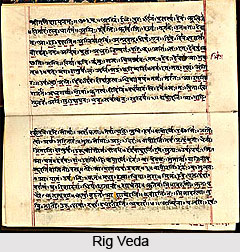 Sanskrit Language is a historical and outstandingly legend-borne Indo-Aryan language, which has since prehistoric times been considered as one of the liturgical languages of Hinduism and Buddhism. Classical Sanskrit, the period in which the language began to spread amongst the common masses, is the `standard register` as represented in the grammar of Panini, approximately around 4th century B.C.E. Its status in the societies and customs of South and Southeast Asia runs almost parallel with that of Latin and Greek in Europe and has profoundly charmed and determined most modern languages of Nepal and India. The pre-Classical form of Sanskrit is referred to as Vedic Sanskrit, with the language of the Rig Veda being the oldest and most antiquated stage preserved to this date.
Sanskrit language applies itself as a member of the Indo-Iranian sub-family of the Indo-European family of languages. Its nearest ancient kin comprise the Iranian languages Old Persian and Avestan. Within the more panoptic Indo-European language family, Sanskrit shares distinctive sound modulations with the Satem languages and also with Greek.
As regards with the origin of Sanskrit language in India, scholars and researchers stand once more in argument with the purpose of explaining common features shared by Sanskrit and other Indo-European languages. Many have proposed the `migration hypotheses` laying stress on the fact that the original speakers of what became Sanskrit arrived in what is presently India and Pakistan from the north-west, some time during the early second millennium B.C.E.
The earliest authenticated and documented Sanskrit texts comprise Hindu texts of the Rig Veda, which are hypothesized to be located in the Punjab region and dated to the mid-to-late second millennium B.C.E. However, written records of any kind from such an early period fail to survive. The oldest surviving Sanskrit grammar is Panini`s Astadhyayi, legendary for its meticulous yet sophisticated handling by such a calculative man, translated to English as "Eight-Chapter Grammar". The text is essentially a prescriptive grammar.
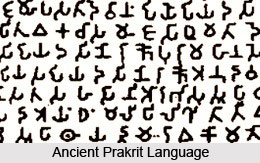
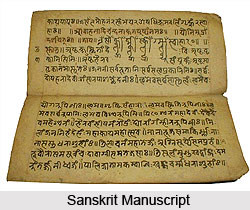
 In this context of Sanskrit language and its ancient usage in India, the term "Sanskrit" was not looked upon as a definitive language sequestered from other languages, but rather as a specially polished or perfected style of speaking. Knowledge of Sanskrit was a an authentic stamp of social class and educational accomplishment in ancient India and the language was taught principally to members of the higher castes, through close scrutiny of Sanskrit grammarians as was Panini. Sanskrit, as the learned language of Ancient India, thus existed together with the Prakrits (vernaculars), which thus germinated into the Middle Indic dialects and eventually into contemporary modern Indo-Aryan languages.
Origin of Sanskrit Language
 Origin of Sanskrit Language reveals that it is a member of the Indo-Iranian sub-family of the Indo-European family of languages. In the second millennium B.C Indo-European tribes had occupied some areas in Iran, Asia Minor and north-west India. On linguistic grounds the speech of Aryan group can be regarded as the precursor of the speeches of India and Iran. The oldest evidence of use of Indian Language is the Rig-Veda. The language used was formal and conventional.
The speech of the Rig-Veda shows dialectic mixture. Borrowings from other dialects can be asserted. From the language used in Rig-Veda one can trace a steady development to Classical Sanskrit through Samhitas and the Brahmanas. In India the evolution of language was emphasized by the notable achievements of early Indian grammarians whose analytical skill was incomparable. As far as normal life is concerned their language witnessed constant destruction and reconstruction. Sanskrit grammarians accepted and carried even beyond than done by the contemporary vernaculars. The process of the removing irregularities and the disuse of variant forms were faster in Sanskrit. However, new formations were not allowed thereby producing a form ordered and purified expression.
The religion`s role in preserving speech accuracy is shown by the existence of a special form of sacrifice. The authority of the grammarians, whose results were summarized in Panini`s Ashtadayai in the fourth century B.C., is visible in the scheme of euphonic combination of the words within the sentence or verses. Rigidity is also seen in the process which substitutes in many cases y and v for the iy and uv. One can trace the dialectic influence in the recognition of l in many words in lieu of r. There is a certain distinction between the dialect which underlies the Rig-Veda and that of Panini. The chief score of progress is the growth of the tendency to intellectualism probably under influence of the Dravidians.
In syllable structure double forms were eliminated for example a as a variant for ena in, a and a yielded to au in the dual, the effective distinction of root and derivative in I disappears. In the same manner in verbal forms the variant masi in the first plural active is kept aside, the e of the third singular leads to te, dkva in the second plural to dhvant. The wealth of forms is seriously reduced.
Despite some of these losses Sanskrit keeps pace with popular speech. Categories such as the dual of noun and verb alike, the middle, and the past tenses vanished from popular speech, however, Sanskrit language rigidly retains them. It rejects irregularities which popular speech had permitted to survive. For example the a of the instrumental singular and nominative plural neuter of a stems, the asas of the masculine plural, the from gonam, the pronominal plurals asme and yustne, the short forms yat and tat, and verbal forms in r.
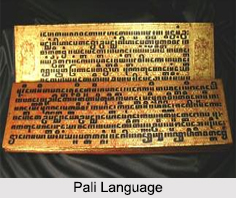
Traces of the subjunctive and the infinitive are banned in Sanskrit. However it can be considered that Classical Sanskrit is an artificial creation, a product of the Brahmins when they wanted to counteract the Buddhist creation of Pali literature. There has been a steady progress through the later Samhitas, the Brahmanas, and the Aranyakas and Upanishads. The spoken language of Panini`s grammar is related to the language of the Brahmanas and the older Upanishads. Classical Sanskrit does not present any artificial symmetry rather admitting exceptions in confusing abundance. This also shows that the grammarians were not creators instead they were engaged in a serious struggle to bring into shape a slightly unyielding material.
Development of Sanskrit Language
 Development of Sanskrit Language hows that it has evolved out of the earlier Vedic form. The corpus of Sanskrit language and literature comprehends an enriched tradition of poetry and drama as also including scientific, technical, philosophical and Hindu religious texts. In contemporary times, Sanskrit continues to be extensively used as a ceremonial language in Hindu sacred rituals in the kinds of hymns and mantras. Sanskrit pronunciation is still in use in a few traditional institutions in India.
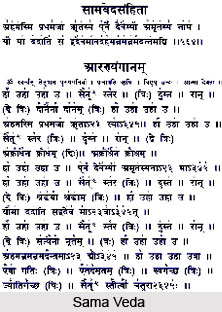
The development of Sanskrit language from the Rig Veda until the time of Panini (fl. 4th century B.C.E.) can be fruitfully ascertained in other Hindu texts of the Sama Veda, Yajur Veda, Atharva Veda, Brahmanas and Upanishads. During this period, the standing and status of the language, its use for sanctified resolves and the importance adhered to its appropriate accent and diction; all served as powerful conformist forces rejecting normal processes of linguistic metamorphosis.
About the mid 1st millennium B.C.E., Sanskrit began its journey of transition from a first language to a second language of religion and learning, marking the commencement of the Classical period. Sanskrit has evolved over the years. It has evolved from Vedic form to Classical to its modern day usage.
Phonology in Sanskrit Language : Classical Sanskrit describes and recognises approximately 36 phonemes (smallest fixed structural unit that marks the meaning). There however exists some allophony (one of several identical speech sounds (phones) that belong to the same phoneme) and the writing systems utilised for Sanskrit normally intend this very precise context. Thus, phonology in Sanskrit distinguishes 48 sounds. The sounds are traditionally listed in the order vowels (Ach), diphthongs (Hal), anusvara and visarga, plosives and nasals (beginning from the back of the mouth and moving forward) and finally the liquids and fricatives.
Nouns include masculine, feminine and neutral subjects. Compounds are also used frequently. There are four categories of compounds which include the:
* Coordinative (dvandva)
* Determinative (tatpurusa)
* Possessive (bahuvrihi)
* Descriptive (karmadharaya)
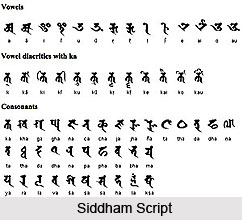
Vowels in Sanskrit Language : The vowels of Classical Sanskrit have their word-initial in Devanagari symbol, along with the diacritical mark with the consonant and its pre-ordained pronunciation.
The long vowels are enounced twice as long as their short twins (pertaining to short vowels). There also exists a third, extra-long length for most vowels, referred to as pluti, which is employed in several cases, but predominantly in the vocative case. However, pluti is not recognised by all grammarians. The vowels /e/ and /o/ continue as allophonic versions of Proto-Indo-Iranian /ai/, /au/ and are assigned as diphthongs by Sanskrit grammarians, even though they are conceptualized phonetically as plain long vowels.
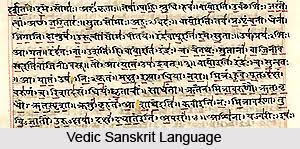
Vedic Sanskrit Language
Origin of Vedic Sanskrit can be traced as early as approximately 1500 B.C.E. (recognised date of composition of Rig Veda). Scholars often discriminate Vedic Sanskrit and Classical or "Paninian" Sanskrit language as separate `dialects`. Though they bear essential similarities, they also differ in a number of elementary points of phonology, vocabulary and grammar and syntax. Vedic Sanskrit is universally acknowledged as the language of the Vedas, a colossal collection of hymns, incantations (Samhitas), theological discourses and religio-philosophical discussions (Brahmanas, Upanishads), representing the earliest religious texts of Hindu religion.
Classical Sanskrit Language
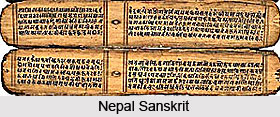 For almost 2000 years, a cultural order was in vogue that wielded influence across South Asia, Inner Asia and Southeast Asia and to a definite extent, East Asia. A noteworthy form of post-Vedic Sanskrit is determined in the Sanskrit of the Hindu Epics, the Ramayana and Mahabharata. The digressions from Panini in the epics are in general regarded on the tremendous basis of intervention from Prakrits, or "innovations" and not because they are pre-Paninean. Traditional Sanskrit scholars coin such digressions as aarsha, or "of the rishis", the traditional designation for ancient authors. In some contexts, there also exists more "prakritisms" as opposed to in Classical Sanskrit proper.
Ancient Sanskrit grammarians had classed the vowel system into velars, retroflexes, palatals and plosives as opposed to back, central and front vowels. Other than the "four" cardinal diphthongs utilised in Sanskrit language, this ancient Indian language normally prohibits any other diphthong. Vowels in progressive sequence, wherever they occur, are transformed to semivowels according to sandhi rules.
Phonology and Sandhi in Sanskrit Language
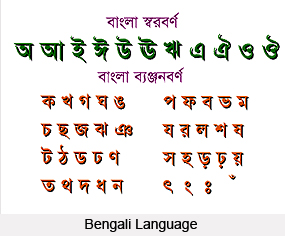
The phonological system of rules to be implemented when amalgamating morphemes to a word and when combining words to a sentence are together clustered in a system called sandhi or placed as "composition". Texts are penned down phonetically, with sandhi made use of accordingly. Sandhi is an integral part in both ancient and present day Sanskrit language, with surging popularity reaching towards influencing Bengali language as well.
In spite of this apparent "death" of Sanskrit language and the literary usage of vernacular languages, Sanskrit continued to be used in literary cultures in India. But the "death" signified that Sanskrit would not be used again to communicate metamorphosing forms of subjectivity and sociality embodied and conceived in the modern era. Instead, it was subdued to "reinscription and restatements" of ideas already explored.