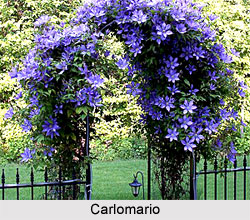
 Vine plants in India are of various types. The vines, creepers and climbers in India, such as, Allamanda, Laurel Clock Vine, Climbing Aroid, Grape Ivy, are frequently grown along the top of the compound wall or as a cover for walls, as well as at the entrance as an arch. Since, these plants contain soft stems; they grow only with proper support. Vines are generally planted for the purpose of decorating gardens and outer parts of buildings and walls, as other types of plants are unable to cover such vast surfaces. Climbers are those plants that sustain themselves with support of other plants and trellis or other structures. Vines, creepers and climbers in India have the ability to produce a large quantity of flowers in the minimum of space and to hide or soften ugly materials or outlines. They should be selected for the reason for which they are adapted. Certain group of vines works well on masonry, others make good ground cover, while some must have artificial support or help in their climbing.
Types of Vines, Climbers and Creepers in India
The vines, climbers and creepers in India are divided into 2 general classes: Annual and Perennial, Hardy or, as often referred to, Woody. The annual vines as well as some of the smaller hardy types grow very well in well-drained soil, which has received ordinary digging. The larger hardy varieties, however, are often expected to remain in a single spot for many years and so merit about one cubic yard of good soil.
Plantation of Vines, Climbers and Creepers in India
The hole for a strong vine should be at least 2 feet square and 2 feet deep, or better, 3 feet each way. The ground in the bottom should be broken up and made to drain if the soil is hard. The excavation should then be filled with good soil, well supplied with rotten manure and coarse raw bone. Each plant should have a space of 3 to 6 feet square in which it will not have to compete for food and moisture with other strong-growing plants. No vine should be planted where water drips on it every time it rains. This is terrible for the foliage but worse still for the plant in winter. Much winter killing is caused by the drip of water on warm days, which coats the plant with ice at sundown. The ice-coated vine swaying in the wind suffers many cracks and wounds which offer means for the ready entrance of pests and the loss of stem juices in the spring.
Wire cages: These work like tomato cages but can be made from wire mesh in any height or shape. A narrow, upright pillar shape is elegant in a formal garden.
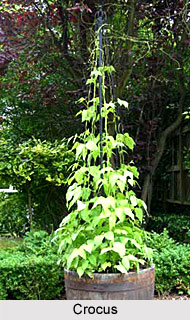 Tepees: There the gardener has to make a support of angled posts tied jointly at the top. Plant one or several vines at the base and let them twine up and fill out to cover the post.
Scrims: These are open-structured, see-through supports that vines can go up and still give a oblique view of the scene beyond. With imagination, scrims can be made of braided wire or other creative materials.
Large plants of vines, climbers and creepers category should be inactive if possible when planted. the roots should be spread to the fullest extent, cutting off all broken or injured ones and take care to see that wooden supports of the plant are made of substantial, long-lasting material. The vines, climbers and creepers grown against a sunny wall should receive special watering. They get the heat not only from the sun but also that reflected from the wall. Also at night the wall will reflect the heat long after sundown. The vines, climbers and creepers are used for screening, for correcting or softening architectural lines and for flowering beauty.
Popular Vines, Climbers and Creepers in India
The common vines, climbers and creepers available in India are mainly Bignonia Venusta, Allamanda, Passiflora, Black-Eyed Susan Vine, Laurel Clock Vine, Scarlet Clock Vine, Bengal Clock Vine, Mysore Clock Vine, Hari Champa, Ceylon Green Champa, Shrubby Deeringia, Malati, Kardal, Ceylon Green Champa, Golden Trumpet Vine, Spiral-Vined Silkpod, Climbing Oleander, Split Leaf Philodendron, Rattan Cane, Creeping Philodendron, Climbing Aroid, Medium Ceropegia, Chain of Hearts, Gurmar, Sneeze Wort, Ambarvel, Aakari Bel, and Jacquemontia. Bleeding Heart, Grape Ivy are popular climbers in India. Some other kinds of the vine plants like Akebia (Akebia quinata), Porcelain Berry Vine (Ampelopsis brivipendunculata), Trumpet Vine (Campsis radicans), American Bittersweet (Celastrus scandens), Winter Jasmine (Jasminum nudiflorum), Chilean Jasmine (Mandevilla laxa), Virginia Creeper (Parthenocissus quinquefolia), Passion Vine (Passiflora pfordtii) and many others.