Kumbha, Waterpots - Informative & researched article on Kumbha, Waterpots
  Indianetzone: Largest Free Encyclopedia of India with thousand of articles Indian Crafts


in  
Art & Culture | Entertainment | Health | Reference | Sports | Society | Travel
Forum  | Free E-magazine
Indian Crafts : Embroidery in India l Crafts of Indian States l Crafts of Union Territories of India l Types of Indian Crafts l Craft l Indian Craft l Indian Tribal Crafts l Indian Durries l Crafts of North eastern India l Indian Handicraft Associations l Indian Carpets
Home > Art & Culture > Indian Crafts > Types of Indian Crafts > Clay Crafts of India > Kumbha
Kumbha, Waterpots
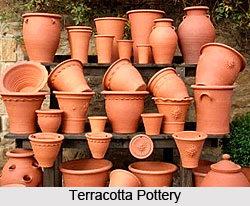
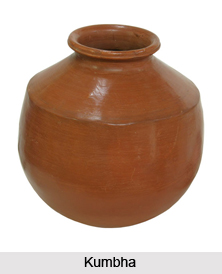
Kumbha are waterpots that were found initially in the Indus valley civilisation, used to store water.

Kumbha, waterpots from Indus Valley CivilizationKumbha are waterpots which gained prominence since the ancient ages. They are used to carry or store water. The origin of the waterpots is traced back to the Indus Valley civilisation. These vessels were of heavy copper and were meant for fetching water. In addition to that lota-shaped vessel with a long spout rising from the base is also found that suggested pouring function.

The shape of the Kumbha resembled natural objects like pumpkins and gourds. These were then adapted to functional requirements, either for balancing on the head, for carrying on the hip, or for storage in the kitchen. These vessels were used for Vedic sacrifices also is the ninhaya. It is an earthen waterpot which was buried in the ground for keeping water cool.

Apart from Kumbha, another functional water vessel is the bhrngara with crossed straps. It is used by every Buddhist monk. The waterpots are also mentioned in the old Tamil literature. It is mentioned as versatile waterpots like the kallam and kundam. Pots were suspended from the roof in a rope sling (shimili) or kept in stands called pattadai, shumudu or shum-madu.

The Kumbha has an exclusive design that was governed by functionality. All carrying waterpots have narrow mouths to prevent spillage. These kumbha or waterpots were expected to be placed in a line on the west side of a kitchen, according to the Shivatattvaratnakara.

This article is a stub. You may enrich the article by adding more information to it. Send your write up to content@indianetzone.com

(Last Updated on : 20/02/2009)
  More Articles in Clay Crafts of India
 
Kumbha Clay Craft of West Bengal Clay Crafts of Uttar Pradesh
Clay Crafts of Delhi Clay Crafts of Jharkhand Clay Crafts of Himachal Pradesh
Clay Crafts of Madhya Pradesh Clay Crafts of Orissa Clay Crafts of Tamil Nadu
Kumhar History of Clay Crafts in India Clay Crafts of Maharashtra
Clay Crafts of Kutch    
Recently Updated Articles in Indian Crafts
  • Gold Jewellery Craft in India
    Gold Jewellery craft in India is deeply related to the history of this country. From its inception is has gone through various changes and reflects the contemporary cultures.
  •  
  • Coconut Craft in India
    Coconut Crafts in India includes an array of products that is etched out of coconut, a popular fruit in the states of Tamil Nadu and Kerala.
  •  
     
  • Horn bone craft in Orissa
    Horn bone craft in Orissa is admired for its vitality and creativity that prevail in the culture of the state.
  •  
  • Ivory Carving in Kerala
    Ivory carving in Kerala is one of the major crafts of the state. Engraving and painting on ivory were also practised in the past.
  •  
  • Metal Craft of West Bengal
    Metal Craft of West Bengal reflect a fusion of tradition and contemporaneity in their creations.
  •  
    E-mail this Article | Post a Comment
    RSS Feeds
    Forum
    Forum on Indian Crafts

    Free E-magazine
    Subscribe to Free
    E-Magazine on Indian Crafts
     
     
    Kumbha, Waterpots - Informative & researched article on Kumbha, Waterpots
    Sitemap
    Contact Us   |   RSS Feeds
    Copyright © 2008 Jupiter Infomedia Pvt. Ltd. All rights reserved including the right to reproduce the contents in whole or in part in any form or medium without the express written permission of Jupiter Infomedia Pvt. Ltd.