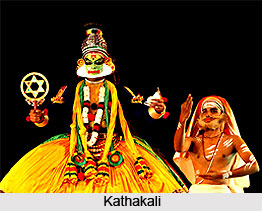
 The history of Kathakali is rich and pregnant with its copious tradition. The most striking element in Kathakali is its dramatic quality; gods and heroes, demons and sprits who appear from another world in costumes and headgears which are inspiring and belong to a world of myth and legend. This dramatic style evolved from many dance traditions of south-western coastal region of India from earliest times. Kerala was the home of ancient form of drama known as the Chakyar Kuttu. This dramatic presentation has references in early Tamil works. Many improvisations took place in the later form of the koottu and some of these innovations appear in contemporary Kathakali.
The indigenous Dravidians of Kerala were worshippers of Bhagavati, the Earth-Mother goddess, and also worshipped the snakes. Later, after the Nambudiris` supremacy had been established, the custom of each household actually set apart a small grove in the compound for the habitation of snakes. These snake groves are common even today and are said to protect the household. This adoration of snakes resulted in one of the oldest dance-forms of Kerala - the Pampin Tullal or the dance of the snakes. An important centre for the worship of snakes is Mannarsala, where special snake-dance festivals are held. These dances are of the Dravidians. All these were early influences which helped towards creating the climate for the composite art of Kathakali. The Kathakali dance uses fantastic costumes, masks or make-up that are representations of super-human beings.
The history of Kathakali unveils the fact that the dance form is indeed the result of fusion between the pre-Aryan Dravidian dances and the later ones were introduced by the Brahmins. It combines the consciousness, the religious practices and the techniques of these two cultural streams in perfect harmony and balance. The history of Kathakali dance is the saga of an ever changing tradition. The coming of the Brahmins resulted in the inevitable changes in the Kathakali dance, which always occur with the arrival of unfamiliar elements. Eventually, they combined with the culture of the Dravidians, the sophistication of the Aryans. When the Nairs migrated to Kerala they exerted their influence on the traditional skill and training techniques of Kathakali. Even today the exponents of Kathakali are mostly Nairs.
 The rich history of Kathakali also points out the fact that the external influences had an impact in the development of the Kathakali dance form. The Aryans did influence Kathakali. The art forms codified and embodied in the Sanskrit shastras of the Brahmins were introduced. They propagated and kept alive the wisdom of the Gods and were in the form of stories and legends. These sacred texts were recited in the temples, which were prohibited to the lower castes. This form of recitation was known as Chakkiyar-kuttu as the orator belonged to the Chakkiyar caste. The Chakkiyars declare their descent from the Sutas of the Mahabharata. The Tirayattam and Kaliyattam also contributed to the formation of Kathakali. Koodiyattom is still performed in some parts of Kerala. Vidushaka played a very important part as it was his task to bridge the gap between the classical Sanskrit spoken by the hero and the regional language spoken by the audience. The Tirayattam invokes Goddess Bhagavati. The actor never sang his lines and the performance was mostly ritualistic, done with elaborate make-up.
Movements in Tirayattam were pure dance patterns. Masks and face paint were common to these dances. The Mudiyettu, the Kolam Tullal has contributed to Kathakali in its present form. The elaborate make-up can be traced back to some of the patterns found in these dances. A third and final source was the martial dances known to the folk tradition of Kerala. Kerala is known for its numerous martial dances and the Kalari are remarkable for their acrobatics. The excellent body-training of Kathakali dancers, the massaging system and the fantastic leg extensions, jumps and leaps in the technique have been assimilated from these martial dances.
Kathakali still emerged as an independent, highly formalistic, dance-drama form in the 17th Century. Kathakali had flourished long in Kerala under Royal Patronage. Two kings gave Kathakali its present form. The origin of Kathakali is attributed to the Zamorin of Calicut in the 17th Century. He was a devotee of Lord Krishna; who wrote plays known as Krishnatam. It is believed that Zamorin refused to send his troupe to Travancore. This resulted in Raja of Kottarakkara`s writing the Ramanattam, a series of eight plays about Rama. The Ramanattam is considered the precursor of contemporary Kathakali. While the Krishnatam made immense use of Sanskrit, the Ramanattam favoured using Malayalam. The efforts of the Raja were supplemented by other writers of Kerala, especially Irayiamman Thampi who wrote three plays, Kicha-kavadham, Dakshayagam, and Sita Swayamvaram. Many other writers followed him soon. Of these, the most important was Swati Thirunal Rama Varma, Maharaja of Travancore in the 19th Century. The tradition continued and many famous Malayalam writers wrote plays for Kathakali performances.
History of Kathakali is incomplete without reference to two significant characteristics of Kerala. Firstly, Kerala was deeply influenced by Gita Govinda and the other Vaishnavite works. A rich literature had developed in Malayalam due to the spread of Vaishnavism which existed side by side with the Sanskrit drama, and shared the popularity with performances of Sanskrit plays in the Natyadharmi tradition. This enriched dramatic writing by providing the dramatist with new themes.
Secondly, the textual evidence supports the view that numerous regional styles were prevalent in the area, which seems to have departed from the tradition of Bharata. A distinction was maintained between the pure Natya forms and the pure dance forms.
The temple sculpture in Kerala and the frescoes in the Mattancheri temple prove that the basic Kathakali positions employed today were established by the 15th Century. The style prevalent in Kerala was akin to the forms prevalent in the Tamil Nadu area, with regards to the typical knee position and the usual accompaniment of drum and cymbals. It is around the 16th Century in the frescoes of Mattancheri, that examples of the rectangular positions, the headgears and the sari also appear which are so basically typical to Kathakali.
Kathakali which was until yesterday a dying art had been revived by poet Vallathol Narayana Menon. Presently many students from the East and West gather in the Kerala Kala Mandalam to master this art. Kathakali has a long and rich history and simultaneously maintained a steady tradition.