The Indian medicinal plant, Haritaki is a semi-deciduous tree which grows up to 24 meter in height, though sometimes it usually much smaller in peninsular India with a cylindrical bole. Haritaki possesses the scientific name Terminalia chebula. It is an important Indian medicinal plant. This plant is popular in other native dialects like: haritaki in Bengali; black myrobalan, chebulic myrobalan, gall nut in English; hardo, haridi, hirde, hirdo in Gujarati;: har, harir, haritaki, harra, pilzari in Hindi; alale, anile, aralaikai, arale, halle, harade, haritaki, herrda in Kannada; ordo in Konkani; kaddukukka, katukka, pulicakku, putanam in Malayalam; habra, hilda, hirda in Marathi; haredha, harida, haridra, horitoki, jonghihorida, karedha in Oriya; halela, har, harar, hurh in Punjabi; abhaya, haritaki, pathya in Sanskrit; illagucam, kadakai, kadukkai in Tamil; karaka, karakkai, kari-taki in Telegu; haejarad in Urdu.
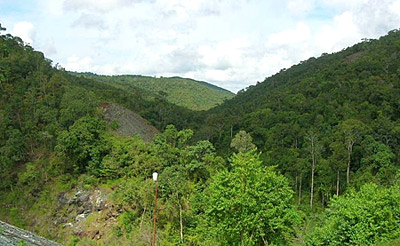
Haritaki is an Indian medicinal plant which is very common in sub-Himalayan hill forests running from the Ravi eastwards to West Bengal and Assam. They grow to an elevation of 1500 meter. This medicinal plant is also available in open deciduous hill forests of peninsular India from northern Maharashtra and Madhya Pradesh. The natural habitat of Haritaki is typical on yellow soils overlying laterite, sandstone and metamorphic rocks, to Tamilnadu and Kerala.
Haritaki plant matures with a rounded crown and spreading branches. Barks in this Indian medicinal plant are dark brown in colour and often found to be longitudinally cracked. This plant exfoliates in woody scales and young parts of twigs are clothed in silky hairs.
Leaves in this medicinal plant develop is alternate or sub-opposite direction. They are within 5 to 16 centimeter long and 2.5 to 5.5 centimeter wide. Their shape varies from ovate-lanceolate to broadly elliptic. At apex the leaves set up from obtuse to rounded or rounded to sub-truncate. Furthermore, the leaves are occasionally oblique and unequal at base. There are about 5 to 8 pairs of veins and the petiole is 0.8 to 1.8 centimeter long with a pair of large glands at the apex. Bracts of Haritaki are 3.5 centimeter long, linear, acute and pubescent on both surfaces.
 Haritaki produces hermaphrodite flowers and all of them grow 4 millimeter across. They are sessile and have dull white to pale yellow colour. Moreover these flowers bear an offensive smell and borne in simple or branched axillary or terminal spikes which are 3-5 centimeter long. Bracts exceeding the flowers are sub-ulate or lanceolate with hairy and conspicuous features among the buds but soon gets deciduous. Calyx campanulate is short with 3 millimeter long and 5 teeth.
The Indian medicinal plant, Haritaki develops fruits which are elliptic-ovoid in shape. They are about 2 to 4 centimeter long and 1.3 to 2.1 centimeter wide. Each fruit is broadly ellipsoid to sub-globular which is further obscurely 5 to10-ridged and glabrous. The medicinal plant, haritaki yields yellow to orange-brown fruit when ripe. These fruits are oblong stone, bony and have very thick which are obscurely angled. In central India, Haritaki remain leafless for a short period between February and April. Flowering in this Indian medicinal plant occurs between April and August and fruiting from November to February. Karnataka experience flowering and fruiting of Haritaki from January to September.
In Ayurveda as well as in traditional practice Haritaki takes in fundamental medicinal properties. The fruits are widely used for curative purpose. They are credited with laxative, digestive, carminative, stomachic, tonic, expectorant, anthelmintic, antidysenteric and alterative properties. In Ayurveda they are used to promote healing of wounds, ulcers and swellings, to treat skin and eye diseases, diabetes, chronic and recurrent fever, anaemia, cardiac disorders, diarrhoea, dysentery, cough and dyspnoea; Haritaki are also found in combination with other ingredients in numerous Ayurvedic preparations for treating a wide variety of conditions and diseases. The ripe fruit is used as an astringent, usually in combination with the fruits of both Terminalia bel-lirica {belliric myrobalan) and Phyllanthus emblica (Euphorbiaceae), which together comprise Triphala, a well-known Ayurvedic drug.
The unripe fruits are used to treat dysentery and diarrhoea, and the ripe fruits for treating ophthalmia, diseases of the spleen, and piles. The fruit pulp also includes a large amount of medicinal property; it is used as a dentifrice to cure bleeding gums, as a gargle for stomatitis, and as a local application to promote healing of chronic ulcers and wounds. The fruits are steeped in water overnight and this water can be used as cooling eyewash to relieve conjunctivitis. In southern Orissa, a paste is prepared from the pericarp of the fruit and is taken with curd (yoghurt) to relieve diarrhoea. The fruit reportedly relieves asthma when coarsely powdered and smoked in a pipe. A fine paste of the fruit with carron oil promotes healing of burns and scalds. The unripe roasted fruits and boiled seeds are used by the tribal inhabitants of Surguja District in north-eastern Madhya Pradesh to relieve coughs.
Haritaki
Haritaki, the Indian medicinal plant has gained importance for its medicinal value.