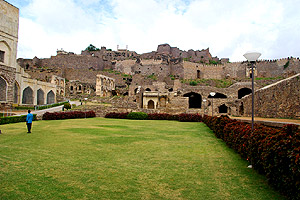
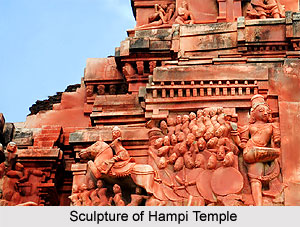
 Hampi has many Hindu temples. The notable ones include Virupaksha Temple, Hazara Rama Temple, Krishna Temple and Vittala Temple. Sculptures of Hampi were created under the reign of the Vijayanagara Empire from 1336 to 1565. Lying on the banks of Tungabhadra River the sculptures here present a visual treat for the travellers. The sculpture of Hampi is popular for its rock cut sculptures. Huge slabs of rocks have been chiselled out and given the form of the beautiful sculptures. Unfortunately the temples of Hampi are in ruins today. Images of gods, goddesses and animals dominate the temple sculptures of Hampi. Built during the Vijayanagara Empire the features of Hampi sculpture reflect the architectural elements that were commonly used during this dynasty.
Hazare Rama temple has five continuous sculptures that cover the outside of the enclosure wall. The panels display processions of horses, elephants, attendants, soldiers, musicians and wrestlers witnessed by a few seated royal figures around the temple.
Virupaksha temple consists of a sanctum, three ante chambers, a pillared hall and an open pillared hall. The temple is surrounded by a pillared cloister, entrance gateways, courtyards, smaller shrines and other structures. The nine-tiered eastern gateway incorporates some earlier structures. It has a brick superstructure. The smaller eastern gateway leads to the inner court which has smaller shrines.
The main feature of Vittala temple is its impressive pillared halls and the stone chariot. The halls are carved with an array of sculptures on the giant granite pillars. The stone chariot located inside the campus is an iconic structure of Hampi. The chariot is built on a rectangular platform. All around this base platform is carved with mythical battle scenes. The four giant wheels attached mimic the real life ones complete with the axis shafts & the brakes. A series of concentric floral motifs decorate the wheels. The northern hall is surrounded with a series of pillars with various facets of Narasimha (the man-lion incarnation of Vishnu). The most notable ones are that of Narasimha slaying Hiranyakashipu on his lap. Prahlada is seen sitting at the base in a praying posture. The outer wall of the sanctum is richly decorated with the Kumbha-Pankajas.