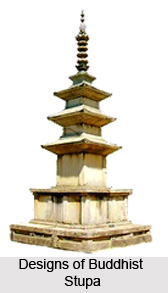
 Indian Stupa sculpture traces a long origin. A Stupa is essentially a funeral monument, a tomb or a cenotaph which was important for its symbolic value. The monument was believed to belong to the village or the cremation ground outside a village and was not usually allowed within the enclosure. However, it soon entered village shrines as a religious symbol associated with life and death. It was used to mark places that had been made sacred by the events in the life of the saint whom it commemorated. An important point to be remarked at this juncture is that Stupas did not originate with Buddhism and neither was it solely associated with that aspect of Indo-Aryan art. Stupas were found existing in Jainism as well as some other sects. However, it was Emperor Ashoka who popularised Buddhist Stupas and thus they are most famously associated with Buddhism.
The earliest known Buddhist Stupas are seen dating back to the 5th century BC. The symbolism inherent in the Buddhist Stupas can be better understood by analyzing its sculpture. The symbolism shows a constant referral to the Hindu religion, probably since this was its point of origin. The four gateways marking the cardinal points were reproductions of the gateways of Indo-Aryan villages. The railing is the same as the one that enclosed the sacrificial area in the Vedic sacrifices. The three bars of the rail signified the three positions of the sun at its rise, zenith and setting in Hinduism. The spiritual interpretation of the same in Buddhism is the three times of the daily prayers. The Buddhists called them Buddha, Sangha and Dharma instead of Lord Brahma, Lord Vishnu and Lord Shiva.
The four bars to the Brahman signified the sacred Veda, the depository of sacred traditions of the Aryan race. The Buddhists interpreted them as the four events in the life of the blessed one- Nativity, Enlightenment, First sermon at Varanasi and Death or Parinirvana. The beautiful open lotus carved on the rails was the symbol and votive offerings which held the same meaning for all Aryan schools of philosophy and religion.
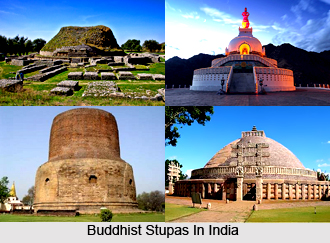 The rite of Pradakshina was an ancient Aryan rite. In Ashok`s time, all the beautiful imagery of Aryan poetry which was seen in the Vedic hymns was woven into the fabric of the Stupa. The dome was the symbol of the sky. The blue lotus flower enveloped the earth with its inverted petals. The group of five columns rose from the base of the dome at the point opposite the four gateways marked the arms of the cosmic cross, like the main streets of the Aryan village. These represented the 5 cosmic jewels- earth, air, fire, water and ether. At the crown of the dome, the reliquary was the Vedic altar of burnt sacrifices. The rail pattern on it reproduced in a decorative form the actual rail which enclosed the sacrificial area and also the village shrine. The umbrella over the reliquary transformed into the spiritual tree, was the only Buddhist and Jain equivalent symbol of the mystic tree of Lord Vishnu.
The sculptures at the gateway of the Sanchi Stupa represent the esoteric teachings of Hinayana Buddhism. As a symbol of Nativity, the Buddhist Indian sculptures use the figure of Ushas and Vedic Dawn Maiden in the sculptures of Bahrut and Sanchi. The maiden is seen rising from the cosmic ocean standing upon the lotus flower and the two elephants, symbols of the rain god, pour lustration over her. The seven different kinds of trees with Vedic altars with stones of Gods placed in front of them, symbolize the second Buddhist sacred cycle that is the illumination under the Bodhi tree.
Another event represented by the sculpture of Stupa was the first sermon of Varanasi. The fourth event that has been represented is the death of Buddha, the complex cycle of rebirth in his Parinirvana. Reincarnation was symbolized by the serpent which periodically sheds its skin and appears with a new body to resume the turning of the wheel. It is believed that the seven Buddhas replaced the Sapta Rishis and this was narrated in the Jataka tales. The sculptures at Sanchi and Barhut are narratives on the life of Sakyamuni or Buddha and his previous existence on earth. They are also an exposition on the teachings of the Hinayana school of Buddhism. The sculpture at Amravati represents a layer stage in the development of Buddhist philosophy, when Mahayana Buddhism was gaining ground over the Hinayana sect.