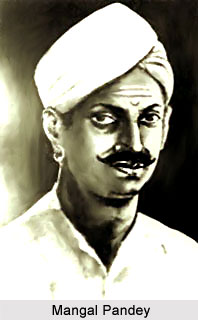
Mangal Pandey is considered as one of the first Indian freedom fighters and was a Sepoy to rise against the British rule during the Great revolt of 1857. He was a sepoy in the 34th Regiment of the Bengal Native Infantry (BNI) of the British East India Company.
Mangal Pandey is well known in the arena of Indian history as he attacked his British officers, sparking off the First War of Indian Independence or as the British termed it, the Sepoy Mutiny of 1857. Mangal Pandey perhaps played the most vital role in the Indian freedom struggle. Some scholars also call him an accidental hero.
 Early Life of Mangal Pandey
Mangal Pandey was born on19th July, 1827, in Akbarpur Tehsil in Faizabad district, Uttar Pradesh. He had spent his childhood in Suhurpur. His father was Divakar Pandey. Mangal Pandey had a sister. They belonged to the typical village middle-class, with his father serving as a peasant. He grew up to become a staunch Hindu with strict religious beliefs. Later, he joined as a soldier in the Bengal Native Infantry (BNI) Mangal was a zealous careerist and viewed his role as a `sipahi` (soldier) for future bright prospects.
However, with the passage of time, his respect and deference for his English masters diminished with stray happenings in the country. Later, the introduction of the P-53 Enfield Rifle and the greased cartridge issue wholly turned the tables for the British forces, as Mangal Pandey to revolt till death.
Role of Mangal Pandey in British Regiment
Mangal Pandey was 22 years old when he joined in the 34th Bengal Regiment. However, his joining in the army was entirely unplanned. During his visit to Akbarpur, a regiment that was marching towards Varanasi recruited him on the road. He willingly gave his consent. However, his move was not entertained by his friend Nakki Khan although his father, Divakar Pandey, had agreed to it impassively.
Role of Mangal Pandey in Barrackpore Unrest
The Barrackpore Unrest was a joint venture of the 34th Native Infantry, 2nd Native Infantry and the 19th Regiment of Bengal Native Infantry. Mangal Pandey was part of the 34th Native Infantry. It was in Barrackpore that the first news of natives arising to revolt had reached the British Generals. Mangal Pandey, along with his trusted band of followers in the two remaining regiments had decided upon to revolt against the callousness of Lt. Wheeler of British East India Company. He was pivotal in inciting men from different parts of the country to unite and make the call a success. This was role of Mangal Pandey in Barrackpore Unrest that happened on Sunday 29th March 1857. He was furious about the issue of the greased cartridge in Barrackpore, which at first was taken as a rumour by all. He was the sole man to opt for extreme measures to stand alone in his crusade. Things were not that much promising in the passing stages of the unrest episodes, and Mangal Pandey had cause to feel downcast. In spite of several threats from English rulers, he did not budge.
Role of Mangal Pandey in Calcutta-Patna Conspiracy
The role of Mangal Pandey in Calcutta-Patna Conspiracy made him the doyen in his regiment and that was the main criteria to lead his men against the British Army. The Calcutta-Patna Conspiracy was planned in gigantic proportions beginning from Bengal and reaching the extremities of northern India. Mangal Pandey, in the beginning was not interested much to join such outcries, he was too engulfed in his private issues. However, his boyhood companion, Nakki Khan had induced him to the problem. Gradually, after meeting several Zamindars from Bengal, Mangal was convinced that the conspiracy could be turned into a huge one. Men from Patna and other parts of Bihar started to collaborate with the ousted Maharajas of the princely states like Baji Rao or Nana Sahib. In his enterprises, Mangal Pandey had several allies to assist him. The Walliullah-ites (also known as the Wahabis) were such a bunch noted for their valance.
Trail of Mangal Pandey
Mangal Pandey`s rebelliousness and his uprisings were condemned and he was put on trial. The court declared him guilty and Mangal Pandey was hanged till death on 8th April 1857, leaving behind him the tremendous chain of freedom fighting.