In Buddhism Klesas or kilesa means `adulteration` or `poison`. It was first referred to mental states which momentarily enclose the mind and leads to vindictive actions.
In the Pali literature, Klesas are regularly related with the different kinds of passions that defile bodily and mental states. There are ten Klesas which are identified. The first three of the Klesas are regarded to be the `roots` of suffering.
The first Klesas is the mental hindrance. This is the emotional obstacles to the search of direct knowledge and wisdom. The five main hindrances are sensual desire or kamacchanda, anger or byapada, sloth torpor, restlessness-worry or uddhacca-kukkucca, and doubt or vicikiccha.
Abhidhamma is the second type of Klesas, which are of ten kinds. The ten defilements are greed or lobha, hate or dosa, delusion or moha, conceit or mana, wrong views or ditthi, doubt or vicikiccha, torpor or thinam, restlessness or uddhaccam, hardheartedness or ahirikam and recklessness or anottappam.
All the ten Abhidhamma together is known as the `unwholesome roots` or akusala-m?la. The opposite of them are the three `wholesome roots` or kusala-mula. The three `wholesome roots` are alobha, adosa and amoha. The presence of such a wholesome or unwholesome root during a mental, verbal or bodily action conditions is the future states of consciousness and associated with mental factors.
In the theory of Klesas it is mentioned that klesas depends on the `three rounds` of Dependent Origination. The three rounds are the `round of defilements` or kilesa-vatta, the `round of kamma` or kamma-vatta and the `round of results` or vipaka-vatta.
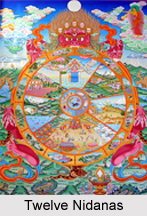
In the Mahayana Buddhism, the Klesas is said to be the mula-klesa of the Twelve Nidanas. They are ignorance (avidya), attachment (upadana) and craving (trishna). The three mula-klesa are said as the `Three Poisons`and are symbolized by the Gankyil.
These three Klesas specifically refers to the delicate movement of mind when it initially encounters a mental object. In Buddhism mental object refers to any object which the mind identifies; this can be a thought, emotion or object perceived by the physical senses. If the mind primarily reacts by moving towards the mental object, seeking it out, or attaching to it, the experience and results will be traced by the lobha kilesa.
Unpleasant objects or experiences are often met by repugnance, or the mind moving away from the object, which is the root for hatred and anger to arise in relation to the object.
The other things related with the three principal kinds of Klesas are lobha, dosa and moha. The `lobha` holds the semantic field of greed, lust and attachment. The `dosa` holds the semantic field of hatred and aversion. Lastly the `moha` holds the semantic field of delusion, sloth and ignorance.
The `Five Poisons` which is known as the five disturbing emotions is also related with Klesas. The five poisons are passion, aggression, ignorance, pride and jealousy.
Passion can be in the form of desire, greed, lust and envy. Aggression comes in the form of anger, hatred and resentment. Ignorance, one of the five poisons comes in form of bewilderment, confusion and apathy. Pride comes in the form of wounded pride and low-self esteem. Last is the jealousy which can be in the form resentment, paranoia, fear and terror.
All the Buddhist schools teach that through serenity or meditation the kilesas or klesas are pacified. Through insight the true nature of the klesas and the mind itself is understood.
According to Vasubandhu views there are six types of Klesas known as the `Six Basic Defilements` or `Six Primary Afflictions`. The Six Klesas are raga, pratigha, avidya, mana, vicikitsa and dristi. The six Klesas consecutively means greed, hatred, ignorance, arrogance, doubt and false views.